
Philips Sonicare 9900 Prestige Electric Toothbrush

Gallery
Deals
This page contains affiliate links: if you buy through them we may earn a commission, at no extra cost to you. Prices and availability may change. As an Amazon Associate, La Casa Sibarita earns from qualifying purchases.
Pros
-
Staining dropped clearly on the first disclosing-tablet pass, with one head for all five modes.
-
Between 20 days and just over three weeks per charge with two brushes a day.
-
Light-ring pressure warning that came on every time we pressed too hard.
-
Travel case with USB charging, so you can recharge away from home without the base.
Cons
-
16 hours for the first full charge, so you need to plan recharging before a trip.
-
Whitening and deep clean feel almost identical, so two of the five modes are hard to tell apart.
Contents
Technical specifications
| Cleaning modes | Clean, White+, Gum Care, Deep Clean and Sensitive, with 3 intensities |
|---|---|
| Accessories | Travel case and charging base |
| Brush heads included | 1 |
| Brush head movement | Sonic technology |
| App | Yes |
Description
Summary
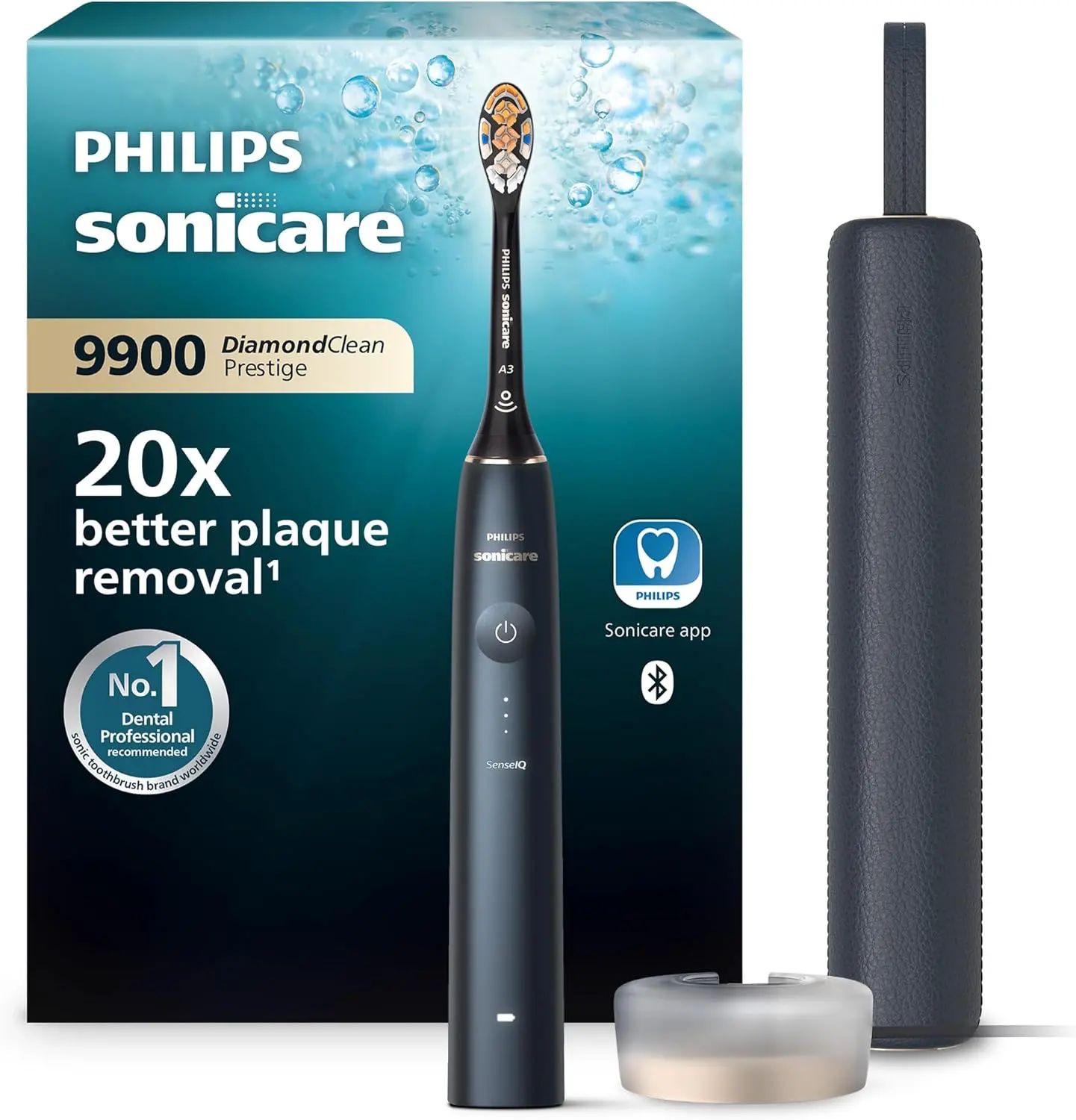
One brush head for 5 modes and 3 intensities, a handle that reads how you’re brushing and turns the power down if you press too hard, and an app that maps on your phone the areas you’ve already covered. That’s the Philips Sonicare 9900 Prestige HX9992/11, a premium sonic toothbrush for people who want the brush itself to correct their technique as they go.
Cleaning is what impressed us most. We tested it in Spain with plaque-disclosing tablets, following the technique in the manual and checking the molars and inner surfaces, and the result was good from the very first brush. On top of that, the A3 All-in-One head works with every mode without swapping heads. On Amazon.co.uk it’s sold as the same HX9992/11 in champagne, so it’s the same toothbrush we tested.
The battery comfortably covers a week away without a charger, and the travel case recharges the brush over USB if the trip runs longer. The trade-off is the full charge, which is slow and means planning ahead.
The pressure sensor does its job, with a clear, easy-to-read warning. Where it falls short is the modes, because two of them feel so alike that in practice they work almost as one.
If you want a brush that guides you, warns you when you press too hard and travels well, the 9900 Prestige is an easy buy to justify. If all you want is a good clean with no app and no settings, many of its features will never get used.
Analysis and verdict
Cleaning – Score: 9.5/10
The head works at 62,000 movements per minute, and the handle reads pressure, motion and coverage up to 100 times per second. It uses that reading to adjust the intensity on the fly, so the result depends less on you pressing with exactly the right force.
The box includes a single head, the A3 All-in-One, and it works with all five modes. You don’t have to change heads to move from the standard clean to gum care or whitening, which simplifies your routine and buying replacements, because you only need one type. When you order spares, make sure they’re A3 All-in-One heads so you don’t end up with one designed for another range.
The score comes from the disclosing-tablet test described below. The molars and inner surfaces, the hardest areas to reach, were well covered, and the app helps you avoid missing any, because it marks on your phone the zones still to do while you brush. This is where the toothbrush comes closest to full marks.
Being sonic, the head doesn’t rotate. It vibrates from side to side at high frequency and pushes water and toothpaste between your teeth, so the right technique is to rest the bristles on the gumline and move slowly, tooth by tooth, without scrubbing. If you’re coming from a manual brush, it takes a few days to change the habit, and the handle helps you correct it because it lowers the power when you press too hard.
Battery life – Score: 8.5/10
The battery is lithium-ion and can be recharged in two ways. At home, the handle sits on the charging base with stand, which also keeps it upright by the basin between uses. Away from home, the travel case has its own USB charging, so you can top up the brush without taking the base.
Battery life per charge is good and comfortably covers a week away with two brushes a day. The weak point is the time a full charge takes, which means thinking about recharging in advance, especially before a trip. That’s why the score stops at 8.5, even though the life of each charge is among the best things about this brush.
If you always brush at home, the slow charging hardly matters, because you just put the handle back on the base each night. It matters more if you run the battery right down and remember to charge it the day before you leave. In that case the travel case is the best answer, because you can plug it into a phone charger or a laptop and let the brush recharge inside your suitcase.
Pressure sensor and modes – Score: 8.8/10
When you press too hard, a light ring comes on and the brush lowers the vibration. It’s a warning you understand without reading the manual, and it corrects people coming from a manual brush who scrub hard, which is exactly the habit that does most damage to the gums. The warning comes while you brush, not afterwards, so it corrects the movement at the moment it happens.
It has 5 modes (Clean, White+, Gum Care, Deep Clean and Sensitive) and 3 intensities (low, medium and high), giving 15 possible combinations. Clean is the everyday mode, White+ targets surface stains on the visible side of your teeth, Gum Care and Sensitive aim for a gentler feel on the gums, and Deep Clean works harder on plaque. There’s also a two-minute timer and pacing prompts to share the time between the different areas of your mouth.
The modes are what keep the score below 9. Five on paper is fine, but two of them blur into each other when you use them, which takes some value away from the variety the box promises. We go into detail in Test 3. And because the handle adjusts the intensity by itself according to pressure, in practice you’ll end up using two or three modes and little else.
Design and what’s in the box
The HX9992/11 is the champagne finish, with a slim handle and a matt feel. The same brush is also sold in other colours under other references, so check the code if colour matters to you. According to the Amazon.co.uk listing, the UK box contains the handle in champagne, one A3 Premium All-in-One head, the Prestige USB charging case, the charging base, a USB lead and wall adapter, and it comes with a UK 2-pin bathroom plug. There’s no spare head, so it’s worth planning for the first one.
The handle tells you when it’s time to replace the head, which is useful because it’s one of those things almost everyone forgets. The base with stand takes up little room by the basin and keeps the brush always to hand and charging. The case protects the head in your wash bag, and with charging built in, there’s no need to pack the base.
App and tracking
The Sonicare app connects to the handle and stores every brushing session. While you brush it marks the zones you’ve covered and the ones still to do, and afterwards it gives you tips to improve your technique and a calendar to keep track of each day. The data syncs automatically.
You don’t need it to brush well, but it’s the part that makes the most of what the handle reads as you use it. If you don’t plan to open it, much of this model’s value goes unused. For those who do, the zone map is the most useful part, because it shows at a glance where each person’s brushing falls short and helps you correct the habit.
Pros
- Staining dropped clearly on the first pass with a disclosing tablet, with a single head for all five modes.
- Between 20 days and just over three weeks per charge with two brushes a day, depending on how much you use whitening rather than daily clean.
- Light-ring pressure warning with lower vibration, which came on every time we pressed too hard.
- Travel case with USB charging as well as the base with stand, so you can recharge away from home without packing the base.
Cons
- 16 hours for the first full charge, so you need to plan recharging before a trip.
- Whitening and deep clean felt almost identical, so two of the five modes are hard to tell apart.
Our test
Test 1: Cleaning – disclosing tablet with the single head
We applied a disclosing tablet before and after a two-minute brush with the technique set out in the manual, using the A3 All-in-One head that comes in the box. We paid close attention to the molars and inner surfaces of the teeth, which is where plaque usually hides, and repeated the disclosing over two weeks.
The staining dropped clearly on the first pass, and in the repeats plaque stopped reappearing in the zones the app flagged as still to do. For you, that means the single head doesn’t force you to give up cleaning performance in the tricky areas. The tablet shows where residue is left, not how much, so we don’t give a figure for plaque removed or a numerical comparison with other brushes. What we can tell you is that cleaning holds up on the molars and inner surfaces, the areas where a manual brush fails most.
Test 2: Battery life – two brushes a day until the battery runs out
We followed our routine of two two-minute brushes a day until the battery was completely flat. We timed a full charge and checked whether a week’s trip could be covered without carrying any charger. It’s the test that matters most if you travel often or tend to forget to charge things.
The first full charge took 16 hours, and after that the battery lasted between 20 days and just over three weeks depending on how much we used whitening rather than daily clean. A week away is covered with plenty to spare. The flip side is that if you let it run flat, you need a long night and much of the next day to get it full again.
Test 3: Pressure sensor and modes – pressing on purpose and trying all 15 combinations
We deliberately pressed the running head against a finger to see whether the light ring came on and whether the vibration dropped by itself. Then we tried the five modes at their three intensities, paying attention to the timer and to how they felt on the gums.
The warning worked every time we forced the pressure, with the ring lit and the vibration reduced. Gum Care felt almost like a gentle massage, and daily clean was noticeably more intense. Whitening and deep clean, on the other hand, felt almost identical in sensation and vibration. We didn’t record a measurement of the quadrant timer or of the exact pressure that triggers the alert, so on those two points we’re going on feel. For you, the sensor responds well and the modes offer less variety than the box suggests.
If you’d like to know more about what to look for, take a look at our guide to the best electric toothbrushes, where you’ll find the best models we’ve reviewed and help choosing the right one for you.
Contents
Other models we analysed

Real tests · No sponsorships
Marco Blasco
I'm Marco Blasco and I've been testing and comparing home appliances for more than five years. My ratings come from real tests, first-hand experience and objective criteria, explained transparently. Our tests are carried out in Spain. Through detailed guides and comparisons I've helped thousands of people choose with more confidence, and I can do that because I'm completely independent of the brands.