
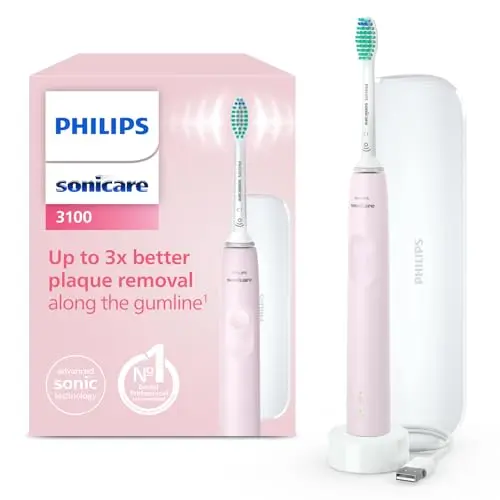
Philips Sonicare 3100 HX3673 Electric Toothbrush

Gallery

Deals
This page contains affiliate links: if you buy through them we may earn a commission, at no extra cost to you. Prices and availability may change. As an Amazon Associate, La Casa Sibarita earns from qualifying purchases.
Pros
-
Pressure sensor that lowers the vibration and warns you if you press too hard.
-
2-minute timer with a prompt every 30 seconds to share your time between quadrants.
-
Fifteen days of battery with two brushes a day in our test, plus a travel case.
-
Gradual start-up over the first 14 uses to ease you into the sonic vibration.
Cons
-
A single mode with no intensities, so you can't lower the starting power.
-
23 h 10 min for a full charge, and no mains adapter in the box we tested.
Contents
Technical specifications
| Cleaning modes | Not specified |
|---|---|
| Accessories | USB charging cable and travel case |
| Brush heads included | 1 ProResults C1 brush head |
| Brush head movement | Sonic technology (vibration) |
| App | Not specified |
| Battery life | 14 days |
| Pressure sensor | Yes, alerts you and reduces vibration if you press too hard |
Description
Summary
A sonic toothbrush with one button and one programme, plus a pressure sensor, a two-minute timer and a prompt at every quadrant change. The Philips Sonicare 3100 HX3673/11 is aimed at people leaving their manual brush behind who want to improve their technique without menus, intensity settings or apps.
We tested it in Spain, using it every day with two brushes a day until the battery ran out, and it’s the same model sold on Amazon.co.uk, where the listing is for the Sugar Rose colour. Our overall impression is of a simple device that does the basics well. Cleaning with a disclosing tablet was good, with just one area needing a second pass, and the pressure sensor warns you clearly when you overdo it.
The battery easily covers a week away and the travel case comes in the box. Charging, on the other hand, is very slow and needs planning, especially if you tend to run the battery right down.
The big limitation is the lack of settings, because the brush always works the same way. To make up for it, it gradually builds up power during the first few uses so the sonic vibration doesn’t take you by surprise at the start.
If you’re after your first electric toothbrush or a no-fuss replacement, it’s an easy one to recommend. If your gums are very sensitive and you need a lower starting power, you’re better off with a model that has several intensities, because here the only way to soften it is to press less.
Analysis and verdict
Cleaning – Score: 8.8/10
The head works at 31,000 movements per minute (Philips quotes the same motion as 62,000 bristle movements per minute on its UK listing). It doesn’t rotate; it vibrates at high frequency and pushes water and toothpaste into the gaps between your teeth and towards the gumline. That’s why the technique is to rest the bristles and move slowly, tooth by tooth, without scrubbing. The most effective approach is to angle the bristles towards the gum and let the head work for a few seconds on each tooth before moving on, rather than sweeping from side to side as you would with a manual brush.
The C1 head included is small, which helps you reach the back molars without straining your mouth. In the disclosing-tablet test it left 3 of the 4 quadrants completely clean. The remaining stain was on the inner surface of the lower right molars, next to the gum, an area that calls for tilting the head and spending a little longer. To reach it properly, rest the bristles almost vertically against the inner surface of your lower molars and move slowly forwards.
We also measured noise, which matters if you brush while others are asleep. With the head fitted and the brush running in the air it gave 57 dB(A) at 30 centimetres, against a background level of 31 dB(A). The score stops at 8.8 because of that area needing a second pass, which on a brush with no settings depends entirely on your technique.
Battery life – Score: 8.6/10
The battery is lithium-ion, with a rated battery life of 14 days, and in our test it beat that, as you’ll see in Test 2. With two brushes a day, a week away is covered with plenty to spare, and the travel case included protects the handle and head in your suitcase.
The score doesn’t go higher because of charging. Our box came with the base and its USB lead but no mains adapter, so you need a phone charger or a free USB port near the basin; the UK listing simply lists ‘1 x charger’ without saying which plug it uses. And a full charge from empty is very slow, so don’t leave it until the night before a trip to plug it in. A 5 V phone charger is enough, and that’s the type we used in the test.
The handle has a battery status indicator. It’s worth checking it after you brush, because with such a long recharge there’s no room to sort it out at the last minute when you’re already packing.
If you travel for more than two weeks at a time, you will need to take the base and a charger, and in that case it’s worth charging it fully the night before you leave and, if you can, the night before that too. For shorter breaks, you’ll normally come home with battery to spare.
Pressure sensor and modes – Score: 7.9/10
The pressure sensor is the best part of this section. When you press too hard, the brush reduces the vibration and the handle pulses to warn you, which protects your gums from the hard-scrubbing habit people bring over from manual brushes. We missed a light to go with the warning, because everything comes through touch.
The timer stops at 2 minutes and every 30 seconds signals the move to the next quadrant. That way the time is spread evenly around your mouth without you having to watch the clock or count.
Where it falls short is modes, because there’s only one cleaning programme, with no intensities or speeds. The only relief for delicate gums is the gradual start-up over the first 14 uses, which builds up the power bit by bit. After that, the only way to soften the feel is to press less, and that’s why the score drops to 7.9.
That lack of settings has an upside too. There’s nothing to set up and no mode to get wrong, so anyone in the household can use it from day one without any explanation. For people who don’t want to think about their toothbrush, it’s more of an advantage than a problem.
Design and what’s in the box
The handle is slim, light and has a single button, the kind that needs no manual. That button switches it on and off, and there’s nothing else to press and no combination to learn. It’s easy to handle with wet hands, and the head pulls off with a tug and clicks back on with no play or rattle.
The box contains the handle, a C1 head, the charger and the travel case. The handle tells you when it’s time to replace the head, which is useful because it’s one of those things almost everyone forgets. As there’s only one, you’ll need to buy replacements after three months, so bear that in mind from day one.
Who we recommend it for
It suits people moving up from a manual brush who want the device to teach them how to brush without reading anything. The pressure warning and quadrant prompt do the job your attention used to do, and the gradual start-up stops the first sessions feeling uncomfortable.
It isn’t the best choice if you already use an electric brush with several intensities and are used to turning the power down, or if you want tracking on your phone. Nor is it right if you only charge your brush when it’s flat and need it ready within a few hours, because the recharge simply isn’t up to that.
Pros
- Pressure sensor that reduces the vibration and warns you if you press too hard, protecting your gums and correcting your technique without you having to think about it.
- 2-minute timer with a prompt every 30 seconds to share your brushing between quadrants, ideal if you’re coming from a manual brush and used to guessing.
- Fifteen days of battery with two brushes a day in our test, beating the rated battery life, and a travel case included.
- Gradual start-up over the first 14 uses, which eases you into the sonic vibration.
Cons
- A single mode with no intensities, so you can’t lower the starting power if you have sensitive gums.
- 23 h 10 min for a full charge and no mains adapter in our box, so you need to plan recharging and use your own charger.
Our test
Test 1: Cleaning – disclosing tablet before and after
We applied a plaque-disclosing tablet before a two-minute brush with the C1 head included, sharing the time between quadrants as the manual describes. We disclosed again straight afterwards and looked at the molars and inner surfaces to see which areas were still stained.
3 of the 4 quadrants were completely clean. The only noticeable residual stain was on the inner surface of the lower right molars, along the gumline. For you, that means the brush cleans almost all of your mouth well with the technique in the manual, and that the inner surface of your lower molars deserves a few extra seconds. It’s a solid result for a brush with a single programme and a standard head, and it doesn’t call for any special technique beyond what the manual explains.
Test 2: Battery life – two brushes a day until it runs out
We started from a full charge and used it for two two-minute brushes a day, with no top-ups, until the battery could no longer complete another cycle. We also timed a full charge from empty with a 5 V, 1 A phone charger connected to the original USB base, and checked whether it covered a week away without a charger.
It lasted fifteen full days, thirty two-minute sessions, and a week away was covered with plenty to spare. The catch is recharging, which took 23 hours and 10 minutes from flat. For you, that means you can forget the charger on a short break, but you can’t count on plugging it in for a while before you go. If you brush three times a day, expect the battery life to shrink in the same proportion.
Test 3: Pressure sensor and modes – pressing on purpose
As there’s only one cleaning programme, we focused the test on the pressure sensor and the timer. We pressed the running head against a fingertip in a sustained way in three repeats, and did full brushing sessions paying attention to the quadrant prompt and to how it felt on the gums.
When you force the pressure, the vibration drops clearly and you feel a warning pulse beforehand that’s noticeable even with the brush in your mouth. The quadrant change comes as a brief pause in the vibration, enough to change zone without looking at the clock. For you, that means the brush corrects your force and the way you share your time on its own. If your gums are very delicate, you’ll miss being able to turn the intensity down.
If you’d like to know more about what to look for, take a look at our guide to the best electric toothbrushes, where you’ll find the best models we’ve reviewed and help choosing the right one for you.
Contents
Other models we analysed

Real tests · No sponsorships
Marco Blasco
I'm Marco Blasco and I've been testing and comparing home appliances for more than five years. My ratings come from real tests, first-hand experience and objective criteria, explained transparently. Our tests are carried out in Spain. Through detailed guides and comparisons I've helped thousands of people choose with more confidence, and I can do that because I'm completely independent of the brands.