
Best Pressure Washers 2026: 5 Models Tested and Reviewed

Avatar of Marco Blasco
Reviewed by: Marco Blasco
Fact-checked by: Shildy Veruska
Last price check: 7 Nov 2026, 03:54 GMT
Last technical update: 05/11/2026

The best pressure washer of 2026 is the Nilfisk Core 140 PowerControl. With PowerControl you turn the pressure down for the car or garden furniture and up for green algae on concrete without changing machine, and its metal pump copes with long sessions better than the plastic ones on entry-level models. If what you need is the most pressure and flow for large patios and driveways, look at the Nilfisk E 145. We tested these 5 pressure washers in Spain, all of them available on Amazon.co.uk, and this is our ranking.

The best pressure washer for every job

  • Best pressure washer overall: Nilfisk Core 140 PowerControl. Adjustable pressure and a metal pump for green algae, patios and the car, with 9.5 metres of reach from the tap.
  • Best for patios and cars: Kärcher K 4 Power Control Flex. Pressure display on the gun and a water-cooled motor for patios, cars and bikes.
  • Best for garage grease: Bosch UniversalAquatak 135. Its 3-in-1 nozzle almost halves cleaning time on stuck-on dirt.
  • Best for big jobs: Nilfisk E 145. The most pressure and flow in our ranking, for big areas and long sessions.
  • Best for balconies without a tap: Bosch EasyAquatak 120. Self-priming from a bucket and only 5 kg.

Pressure washers compared

This is our pressure washer comparison of the models we tested. Here you can compare the key technical specifications, the main advantages and the scores, all based on our tests.

Scroll right to see every product in the table.

Swipe to scroll sideways.

Technical specifications

Maximum pressure
140 bar130 bar135 bar145 bar120 bar
Weight
8.7 kg11.9 kg6.4 kg19.8 kg5 kg
Power
1,760 W1,800 W1,900 W2,100 W1,500 W
Maximum flow rate
370 L/h420 L/h6 L/min610 L/h320 L/h

Pros

Metal pump held a stable 105-110 bar in our test, enough to shift algae from concrete.Pressure display on the gun shows at a glance which level you're using.Rotary jet halves the work: 9 minutes for a garage space against 16 with the fan jet.Quiet induction motor, easy on the ears in long sessions.Self-priming pump works from a bucket, ideal where there's no outdoor tap.
Adjustable pressure takes you from stone to the car without changing machine.Water-cooled motor barely warms up after 25 minutes of continuous use.1,900 W and 135 bar give plenty of headroom for the car, floors and patio.Durable aluminium pump built for years of use.Just 5 kg, easy to store and carry up the stairs.
6 m hose with built-in reel and wheels: 9.5 m of reach from the tap.Motor cuts out when you release the trigger, dropping to just 6 W at rest.Motor stops when you release the trigger and draws only 12-15 W at rest.Generous reach with a 5 m cable and a 9 m hose.Three push-fit nozzles that click on and off in seconds.
Motor stops when you release the trigger, dropping to around 9 W in standby.Wheels and a telescopic handle let you pull it along like a suitcase.6.4 kg, large wheels and an extendable handle make it easy to move.Automatic shut-off system.Rotary nozzle cleaned stubborn dirt in almost half the time of the fan nozzle.

Cons

Loud, at 81 dB(A) at one metre while running and 84 on start-up.Only three pressure steps, with no continuous adjustment.Real sustained pressure of 105-110 bar, not the 135 bar in the catalogue.No built-in detergent tank, so you rely on the foam sprayer.No wheels, so you lift and move it by hand on long patios.
Strong vibration at full flow; it can creep across smooth tiles.5 m cable and 8 m hose limit your reach to about 8 m from the socket.Self-priming of only 0.5 m and a 5 m cable limit your working radius.Lower pressure than some rivals in the same price bracket.Noisy in continuous use, at 82-85 dB(A) at one metre.

A pressure washer only shows what it’s worth when you put it in front of dirt that a garden hose can’t shift. We test every model on the same patio floor and the same muddy car, setting it up straight from the box and using it until the job is finished, not for a couple of minutes. We note how long it takes, whether we have to go over areas again and how the whole kit behaves while you work: the lance, the hose and where the accessories live. Afterwards we pack it away and store it, because a machine that’s a pain to put away ends up rarely leaving the shed. All our tests were carried out in Spain, with the same models sold on Amazon.co.uk.

The three tests that decide the score

  • Pressure and flow. A patio floor with ingrained dirt and a car with dried-on mud: a 1 m² strip cleaned with the standard lance at 30 cm, counting the passes needed. We compare it with the same area cleaned with a hose alone.
  • Accessories. We try every nozzle in the box, plus the brush and the detergent tank if there is one. We note which ones genuinely work on each surface and which are sold separately.
  • Handling. Setting up from the box, connecting to the water and packing away after use. On mains models we check whether the trolley copes with steps, whether the cable and hose reach the far wall and whether it tips over when you pull on the lance; on battery models, the weight when full and how far you can go without a socket.

Every rating in this guide is based on real-world tests, extended use and direct comparison between models. Our full testing methodology explains the details.

The final score for each pressure washer is the simple average of three criteria, each rated independently out of 10:

  • Pressure and flow
  • Accessories
  • Handling

These three criteria are exactly the sub-scores you’ll see broken down on each product review, so you can compare one model with another using the same yardstick. There’s no weighting: the overall score is the average of the three, in equal parts.

The order of the ranking isn’t based on the overall score alone. We also weigh how well each model suits the most common home jobs, so a model with a higher score can appear behind one that covers everyday use better.

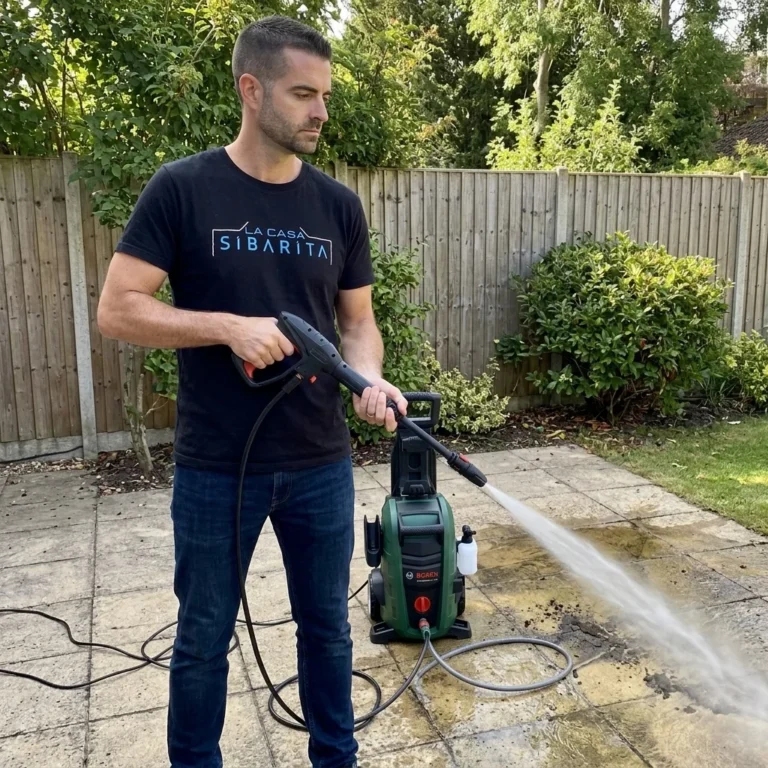
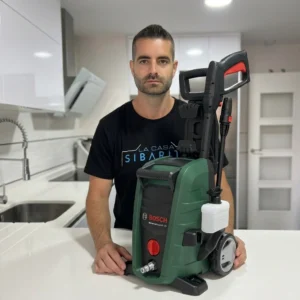
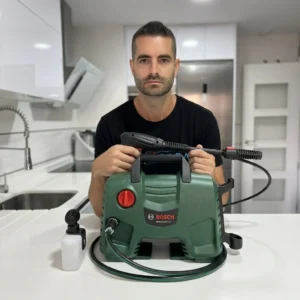
Bosch UniversalAquatak 135 Pressure Washer – image 2
Testing the Bosch UniversalAquatak 135 pressure washer

"This article contains affiliate links. We may earn a commission if you buy through them, at no extra cost to you"

The best pressure washers: our tested ranking

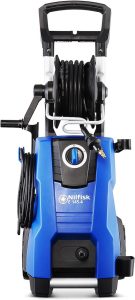
1. Nilfisk Core 140 PowerControl: our top pick for home patios, green algae and ingrained paving

7.5
Score
Pressure and flow
7.9
Accessories
7.4
Handling
7.2
Features Details
Maximum pressure 140 bar
Weight 8.7 kg
Power 1,760 W
Maximum flow rate 370 L/h
Water temperature Not specified
Accessories Concentrated jet nozzle, fan nozzle, 450 ml foam tank compatible with any detergent
  • Performance: steady pressure of 105-110 bar (peaks of up to 135 bar)
  • Reach: 9.5 m from the tap
  • Weight: 8.7 kg
  • Running noise: 81 dB(A) at 1 m (84 at start-up)

Why we recommend it

We spent several weeks working round the patio with it, and where it impressed us most was on green algae ground into concrete: with the point-jet nozzle it lifted the growth without any scrubbing afterwards. The spec sheet says 140 bar, while the steady working pressure was around 105-110 bar, with brief peaks of 135 when closing the gun, which is normal for these machines. Against the Bosch UniversalAquatak 135 it hits slightly harder (7.9 against 7.8 for pressure and flow), although it falls clearly behind on accessories (7.4 against 8.3).

What we used most day to day was adjusting the pressure with PowerControl: you turn it down for a garden table or a painted wall and up for concrete, without changing machine. The foam bottle (450 ml) takes any detergent and is great for soaping the car and leaving it to work before rinsing. The 6 m hose and the wheels let us cover much of the patio from one spot, and the metal pump copes with long sessions better than the plastic ones on entry-level models. The motor stops when you release the trigger (1,760 W with the lance open and almost nothing when paused), which helps on long jobs, both for your bill and for wear. The unit we tested in Spain came as the Premium Car Wash pack; on Amazon.co.uk you get the standard Core 140 PowerControl, the same machine with a foam sprayer and two nozzles.

Weak points

What we liked least was the noise: we measured 81 dB(A) at one metre while running and a peak of 84 dB(A) at start-up, so using it early in the morning with neighbours nearby could cause some friction. At full flow it vibrates enough to ‘walk’ a few centimetres on smooth tiles, so it’s worth bracing it or standing it on something with more grip. And the 5 m cable is short: if the socket is far away, you’ll need an extension lead.

Who it's for

👤 For anyone with a terrace, patio or garden covered in green algae and ingrained paving (and a car to wash now and then) who wants to blast it clean without stepping up to professional kit: 140 bar, about 370 l/h and 8.7 kg on wheels. A mid-range buy, as long as you accept that it's loud (81 dB(A)) and better suited to weekend jobs than daily work.

Biggest advantage

✅ PowerControl pressure adjustment and a metal pump: turn it up to strip algae from concrete, down for painted furniture or the car, all with the same machine.

Biggest drawback

❌ Loud, at 81 dB(A) at one metre while running and 84 at start-up, and it vibrates enough to shift on smooth tiles.

Nilfisk Core 140 PowerControl Pressure Washer

Deals

Prices may change. We earn a commission on purchases made through these links.

2. Kärcher K 4 Power Control Flex: the smart all-rounder for patios and cars

8.2
Score
Pressure and flow
8.2
Accessories
8.6
Handling
7.7
Features Details
Maximum pressure 130 bar
Weight 11.9 kg
Power 1,800 W
Maximum flow rate 420 L/h
  • Pressure: 118 bar steady with the vario lance (peaks of 124 bar with the narrow jet)
  • Flow: 420 l/h in normal use (735 l/h free flow without the nozzle)
  • 1 m² strip of green algae: clean in a single pass with the rotary nozzle
  • Noise: 78 dB(A) under load
  • Working radius: about 8 m from the socket

Why we recommend it

If your patio turns green as soon as the damp arrives and the car comes back muddy every weekend, the K 4 Power Control Flex is made for exactly that kind of everyday dirt. Its best idea is the pressure display on the gun: you see at a glance which of the three levels you're on, so you don't overdo it on decking or car paint. In our test it held 118 bar steady with the vario lance and delivered the quoted 420 l/h, and the rotary nozzle cleared a strip of green algae in one pass where the hose alone left the stain untouched.

The water-cooled 1.8 kW motor was barely warm after 25 minutes of continuous use, which bodes well for frequent jobs, and it cuts out when you release the trigger, dropping to around 6 W. Wheels and a telescopic handle let you pull it along like a suitcase. In Spain we tested the kit version, with a surface cleaner and detergent; the Amazon.co.uk listing is the standard version (hose, Dirt Blaster rotary nozzle, spray lance and water filter), so those two extras aren't in the box.

Weak points

There are only three pressure steps, with no continuous adjustment, so the jumps can feel abrupt if you need to fine-tune between delicate materials. The vario lance struggles with deeply ingrained dirt, which leaves you relying on the rotary nozzle, and that one splashes everything around it. With a 5 m cable and an 8 m hose you get about 8 metres of reach from the socket, so without an extension lead you won't stray far. Carrying its 11.9 kg up stairs is hard work, too.

Biggest advantage

✅ Pressure display on the gun, so you always know which level you're working at and don't damage wood or car paint.

Biggest drawback

❌ Only three pressure steps, with no fine adjustment in between.

Kärcher K 4 Power Control Flex Pressure Washer

Deals

Prices may change. We earn a commission on purchases made through these links.

3. Bosch UniversalAquatak 135: the best for garage grease and everyday jobs

7.7
Score
Pressure and flow
7.8
Accessories
8.3
Handling
7
Features Details
Maximum pressure 135 bar
Weight 6.4 kg
Power 1,900 W
Maximum flow rate 6 L/min
  • Steady pressure: 105-110 bar (135 bar only as a brief peak)
  • Flow: 6.8 l/min (about 410 l/h)
  • Greasy garage bay: 9 min with the rotary jet vs 16 min with the fan jet
  • Noise: 82 dB(A) under load
  • Weight: 6.4 kg

Why we recommend it

For the car, a greasy garage floor, the gate and the patio, the UniversalAquatak 135 hits the sweet spot of Bosch's range. The 3-in-1 nozzle (fan, point and rotary jet in one head, with a colour dot showing which one is active) is its big win: on a garage bay with stuck-on grease the rotary jet took 9 minutes, against 16 with the fan jet, and it lifted algae off tiles in a single pass. Steady pressure settled at 105-110 bar, and the flow held firm at 6.8 l/min (the UK listing quotes 450 l/h).

At 6.4 kg, with big wheels and an extending handle, it's easy to wheel round the patio and to store. The motor stops when you release the trigger and drops to 12-15 W, and the built-in detergent tank is enough to soap a whole car without refilling. On Amazon.co.uk it's the UK version (ref. 06008A7C70), and its listing quotes a 7 m high-pressure hose, where the unit we tested had a 6 m one.

Weak points

Real working pressure is 105-110 bar, not the 135 bar in the specs, which you only see for an instant: plenty for home jobs, but short for façades or heavy use. It self-primes from only 0.5 m, so the water supply needs to be close, and with a 5 m cable the working radius is tight for bigger patios. The cable winder is small and the cable tends to slip off, the foam dispenser doesn't make dense foam, and after a quarter of an hour the gun vibrates noticeably.

Biggest advantage

✅ The rotary jet almost halves the work: 9 minutes for a greasy garage bay, against 16 with the fan jet.

Biggest drawback

❌ Real working pressure stays at 105-110 bar, well short of the 135 bar quoted.

Bosch UniversalAquatak 135 Pressure Washer

Deals

Prices may change. We earn a commission on purchases made through these links.

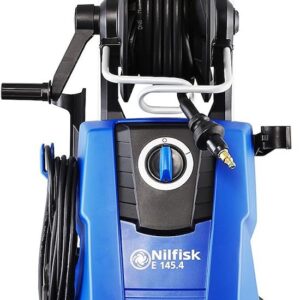
4. Nilfisk E 145: the most pressure and flow, for big jobs and long sessions

8.5
Score
Pressure and flow
8
Accessories
9
Handling
8.5
Features Details
Maximum pressure 145 bar
Maximum battery life Not specified
Water temperature Not specified
Accessories
Maximum flow rate 610 L/h
Power 2,100 W
See all
Weight 19.8 kg
  • Pressure levels: two, 135 and 145 bar
  • Dried-on mud on the car: lifted without going over the same spot again and again
  • Flaking paint: removed only the loose paint, not the paint that was still well bonded
  • Recommended level of use: high

Why we recommend it

The E 145 sold on Amazon.co.uk is the standard E 145.4, with a 2,100 W induction motor and 145 bar of maximum pressure, plenty to shift the dirt on walls, patios and paving. For this version Nilfisk quotes a flow of 420-500 litres an hour, the highest of any model in our ranking, so rinsing large areas goes noticeably faster. The induction motor is also pleasantly quiet for a machine this powerful.

Its 9 m hose and 5 m cable give you a working radius of about 14 metres, so moving around with it is never a problem. We like the large wheels, which keep it steady on uneven ground, and the easy-grip telescopic handle. There's a hose reel, a side compartment for the cable and space to carry the accessories.

Check what's in the box before you buy. The UK version comes with a rough nozzle for hard surfaces such as stone or garden furniture, a gentle nozzle that's ideal for bike and car wheels and a foam sprayer for deeper cleans.

Weak points

Nilfisk sells the E 145 in so many kits that choosing one can be confusing. The unit we tested in Spain was the X-TRA kit, which came with extra accessories such as a patio cleaner, a rotating brush and a drain cleaner. On Amazon.co.uk you get the basic E 145.4: the same machine, with the foam sprayer and two nozzles. There’s no built-in detergent tank, and at 19.8 kg it’s by far the heaviest model here, so it’s one to wheel rather than carry.

Biggest advantage

✅ Built to last, thanks to its aluminium pump and induction motor.

Biggest drawback

❌ No built-in detergent tank.

Nilfisk E 145 Pressure Washer

Deals

Prices may change. We earn a commission on purchases made through these links.

5. Bosch EasyAquatak 120: the best for balconies without an outdoor tap

7.4
Score
Pressure and flow
7
Accessories
8.4
Handling
6.8
Features Details
Maximum pressure 120 bar
Weight 5 kg
Power 1,500 W
Maximum flow rate 320 L/h
  • Steady pressure: 100-105 bar (120 bar quoted)
  • Flow: 320 l/h (5.3 l/min)
  • 1 m² of porcelain tile: 1 min 50 s with the rotary nozzle vs 3 min 10 s with the fan nozzle
  • Noise: 82-85 dB(A) at 1 m
  • Weight: 5 kg

Why we recommend it

If you live in a flat, have no outdoor tap on the balcony or just need to freshen up a small terrace and the car now and then, this is the one. Its self-priming pump draws water from a bucket or tank, so it doesn't need to be connected to a tap, and that's where it really stands apart. At 5 kg it's tiny, fits in any corner and you can carry it upstairs in one hand.

The push-fit nozzles click on and off in seconds without any threads, and the rotary one cleaned a tile with stuck-on dirt in 1 min 50 s, against 3 min 10 s for the adjustable fan nozzle. With its 1,500 W motor it measured 100-105 bar in continuous use, fine for loose mud, dust and soaping the car. On Amazon.co.uk it's the Amazon Exclusive edition (ref. 06008A7972), whose listing adds a patio cleaner and a wash brush and quotes a 5 m hose; the unit we tested had a 6 m hose and no brush, so we haven't tried those extras.

Weak points

It has no wheels, so on larger areas you keep picking it up and moving it, which gets tiring on long patios or with several cars. Working pressure stays below the quoted figure (100-105 bar against 120), so it falls short on big surfaces or very stubborn dirt. It's also loud (82-85 dB(A) at one metre), gives a jolt on start-up and the pump housing gets hot after about 25 minutes of continuous use.

Biggest advantage

✅ Self-priming pump: it works from a bucket of water, ideal for balconies and flats without an outdoor tap.

Biggest drawback

❌ No wheels, so you have to lift it and move it around on larger areas.

Bosch EasyAquatak 120 Pressure Washer

Deals

Prices may change. We earn a commission on purchases made through these links.

Buying guide: how to choose the best pressure washer

If you’ve made it this far, it’s probably because your trusty garden hose can no longer cope with the green algae on the patio, you’re tired of queuing at the car wash every fortnight or scrubbing the garden furniture by hand feels endless. A pressure washer solves exactly that: it blasts dirt away with high-pressure water and saves you hours of scrubbing. Compared with a hose and spray gun the difference on stuck-on dirt is huge, and compared with paying for car washes it pays for itself within a few months. The question is rarely whether to buy one, but which, because they range from compact balcony models to machines that border on semi-professional.

Below we translate the spec-sheet figures into what you’ll notice at home: how much pressure and flow you need for what you clean, which nozzles are worth having, when a short hose will ruin the job and when it’s worth moving up a range. The idea is that you reach the buy button knowing exactly what you’re looking for. If you only need it for occasional jobs on a balcony or a small patio, a light, compact model will do.

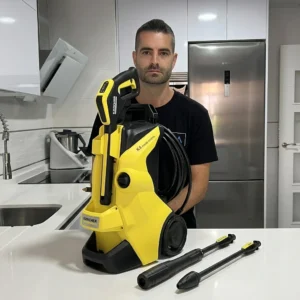
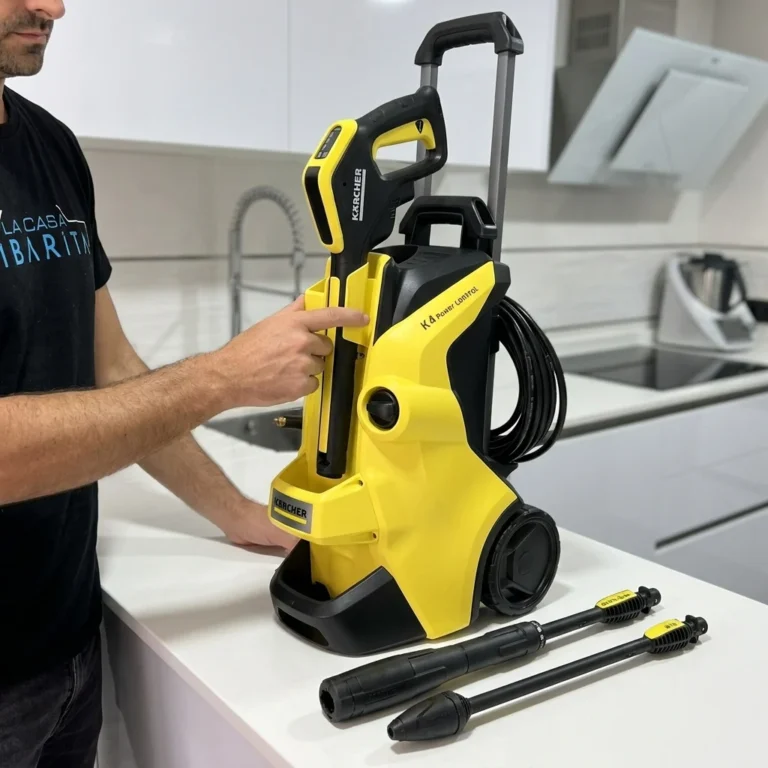
Kärcher K 4 Power Control Flex Pressure Washer – image 2
Kärcher is one of the strongest brands in pressure washers, and the K 4 Power Control Flex proves it

How much pressure do you really need?

Pressure in bar is the first thing everyone looks at, and it’s exactly where most people go wrong. More pressure doesn’t clean better on its own: it cleans differently depending on the surface. For the car and garden furniture, a machine of around 100-110 bar is more than enough; for a patio with moderate dirt, 110-125 bar is ample; and only when you’re dealing with stone, concrete or stubborn algae do you start to appreciate 130-140 bar.

Watch out for a detail hardly anyone mentions: the peak pressure (the one in the spec sheet) isn’t the one the machine holds while you work. It’s common for a machine rated at 135-140 bar to sustain 105-115 bar continuously, and that’s the figure that really counts.

Flow rate: the figure few people check and everyone notices

Flow rate (litres of water per hour) matters as much as pressure, or more, when you’re cleaning large areas, yet few people check it. Pressure loosens the grime; flow carries it away and rinses it. If the flow is weak, you end up passing the lance over the same spot again and again.

On flow, the most generous figure in our ranking belongs to the Nilfisk E 145.

Nozzles: using the right one avoids damaging what you clean

The nozzle changes the result more than almost anything else. The flat (fan) jet is the all-rounder and the safe choice for delicate surfaces; the rotary nozzle concentrates the water and spins it, so it strips algae, grout lines and ingrained dirt in one pass; and the lance or foam bottle is great for the car and light grease.

The detergent tank is fine for the car and greasy paving, but don’t expect it to replace scrubbing on heavily caked-on grime: it helps loosen dirt, it doesn’t work miracles. An adjustable nozzle, which changes intensity without swapping accessories, will speed up everyday jobs. For garage grease with a rotary nozzle, our best results came from the Bosch UniversalAquatak 135.

Hose, cable and how far you can go without moving the machine

This makes a big difference day to day, and hardly anyone thinks about it until it’s too late. The working radius (hose plus cable) decides how many times you have to stop, unplug and move the machine. A 5-metre hose quickly feels short once you have a patio or a large car; between 6 and 8 metres things change and you can work without interruptions.

Here a long hose improves the experience more than a few extra bar. As a guide, an effective radius below 5 metres forces you to move the machine constantly; at around 8-10 metres you can cover a patio and a car without repositioning it. If your plot is large, also check that it stays stable when you pull on the hose, because light compact models tend to tip over.

For a comfortable working radius without an extension lead, the one that suited us best was the Nilfisk E 145, with its 9 m hose and 5 m cable.

Weight, wheels and where you'll store it

Before looking at performance, think about where the machine will live and how much you’ll be carrying it. If you have to take it up stairs, get it out of a small shed or move it between the balcony and a parking space, weight goes from a minor detail to a deciding factor.

Compact models (around 5-6 kg) fit in any gap and can be carried in one hand, but they often have no wheels. Models with wheels and a telescopic handle weigh more (8-12 kg) and move better around a garden or a large patio, although they take up more space when stored. On a small balcony, wheels are unnecessary; across several outdoor areas, you’ll be glad of them every time.

For anyone very short on space, the lightest and easiest to handle was the Bosch EasyAquatak 120.

When is it worth paying more, and when isn't it?

You don’t always need to move up a range. If you wash the car and tidy up the garden furniture once a month, an entry-level machine will do the job easily, and stretching further is wasted money. The mid-range is the sweet spot if you have a terrace or patio and use it at weekends: it balances pressure, flow and comfort. And the top domestic range starts to make sense when there are lots of hard surfaces, long sessions or you want the machine to last for years of frequent use. Our ranking of the best pressure washers above lets you compare them side by side.

A real sign of quality, beyond the bar figure, lies in the hose and connections: if they fit without leaks and the machine doesn’t tip over when you pull on it, you’ll have a much easier time. For heavy use, a more robust motor that runs cooler extends the machine’s life, and you do notice it. For anyone who uses it every weekend and puts durability first, the water-cooled motor of the Kärcher K 4 Power Control Flex was the best fit.

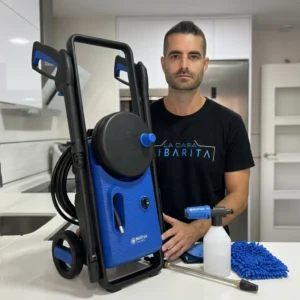
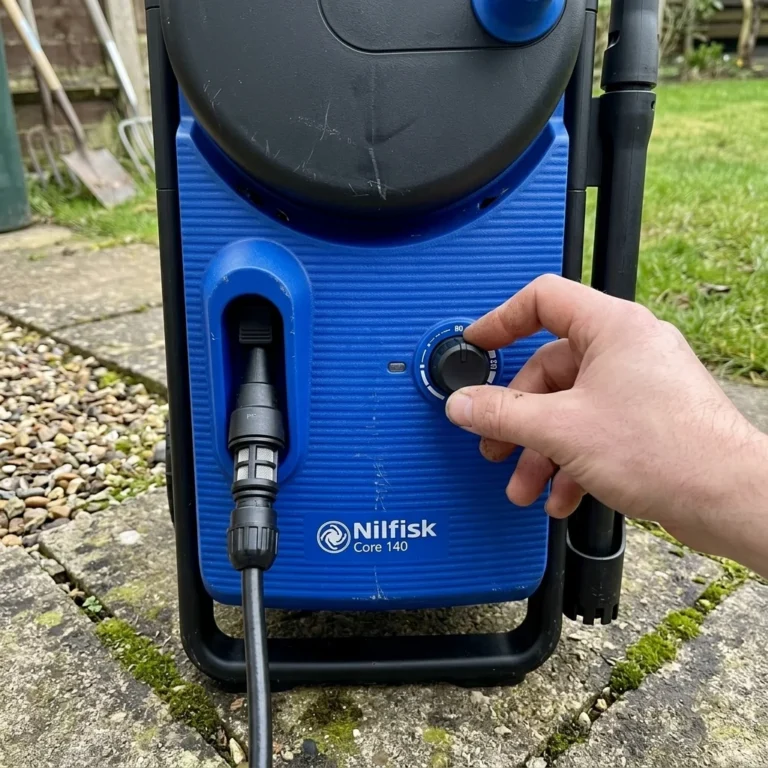
Nilfisk Core 140 PowerControl Pressure Washer – image 2
Nilfisk Core 140 PowerControl pressure washer

Checklist: what to look for before you buy

  • What will you clean most often? (The car and furniture call for moderate pressure; algae and concrete need more bar and more flow.)
  • Do you have a tap and a socket nearby, or do you need a machine that can draw water from a bucket?
  • Does the real working radius (hose + cable) cover your patio or car without moving the machine?
  • How much does it weigh and where will you store it? (It matters if there are stairs or little space.)
  • Does it come with a rotary nozzle and a foam lance, or will you have to buy them separately?
  • How noisy is it? (Key in shared gardens, enclosed courtyards or long sessions.)
  • Do the connections fit without leaks, and does the machine stay stable when you pull on the hose?
  • Are servicing and spare parts available in the UK for that brand?

Editorial independence

The selection in this comparison was put together after testing every model under the same editorial criteria and in comparable conditions. The order reflects that analysis and no commercial agreement.

This article contains affiliate links, but they don’t influence the scores or the ranking positions. If a model performs worse in future tests, its price changes too much or a better alternative appears, we update the guide and change the ranking.

Update history

  • 05/11/2026: We publish our UK ranking, with the models available on Amazon.co.uk.

FAQs about pressure washers

If your model’s pump needs oil, SAE 20W40 from any brand will keep the pressure washer running properly. The first oil change should be done after 50 hours of use, and after that you can wait up to 500 hours. Make a note of the date you changed it and check the oil level before you start cleaning. Always follow the manufacturer’s manual, because many domestic models have sealed pumps that need no oil changes.

Yes and no: it all depends on how you use it. Pressure washers are designed to make the most of every drop of water available. In fact, some have an ECO mode, which raises the pressure but reduces the flow. Even so, keep the following tip in mind to avoid wasting water.

To remove stubborn dirt, it’s best to reduce the flow and increase the pressure. Use the accessories properly as well, such as the spray lance or scrubbing brushes. That way, you’ll only use water when it’s really needed.

Some models come with a whole range of accessories that help you get the most out of the powerful jet of water. In fact, accessories are grouped according to the object or surface to be cleaned. For example, for washing the car they include an angled lance, a 360° cone brush and a narrow triangular brush.

For gardens and patios, a self-priming suction hose is very useful for drawing water from a water butt, a tank or a pool. You’ll also need an extension for the high-pressure hose and the power cable, and a rotating brush for cleaning rough-finish surfaces.

Related comparisons

The models we have analysed or tested

Real tests · No sponsorships

Marco Blasco

I'm Marco Blasco and I've been testing and comparing home appliances for more than five years. My ratings come from real tests, first-hand experience and objective criteria, explained transparently. Our tests are carried out in Spain. Through detailed guides and comparisons I've helped thousands of people choose with more confidence, and I can do that because I'm completely independent of the brands.