
Best Air Fryers 2026: 5 Models Tested and Reviewed
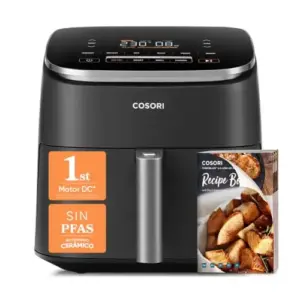
The best air fryer of 2026 is the Cosori TurboBlaze 6L. Its 6 litres give 3 or 4 portions per batch, and we measured a peak of 1,746 W against the 1,725 W declared. We tested these five air fryers in our kitchen in Spain, and all of them are available on Amazon.co.uk.
The best air fryer for every need
- Best overall: Cosori TurboBlaze 6L. 6 litres for 3 or 4 portions per batch, with a measured peak of 1,746 W against 1,725 W declared.
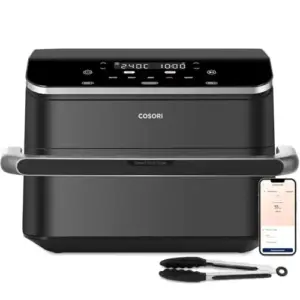
- Best dual-zone: Cosori Dual Blaze TwinFry 10L. 10 litres that split into two 5 L zones, with 2,786 W measured using both.
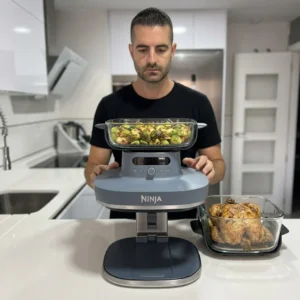
- Best glass air fryer: Ninja CRISPi PRO AS101UK. Two glass containers, of 5.7 and 2.3 litres, that go from fridge to table.
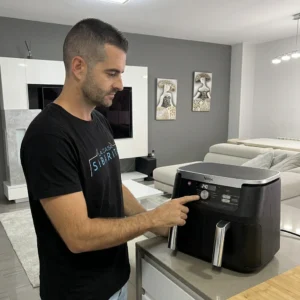
- Best for whole joints: Ninja Foodi FlexDrawer AF500UK. 10.4 litres as a single drawer or two 5.2 L zones with the divider, and up to 240 °C.
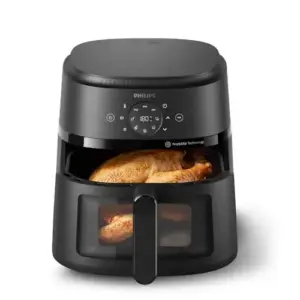
- Best for keeping an eye on the browning: Philips Airfryer 2000 Series NA230. 6.2 litres with a viewing window, for up to 800 g of chips per batch.
Air fryers compared
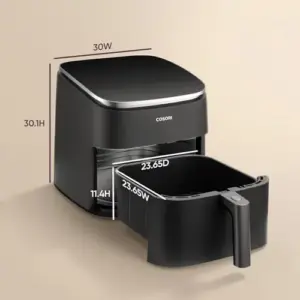
Scroll right to see every product in the table.
Swipe to scroll sideways.
|
|
|
|
|
|
Technical specifications
Dimensions | ||||
| 36.6 x 28.6 x 30 cm | 33.8 x 51.8 x 31.3 cm | 29.97 x 30.99 x 27.94 cm | 56.79 x 38.81 x 41.91 cm | 30.8 x 40.4 x 30.9 cm |
Number of people | ||||
| 2-3 people | Up to 10 people | 6 people | 8-10 people | 4-5 people |
Power | ||||
| 1,725 W | 2,800 W | 2,050 W | 2,470 W | 1,700 W |
Capacity | ||||
| 6 L | 10 L | 5.7 L + 2.3 L | 10.4 L | 6.2 L |
Keep warm | ||||
| Yes | No | Yes | Not specified | Yes (keep warm) |
Programmes | ||||
| 9-in-1 | 6 cooking functions (Air Fry, Roast, Bake, Grill, Reheat, Dehydrate) | 7 | 7 | 13 cooking modes |
Timer | ||||
| 1 min - 24 h | 1 min - 48 h | Yes | Yes, 24 h | 1 to 60 minutes |
Delayed start | ||||
| No | No | No | No | No delayed start |
Temperature | ||||
| 30-230°C | 40°C-240°C | Up to 230°C | Up to 240 °C | 60-200 °C |
Cooks 2 foods at once | ||||
| No | Yes | Yes | Yes | No |
Pros
| Even browning without shaking, so you don't need to open the drawer halfway. | Four heating elements, top and bottom in each zone, for even browning without shaking. | PFAS-free glass containers go from fridge to air fryer to dishwasher without decanting. | Single 10.4 L drawer fits whole joints or rectangular trays without cutting them up. | The window in the drawer lets you check browning without opening it and losing heat. |
| 30 to 230 °C range and a 24 h timer for dehydrating fruit or proving dough. | 10 L basket splits into two 5 L zones with independent settings and a synchronised finish. | Large 5.7 L container fits a whole chicken and vegetables for up to six people. | Dual zones with sync cook two dishes at different temperatures and finish together. | Heats up quickly: 180 °C in 2 min 21 s, a little over three minutes for a true 200 °C. |
| Five fan speeds: gentle for light vegetables, strong for crisp skin. | 40 °C to 240 °C range and a 48 h timer, from dehydrating fruit to high-heat roasting. | Two container sizes let you cook a main and a side at the same time. | 2,470 W keeps performance steady even with a full drawer. | 13 presets plus manual control suit both beginners and fine-tuners. |
| Very quiet on the lowest setting, barely above the background noise of the kitchen. | Pauses and resumes by itself when you open the drawer to check the food. | 7 cooking functions, from air frying to proving and dehydrating, with manual temperature control. | 7 functions, including proving and dehydrating, go well beyond a standard air fryer. | Dishwasher-safe basket and crisper plate, with a non-stick that resists scrubbing. |
Cons
| Tight capacity: a standard whole chicken won't fit and a full batch serves 3–4. | At 51.8 cm wide and 9.2 kg, it takes up a lot of worktop in a small kitchen. | The 3.8 L container, the handiest for everyday use, isn't included and is sold separately. | Awkward to clean: the drawer hogs the dishwasher, so in practice it's 6 min 18 s of hard scrubbing by hand. | With compact loads such as chips, the centre browns less and needs a shake halfway. |
| The divider traps oil in the corners and the body can only be wiped with a cloth. | The large drawer only fits the dishwasher without the cutlery basket, and the tray traps grease in the corners. | The glass containers need both hands, which is more awkward than a standard basket. | Large and heavy, it needs a generous permanent spot on the worktop. | The deep basket won't take a medium whole chicken without touching the element. |
How we test air fryers
An air fryer replaces the frying pan and, on many weeknights, the oven. What’s at stake isn’t only whether the chips come out crisp, but whether you’ll still be using it in a few months: whether it cooks evenly without you hovering over it, whether the portions you need actually fit and whether cleaning it is so quick you don’t think twice. We test in our kitchen in Spain, and the five models in this ranking went through the same protocol, with the same loads, the same programmes and the same reviewer, so the differences we describe come from the machine and not from the cook.
The three tests that decide the score
- Cooking results. 500 g of chips in a single batch, with no preheating, no shaking and the chips programme. We score the browning in the centre of the basket and around the edge separately, from 0 to 10, and note whether a flip halfway is needed to even them out; in the models we assessed this way, the centre ranged from 5 to 8 out of 10. We monitor the temperature with a thermocouple probe in the centre of the basket, and we repeat the test with wings and with vegetables.
- Capacity. We load up to the maximum the manufacturer declares and weigh on kitchen scales what really fits, counting real portions. We also check whether a whole chicken goes in and whether four fillets fit in a single layer without overlapping. Neither of the 6 L baskets in the ranking took a standard whole chicken, and both failed on height, not volume.
- Cleaning. After cooking something greasy, we let the appliance cool and wash the basket and crisper plate by hand with a non-abrasive sponge, timing the whole job. Across the five models we timed, it ranged from 3 min 31 s to 6 min 18 s. We note whether the coating releases the residue on the first wipe and which parts are dishwasher safe according to the manufacturer’s official documentation.
What else we measure, and with what. Real power draw while cooking, with a power meter plugged in between the appliance and the socket. Noise, with a class 2 digital sound level meter, A-weighting and slow response, one metre from the appliance at worktop height, allowing for the background noise of the room. Most manufacturers don’t publish these two figures, or publish them without saying under what conditions they were taken.
When a figure comes from our own at-home tests, you’ll see it marked (tested); when it comes from the manufacturer, we attribute it to their official documentation. If we have neither, we say so and don’t estimate it. You can read the details in our full methodology.
How we calculate the score
The score you’ll see in each review isn’t the sum of features on a spec sheet. It comes from three criteria we score separately after putting every air fryer through the same protocol:
- Cooking results
- Capacity
- Cleaning
Each product’s overall score is the simple average of those three criteria, weighted equally, and they’re the same three you’ll find broken down as sub-scores in each model’s review.
We score what we see when using it, not what the manufacturer promises: whether the browning is even without supervision, how many portions really fit, how much effort it takes to get it clean and whether what it offers is in proportion to what it costs within its range. A high score means it’s well balanced for its segment; a lower score doesn’t mean it’s a bad appliance, only that we’d recommend it for specific users or budgets.
We penalise shortcomings that affect real use (a basket that doesn’t fit in the dishwasher, cooking that always needs shaking), not minor spec differences. And scores can change: if a better model comes along, the price moves or a product stops being available, we review the score.
One note on the order of the ranking: the list isn’t sorted by review score alone. Overall fit in real use also counts, meaning which model best suits each type of buyer, its value for money and whether you can buy it today without problems. That’s why a product with a higher score can appear behind another that covers a specific use better.
‘This article contains affiliate links. We may earn a commission if you buy through them, at no extra cost to you.’
The best air fryers: our tested ranking
1. Cosori TurboBlaze 6L: the best air fryer overall for even cooking and airflow control
| Features | Details |
|---|---|
| Dimensions | 36.6 x 28.6 x 30 cm |
| Number of people | 2-3 people |
| Power | 1,725 W |
| Capacity | 6 L |
| Dishwasher safe | Yes |
| Keep warm | Yes |
| See all | |
| Programmes | 9-in-1 |
| Timer | 1 min - 24 h |
| Delayed start | No |
| Temperature | 30-230°C |
| Stirs food | No |
| Cooks 2 foods at once | No |
Test results
Specifications declared by Cosori for the DC601, sold on Amazon.co.uk as the CAF-DC601-KUK. Figures marked (tested) are our own measurements from 14/09/2026, taken in Spain.
- Capacity: 6 L · a full batch gives 3-4 portions (tested)
- Power: 1,725 W declared · 1,746 W peak and 1,708 W steady (tested)
- Temperature range: 30–230 °C
- Fan speeds: 5 · on the lowest, leafy vegetables stay put; on the highest, they get blown around (tested)
- Noise: 27 dB declared · we measured 31.2 dB(A) on speed 1 against a background of 28.8, and 43.9 dB(A) on the chips programme (tested)
- Evenness without shaking: 8 out of 10 chips browned in the centre and 9 out of 10 around the edge (tested)
- Cleaning after 20 wings: 7 wipes for the basket, 11 for the crisper plate, 4 min 12 s with no soaking (tested)
- Timer: from 1 minute to 24 hours
- Dimensions: 36.6 × 28.6 × 30 cm
- Dishwasher safe: basket and crisper plate, with no damage to the non-stick after the cycle (tested)
Why we recommend it
Fill it with chips straight from the bag, close it and walk away. When you come back you won't find the usual ring of well-done chips around a pale middle, because the DC motor pushes the air hard enough to brown the edge and the centre of the basket almost equally. In our test, 8 out of 10 chips came out golden in the centre against 9 around the edge, without touching anything.
The 6 litres are enough for three or four portions, which is the real load of most midweek dinners. With 1,725 W and a range of 30 to 230 °C it doesn't just fry; it also dehydrates fruit and proves dough, and the five fan speeds aren't just for show. On the highest, leafy vegetables get blown into a heap against one side; on the lowest, they stay where you put them and come out more tender.
What tips the balance is noise. Cosori quotes 27 dB, which we couldn't verify because our kitchen's background noise was already 28.8, but we measured 31.2 dB(A) on speed 1, so it barely rises above silence. On the chips programme it goes up to 43.9 and still doesn't make you raise your voice. It isn't the air fryer for a table of six, and it's only fair to say it falls short there.
Weak points
The biggest drawback is capacity. Six litres sounds like a lot until you try to fit a whole chicken and it won’t go in. The 1,546 g bird we tested didn’t fit on height, not width, so a 1.2 or 1.3 kg chicken should. A full batch gives 3-4 portions, and with bulky pieces, or if you want generous protein and sides for four, you’ll need a second round.
Then there’s cleaning the body. The basket and crisper plate go in the dishwasher and come out unmarked, but the plate needs 11 wipes against the basket’s 7 because it holds oil in the corners, and the body can only be wiped with a cloth. The top area around the heating element is hard to reach without taking it apart.
Who it's for
Biggest advantage
Biggest drawback
Deals
Prices may change. We earn a commission on purchases made through these links.
2. Cosori Dual Blaze TwinFry 10L: the best dual-zone air fryer for big families
| Features | Details |
|---|---|
| Dimensions | 33.8 x 51.8 x 31.3 cm |
| Number of people | Up to 10 people |
| Power | 2,800 W |
| Capacity | 10 L |
| Dishwasher safe | Yes |
| Keep warm | No |
| See all | |
| Programmes | 6 cooking functions (Air Fry, Roast, Bake, Grill, Reheat, Dehydrate) |
| Timer | 1 min - 48 h |
| Delayed start | No |
| Temperature | 40°C-240°C |
| Stirs food | No |
| Cooks 2 foods at once | Yes |
Test results
Specifications declared by Cosori for the CAF-TF101S. Figures marked (tested) are our own measurements from 14/09/2026, taken in Spain.
- Total capacity: 10 L, which splits into 5 L + 5 L · a 1,920 g chicken with 650 g of sides around it fitted, filling 75 to 90% of the drawer, and gave 6 real portions (tested)
- Power: 2,800 W declared · 2,786 W peak with both zones and 1,438 W with just one (tested)
- Energy use over 10 minutes at 240 °C: 194 Wh with one zone, 371 Wh with both (tested)
- Evenness without shaking: 8 out of 10 chips browned in the centre and 9 out of 10 around the edge, and with the full 10 L drawer the browning is even from one end to the other (tested)
- Browning on both sides: skin-on chicken thighs brown on top and underneath without flipping, something no other model in the ranking manages (tested)
- Heating elements: 4, top and bottom in each zone · Range: 40–240 °C · Timer: up to 48 h
- SYNC function: set to 200 °C/15 min and 180 °C/9 min, the two zones finished 1 second apart (tested)
- MATCH function: the second zone copies the temperature and time of the first and both start together (tested)
- Drawer: 43.5 × 28.1 × 12.4 cm measured · only fits in the dishwasher once you take out the cutlery basket (tested)
- Cleaning after 1 kg of wings: 9 wipes for the drawer, 12 for the crisper plate and 6 for the divider, 5 min 08 s with no soaking or hard scrubbing (tested)
- Dimensions and weight: 33.8 × 51.8 × 31.3 cm and 9.2 kg
- App: VeSync · according to its Amazon.co.uk listing, UK rules mean you have to start it manually, and Alexa isn’t supported
Why we recommend it
It's the only model in the ranking that heats from above and below in each of its two zones, with four elements in total, and you notice it as soon as you cook anything with skin. We roasted chicken thighs without turning them and they browned on both sides, with a dry base instead of a soggy one. None of the others in our ranking manages that.
The 10 litres live up to the promise. A 1,920 g chicken with 650 g of sides around it went in without forcing anything, and it gave six proper portions. With the divider in place you get two 5 L zones with independent temperature and time, and when we set one to 200 °C for 15 minutes and the other to 180 °C for 9, they finished one second apart.
The cooking backs it up with no tricks. Without a single shake, 8 out of 10 chips came out golden in the centre, level with the best in the ranking, and with the full 10-litre drawer the browning stays even from one end to the other. Power is also used sensibly: we measured 2,786 W with both zones but only 1,438 W with one, so cooking for two doesn't cost what cooking for six does.
Weak points
What will bother you most is washing it up, and not because of the non-stick but because of its size. After a kilo of wings it took us 5 minutes and 8 seconds spread across three parts: 9 wipes for the drawer, 12 for the crisper plate and 6 for the divider. It doesn’t need soaking or hard scrubbing, but manoeuvring a 43.5 cm part in the sink is awkward and the plate collects grease in the corners.
The dishwasher isn’t a shortcut either. The drawer is dishwasher safe, but at 43.5 cm wide there’s no room with the cutlery basket in. You have to take it out and fold down the racks, and once it’s in, it takes up almost the whole bottom rack. Add the appliance’s 51.8 cm width and 9.2 kg, and this isn’t an air fryer you’ll be putting away after each use.
Who it's for
Biggest advantage
Biggest drawback
Deals
Prices may change. We earn a commission on purchases made through these links.
3. Ninja CRISPi PRO AS101UK: the glass air fryer that goes from fridge to table
| Features | Details |
|---|---|
| Dimensions | 29.97 x 30.99 x 27.94 cm |
| Number of people | 6 people |
| Power | 2,050 W |
| Capacity | 5.7 L + 2.3 L |
| Dishwasher safe | Yes |
| Keep warm | Yes |
| See all | |
| Programmes | 7 |
| Timer | Yes |
| Delayed start | No |
| Temperature | Up to 230°C |
| Stirs food | No |
| Cooks 2 foods at once | Yes |
Test results
Specifications declared by Ninja for the AS101EUCY we tested in Spain; on Amazon.co.uk the same model is sold as the AS101UKGY in Ash Grey. Figures marked (tested) are our own measurements from 14/09/2026.
- Containers included: one 5.7 L and one 2.3 L, both glass
- Power: 2,050 W declared · 2,086 W peak and 2,031 W steady (tested)
- Maximum temperature: 230 °C · Functions: 7
- Real capacity: a 1,538 g chicken plus 410 g of vegetables, with the container 90% full. That gives six modest 255 g portions (tested)
- Evenness without shaking: 5 out of 10 chips browned in the centre against 8 out of 10 around the edge. It’s the weakest spread in the ranking (tested)
- Loaded weight: 2.19 kg for the empty container with its rack, 4.14 kg with the raw chicken and vegetables (tested)
- Cleaning after 1 kg of wings: 5 wipes for the container, 8 for the rack, 3 min 31 s with no soaking and no grease left behind (tested)
- Materials: PFAS-free glass · dishwasher, oven and fridge safe
- Not included: the 3.8 L container, which is sold separately
Why we recommend it
Designed for anyone fed up with tipping food from the basket into a plastic tub, the CRISPi PRO cooks directly in glass dishes that you then cover and put in the fridge. There's no non-stick to scratch and no PFAS involved, and the same dish copes with the oven and the dishwasher.
You get two of them, 5.7 and 2.3 litres, and Ninja claims up to six servings with a whole chicken and vegetables. We checked and it does fit: a 1,538 g chicken plus 410 g of vegetables, although the dish ends up 90% full and the six portions come out at 255 grams, on the modest side. For four, the quantities are far more generous.
Where it shines is at the sink, and that's where glass really pays off. It releases grease better than any non-stick in the ranking: five wipes for the dish, eight for the rack, three and a half minutes and no trace by touch or against the light. You can also see whether any dirt is left instead of guessing.
Weak points
The underlying problem is heat distribution. The deep shape of the dish leaves less circulation in the centre, and without shaking, 5 out of 10 chips came out golden in the middle against 8 at the edge. It’s the worst result of the four we measured, and you do need to stir halfway to even it out. Wings, with more space between pieces, come out well without touching them.
Then there’s handling, because glass is heavy. With the raw chicken and vegetables inside we weighed 4.14 kg, so you can’t lift it with one hand or keep it safely level. It’s also slippery when soapy. And the 3.8 L dish, the most practical size for everyday use, isn’t included and has to be bought separately.
Who it's for
Biggest advantage
Biggest drawback
Deals
Prices may change. We earn a commission on purchases made through these links.
4. Ninja Foodi FlexDrawer AF500UK: the XL single-drawer air fryer for whole joints
| Features | Details |
|---|---|
| Dimensions | 56.79 x 38.81 x 41.91 cm |
| Number of people | 8-10 people |
| Power | 2,470 W |
| Capacity | 10.4 L |
| Dishwasher safe | Yes |
| Keep warm | Not specified |
| See all | |
| Programmes | 7 |
| Timer | Yes, 24 h |
| Delayed start | No |
| Temperature | Up to 240 °C |
| Stirs food | No |
| Cooks 2 foods at once | Yes |
Test results
Specifications declared by Ninja for the black AF500EU we tested in Spain; on Amazon.co.uk it’s sold as the AF500UK. Figures marked (tested) are our own measurements from 14/09/2026.
- Capacity: 10.4 L as a single drawer, or two 5.2 L zones with the divider in
- Power: 2,470 W · Maximum temperature: 240 °C · Functions: 7, with zone sync
- Drawer as measured: 38.7 × 31.5 × 12.8 cm and 2.3 kg empty (tested)
- Dishwasher safe: drawer, divider, crisper plates and accessories. Ninja recommends washing the drawer by hand to extend its life
- Fit in the dishwasher: it goes on the bottom rack and the spray arm turns freely, but you have to take out the cutlery basket and fold down the racks, and it fills almost the whole rack (tested)
- Dishwasher cycle: drawer, divider and plates come out clean with no damage to the non-stick; some residue stays in the corners (tested)
- Hand washing after 1 kg of wings: 11 wipes for the drawer, 14 for the plates, 6 min 18 s and it needed hard scrubbing. It’s the hardest work in the ranking (tested)
- Dimensions and weight: H 32.7 × W 31.6 × D 49.6 cm and 9.3 kg, according to the UK listing
Why we recommend it
You'll get the most out of it the day you want to cook a whole joint of meat without cutting it up. The single 10.4-litre drawer is one long rectangle, so a pork shoulder or a full dish fits, and no twin-basket air fryer allows that, however many litres it adds up to.
When you need it, that same drawer splits with a divider into two 5.2-litre zones, and the SYNC function makes them finish together even at different temperatures. With 2,470 W the performance doesn't drop even with the drawer full to the top, which is where many large air fryers run out of steam.
At home it works like a small oven that heats up quickly. The seven functions go as far as proving and dehydrating, and the 240 °C maximum gives you room to grill and brown. The price of all that is space, because it's almost 50 cm deep and weighs 9.3 kg, and it stays wherever you put it.
Weak points
What will bother you most is washing it up. The drawer is dishwasher safe and we measured it at 38.7 × 31.5 cm, so it goes on the bottom rack and the spray arm turns without touching it, but you have to take out the cutlery basket and fold down the racks every time, and once it’s in, it takes the whole rack. In other words, putting it in means washing hardly anything else in that load.
By hand it isn’t rewarding either. After a kilo of wings it took us 6 minutes and 18 seconds, with 11 wipes for the drawer and 14 for the plates, and it was the only one in the ranking that made us scrub hard. It’s not that the non-stick fails; the size and weight force you into big movements and the corners are hard to reach.
Who it's for
Biggest advantage
Biggest drawback
Deals
Prices may change. We earn a commission on purchases made through these links.
5. Philips Airfryer 2000 Series NA230: the air fryer with a viewing window, so you can check the browning without opening it
| Features | Details |
|---|---|
| Dimensions | 30.8 x 40.4 x 30.9 cm |
| Number of people | 4-5 people |
| Power | 1,700 W |
| Capacity | 6.2 L |
| Dishwasher safe | Yes |
| Keep warm | Yes (keep warm) |
| See all | |
| Programmes | 13 cooking modes |
| Timer | 1 to 60 minutes |
| Delayed start | No delayed start |
| Temperature | 60-200 °C |
| Stirs food | No |
| Cooks 2 foods at once | No |
Test results
Specifications declared by Philips for the NA230/00 we tested in Spain; on Amazon.co.uk it’s sold as the NA230/09. Figures marked (tested) are our own measurements from 14/09/2026.
- Capacity: 6.2 L · suggested load of up to 800 g of chips
- Power: 1,700 W declared · 1,742 W peak and 1,688 W steady (tested)
- Maximum temperature: 200 °C · Preset modes: 13, plus manual settings
- Heat-up speed: 180 °C in 2 min 21 s and 200 °C in 3 min 18 s, with a probe in the centre of the basket and a room temperature of 22.4 °C (tested)
- Evenness without shaking: 6 out of 10 chips browned in the centre against 9 out of 10 around the edge (tested)
- Evenness with a shake halfway: the browning is even and you can no longer tell the centre apart (tested)
- Cleaning after 1 kg of wings: 6 wipes for the basket, 9 for the crisper plate, 3 min 46 s with no soaking (tested)
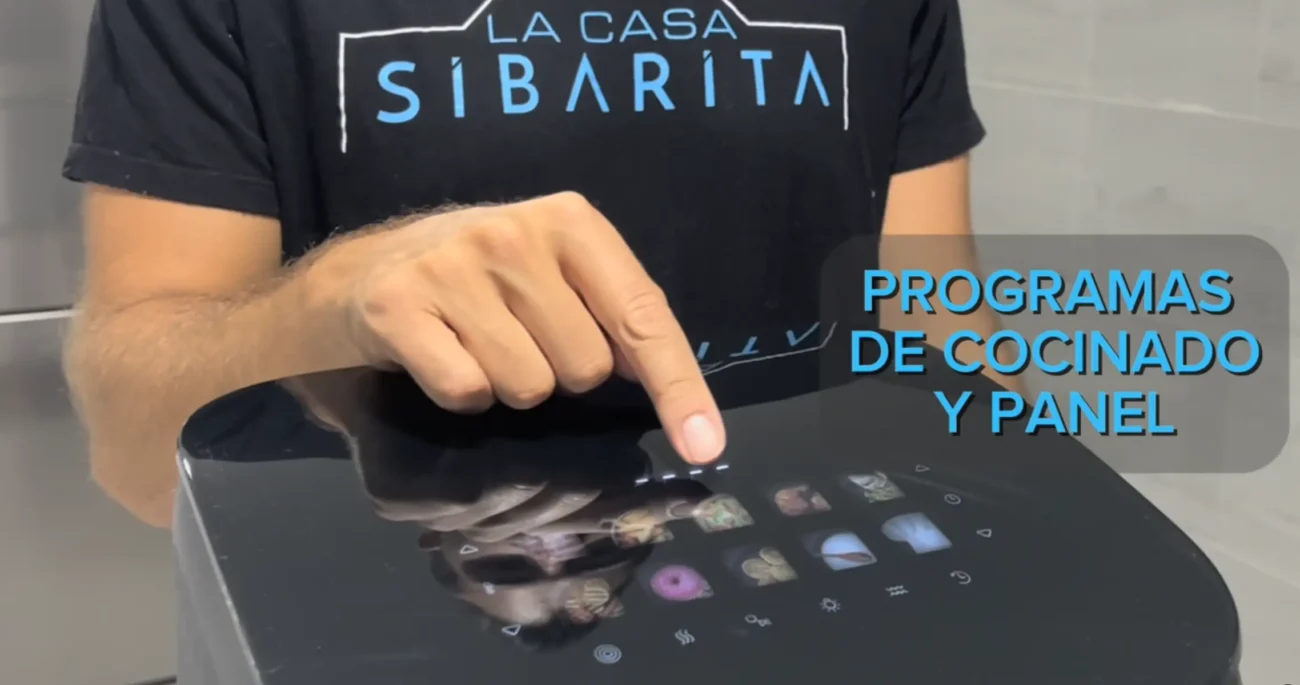
- Viewing window: yes, on the front of the drawer · Controls: touchscreen
- Dishwasher safe: basket and crisper plate, with no damage to the non-stick after the cycle (tested)
- Preheating required: no, according to Philips · App: HomeID
Why we recommend it
If opening the drawer every couple of minutes to see how things are going drives you mad, this Philips solves it with a window on the front. You check the browning without pulling the basket out, you don't lose heat and you don't lengthen the cooking time, which is exactly what happens every time you peek inside.
At 6.2 litres it's a comfortable size for three or four, and it has 13 preset modes plus manual settings, so it suits both the cook who doesn't want to think and the one who fine-tunes every dish. It really does heat up fast: with the probe in the centre of the basket it reached 180 °C in 2 minutes and 21 seconds, although it needed a little over three minutes to hit a true 200.
Where it gains ground is at the sink. The basket and crisper plate go in the dishwasher, and by hand it took us 3 minutes and 46 seconds, the second-quickest time in the ranking, with no soaking or scrubbing. In return, its cooking is decent but doesn't reach the level of the two Cosori models at the top.
Weak points
The underlying problem is heat distribution. With the basket full of chips and no stirring, 6 out of 10 came out golden in the centre against 9 around the edge. The outer area gets more airflow and colours sooner, so if you leave it alone you get two textures on the same plate. The good news is that a shake halfway through makes the difference disappear completely.
The second issue is shape. The basket is deeper than it is wide, so a medium whole chicken touches the heating element and you’ll need to joint it first. Some grease also stays on the crisper plate supports and in the bottom corners, although it comes off without leaving the part to soak.
Who it's for
Biggest advantage
Biggest drawback
Deals
Prices may change. We earn a commission on purchases made through these links.
Buying guide: how to choose the best air fryer
If you’re here, the question is no longer whether to buy an air fryer but which one. The oven feels slow for a few wings on a Tuesday, and the frying pan leaves the kitchen smelling of chip fat. An air fryer heats a small space with very fast-moving air, so it gets up to temperature quickly, browns without you watching and manages with a spoonful of oil or none at all. What it doesn’t do, and it’s worth being clear about this from the start, is replace a big oven for trays of lasagne or roasts for ten.
What follows isn’t a run-through of specifications. It’s the decisions that really change how you use it, in the order we’d go through them when advising a friend: first size and format, which shape everything else; then what affects the food; and finally what decides whether you’re still using it in six months or it’s at the back of a cupboard. We draw on what we’ve seen with the more than 14 air fryers that have been through our kitchen in Spain.
How many litres do you really need?
It’s the decision that shapes the purchase most, and the one spec sheets explain worst. The rule goes by the number of people, not by what you’d like to cook at Christmas:
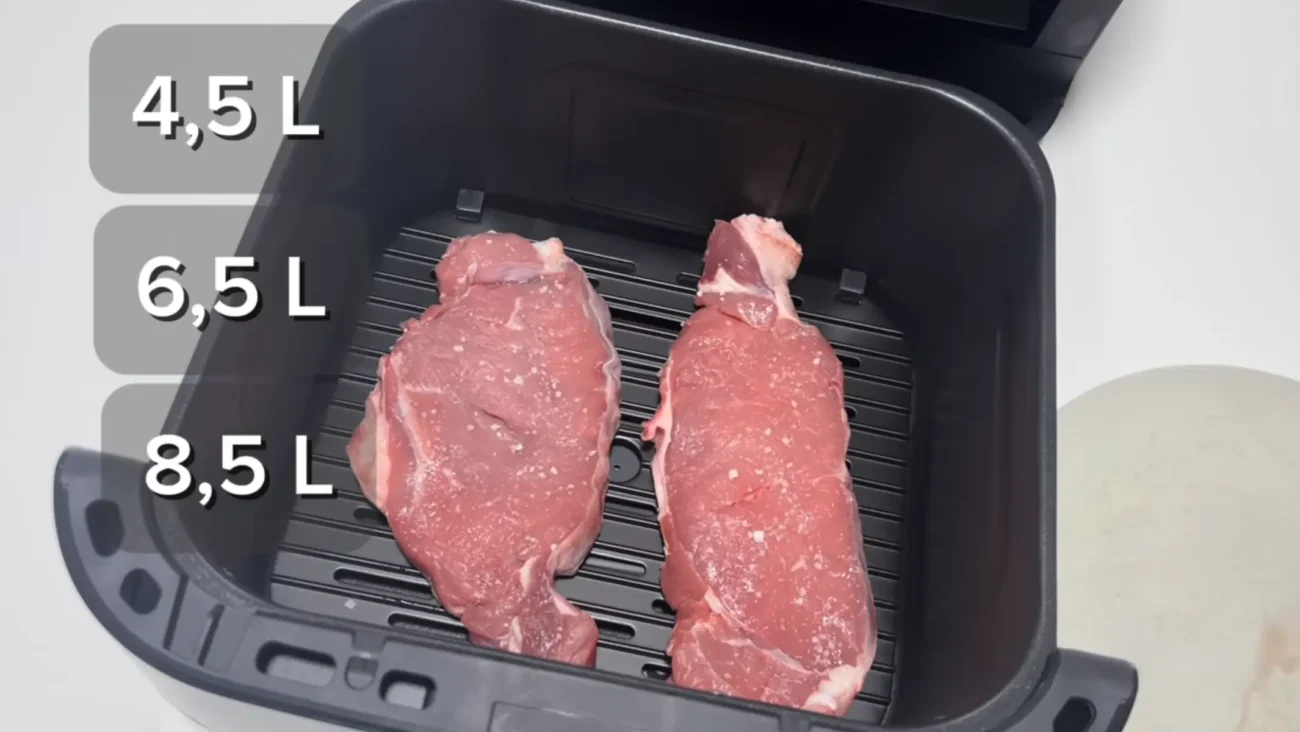
- 3.5 to 5 L for one or two people: sides, quick dinners, reheating.
- 6 to 6.5 L for households of two to four. It’s the best-selling size, and two of the five models in our ranking fall into it.
- 8 L and above for five or more, for freezing portions or for roasting large pieces often.
Fillets are a similar story. In the Cosori TurboBlaze 6L four medium chicken fillets fit in one layer with air around them, while in the 6.2 L Philips they fit but practically touching at the edges. If there are four of you and you eat flat cuts of protein every day, you’re at the limit. Where we saw the litres go furthest was in the large glass dish of the Ninja CRISPi PRO: a 1,538 g chicken plus 410 g of vegetables fitted in its 5.7 L with the dish 90% full (tested). Its deep shape gains exactly the height the 6 L baskets lack: in the TurboBlaze, a 1,546 g chicken didn’t fit, and it failed on height.
One basket, two zones or one long drawer?
This is where many people get it wrong, because twin drawers sell well and aren’t always needed. A single basket cooks better per litre, because all the air works on one space, and it’s quicker to clean because there are fewer parts. Two zones cook the protein and the side at the same time, each at its own temperature, and save you a second round while the first batch goes cold. In return they take up as much room as a microwave, they’re heavy and they cost more. As a practical rule, if there are more than four of you or you often serve two hot dishes at once, they’re worth it; if not, you’re paying for something you’ll use twice a year.
There’s a third format that hardly anyone explains: the long single drawer, one large rectangular drawer that takes whole joints and dishes, and splits in two with a divider when you want two zones. It’s the only format that lets you roast a piece without cutting it up. In return it’s the biggest appliance and the hardest to clean, not because it isn’t dishwasher safe (on the model we tested it is, according to the manufacturer) but because there are three bulky parts and, if you put it in, it takes up almost the whole bottom rack. By hand it was the longest wash-up in the ranking: 6 min 18 s (tested). For whole joints, the one that came out best was the Ninja Foodi FlexDrawer AF500UK: a pork shoulder of about 2 kg went in without cutting it, which is impossible with two separate baskets.
How many watts and what temperature range do you need?
Power on its own tells you very little: what matters is how the air is distributed, and you only see that by cooking. What is worth checking is the temperature range. A minimum of 30 or 40 °C lets you dehydrate fruit and prove dough; one that starts at 80 °C doesn’t. A maximum of 230 or 240 °C browns and crisps with real energy; with a 200 °C ceiling it still cooks well, but the blast of heat some frozen foods and very crispy skins need is better delivered by the models that go higher. All three cases are in the ranking.
On heat distribution, here’s the yardstick we use. Good means the centre and the edges come out the same colour without shaking; acceptable means they even out after a flip halfway; poor would be raw patches, something we didn’t see in any of the models we tested. Several entry-level and mid-range models are in the second group, and that’s fine if you don’t mind opening the basket once.
Cleaning, which decides whether you keep using it
Nobody stops using an air fryer because the chips come out a little less golden; they stop because washing it up is a pain. Before you buy, ask three questions: which parts are dishwasher safe (sometimes the crisper plate is and the basket isn’t), how much of the dishwasher the drawer takes up (long drawers fit, but they eat almost the whole bottom rack, so in practice you end up washing them by hand, and that weighs on our cleaning score even when they cook very well) and whether the body can be washed or only wiped with a cloth, because grease builds up on the outside too. Timed by hand, the slowest in the ranking takes almost twice as long as the quickest: from 3 min 31 s to 6 min 18 s (tested).
Glass vs non-stick
Glass containers don’t scratch, contain no PFAS and let you cook, store in the fridge and reheat without moving the food; they’re heavy, always a two-handed job and slippery when wet. Non-stick is more convenient and cheaper, but it wears with use and with metal utensils. As proof that a good one lasts, the coating on the Cosori TurboBlaze 6L came out of the dishwasher with no scratches or smell after several washes over three weeks.
Do you need an app? And does noise matter?
Connectivity makes sense in two cases: if your home already runs on the same ecosystem, or if you like to plan meals ahead. Following the cooking from your phone, getting recipes and having the appliance keep dinner warm until you sit down helps people with tight schedules. Bear in mind that, according to its Amazon.co.uk listing, UK rules mean the app-connected Cosori TwinFry has to be started manually at the machine. If you only ever fry frozen food when you get home, an app adds nothing and pushes the price up. It isn’t a silly feature; it’s a feature for a particular kind of user.
Hardly anyone looks at noise, yet it matters a lot in kitchens open to the living room or if you eat late: powerful air fryers blow hard. We have to be honest about the data here. The only manufacturer that publishes an official figure is Cosori, with 27 dB for the Cosori TurboBlaze 6L, but it doesn’t say under what conditions it was measured and we couldn’t reproduce it. With a class 2 sound level meter at one metre we got 31.2 dB(A) (tested) on the lowest speed, against background noise of 28.8 dB(A), and 43.9 dB(A) (tested) with the chips programme running. That second figure is the one you’ll actually hear, and it’s the order of magnitude they all blow at: a constant hum you notice if the kitchen opens onto the living room, not a noisy appliance. For the other models there’s no official figure and we don’t estimate one.
How much is it worth paying, and where should you buy?
The ranking runs from entry level to high end, and what we’ve seen is that from the mid-range upwards you’re paying for even cooking, temperature range and finish, not litres: there are affordable models with the same 6 L basket as others that cost quite a bit more. If you mainly cook frozen food and sides, there’s no need to go higher; if you want to dehydrate, roast whole or cook two things at once, it’s worth it.
A practical note on models: on Amazon.co.uk some of these air fryers carry a UK reference that differs from the one we tested in Spain. The Ninja CRISPi PRO is sold as the AS101UKGY in Ash Grey (we tested the AS101EUCY), the Philips as the NA230/09 (we tested the NA230/00) and the FlexDrawer as the AF500UK (we tested the AF500EU).
Where our data comes from
The specifications are checked against each manufacturer’s official documentation, and the scores for the three criteria come from the test protocols we run in our kitchen in Spain. For this batch we did measure with our own instruments: real power draw with a power meter, noise with a class 2 sound level meter at one metre and wash-up time with a stopwatch. Those figures are marked (tested), so you always know whether a figure comes from the manufacturer or from us. What we haven’t measured systematically is energy use per recipe, so you won’t see electricity consumption figures in this guide presented as our own measurements.
When isn't an air fryer worth it?
If you live alone, cook little and already have a small fan oven you’re happy to use, an air fryer will do almost the same while taking up worktop space. It isn’t worth it either if what you love is wet batter, such as battered squid or homemade croquettes that haven’t been frozen: hot air doesn’t do what oil does and they’ll come out dry. For that, a small lidded deep fat fryer does a better job. And if your worktop is tiny, a good non-stick pan and a mini oven with a fan give you more versatility per centimetre.
On the other hand, if you cook for lots of people and roast large joints every week, a large tabletop oven or your usual oven may serve you better: an air fryer, even one with a long drawer, doesn’t replace a full oven tray.
Checklist: what to look for before you buy
- How many of you sit down to eat every day, and how many litres do you need for that, not counting Christmas dinner?
- Does it fit on your worktop with space around it and the hot air outlet clear, or will you be putting it away in a cupboard every time?
- Which parts are dishwasher safe according to the official spec sheet, and will the basket or drawer fit in yours?
- Will you often cook two things at once, or would a twin drawer be a whim that takes up space?
- Does the temperature range cover what you want to do: dehydrating at the low end, strong browning at the top?
- Does the manufacturer publish a noise figure, and does it matter to you because the kitchen is open to the living room or you eat late?
- Are the accessories you’ll use (rack, baking tin, divider) included, or do they have to be bought separately?
- Is there after-sales service and are replacement baskets available in the UK? The non-stick wears out before the motor does.
Editorial independence
We choose the products in this comparison based on our own tests, real use and editorial judgement, not on commercial agreements with brands.
Although this guide includes affiliate links, they have no influence on the ratings or the order of the ranking.
We prioritise performance observed in everyday home use, consistency across tests and how well each air fryer fits each type of user, frequency of use, features, ease of maintenance, the limitations we found and value for money.
If a product stops offering a good balance between performance and price, or a better alternative appears, we update the ranking and change our recommendation, even if that means replacing models that pay a higher commission with more competitive ones.
Update history
- 05/11/2026: We publish our UK ranking, with the models available on Amazon.co.uk.
FAQs about air fryers
Do you need to add oil?
It isn’t essential, but a spoonful of oil spread over the food makes a big difference with chips and vegetables: they brown more evenly and don’t dry out. What you shouldn’t do is pour it into the bottom of the drawer; mix it with the food beforehand instead.
Can you use foil or baking paper inside?
You can, as long as it doesn’t block the air outlet or sit loose, because the fan lifts it and throws it against the heating element. Never put paper in the empty drawer while preheating. And with acidic foods such as tomato or lemon, baking paper is better than foil.
Does the whole house smell of frying?
Much less than with a pan of oil, because the steam comes out filtered and there’s no oil smoking. What does leave a smell is fish and very fatty foods, especially if you don’t clean the drawer straight away. A kitchen without an extractor hood notices it more than you’d expect.
Can I cook anything I'd cook in the oven?
Almost anything quick and in small portions. What doesn’t work well is tall sponge cakes, runny batters without a tin and anything that needs long, gentle heat. The air circulates hard, so anything light will fly around unless you hold it down.
How much energy does it use compared with an oven?
Quite a bit less in practice, not because of the wattage but because of the time: it barely needs preheating and cooks in a fraction of the time. For a tray of food for two, the difference is significant. For a meal for eight, the oven still wins because everything fits in one go.
Does the non-stick coating wear out quickly?
It wears out if you use metal utensils, aerosol cooking spray or scourers. With a silicone spatula, a soft sponge and cleaning while it’s still warm, it lasts for years. Spray is the silent enemy: it leaves a film that polymerises and ruins the coating.
The models we have analysed or tested
Real tests · No sponsorships
Marco Blasco
I'm Marco Blasco and I've been testing and comparing home appliances for more than five years. My ratings come from real tests, first-hand experience and objective criteria, explained transparently. Our tests are carried out in Spain. Through detailed guides and comparisons I've helped thousands of people choose with more confidence, and I can do that because I'm completely independent of the brands.