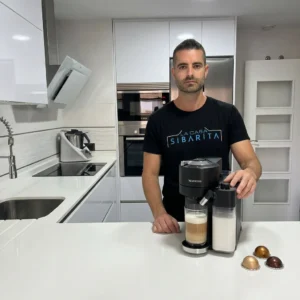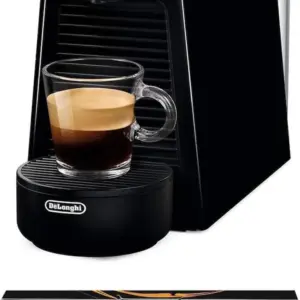

Best Pod Coffee Machines 2026: 5 Models Tested and Reviewed
The best pod coffee machine of 2026 is the Nescafé Dolce Gusto Genio S. It makes both hot and cold drinks, and at 12 cm wide and 2 kg it’s the lightest machine in our ranking, with the top Design score on the list (8.9) and an 8.7 for Cleaning. If you’re looking for the best Nespresso machine, three of our five picks run on Nespresso pods. We have analysed 19 pod coffee machines in Spain, plus the Nespresso models from our Spanish Nespresso comparison, and these are the 5 sold on Amazon.co.uk that made the cut.
The best pod coffee machine for every need
- Best overall, for hot and cold drinks in a small kitchen: Nescafé Dolce Gusto Genio S. 12 cm wide and 2 kg, the lightest in the ranking.
- Fastest warm-up: Nespresso CitiZ & Milk. Ready from cold in 25-30 seconds; we tested the Magimix version, and the UK model made by De’Longhi adds an Aeroccino frother we haven’t tested.
- Most compact: Nespresso Essenza Mini. Just 8.4 cm wide, with 19 bar and support for compatible pods.
- Best for families with different tastes: Tassimo My Way 2. Reads every pod, saves four favourite profiles and makes 4-5 drinks in a row.
- Easiest to use: Nespresso Vertuo Up. Seven cup sizes with automatic pod recognition and an 8.8 for Ease of use, the highest in the ranking; currently out of stock on Amazon.co.uk.
Pod coffee machines compared
To see at a glance how each model stacks up against the rest, we’ve summarised in a table the criteria where the real differences show: pressure and type of system, tank capacity, the drinks it makes and the results of our tests. It’s a quick snapshot for shortlisting and comparing, not a substitute for the full review of each model, where we explain the nuances a figure can’t capture.
Scroll right to see every product in the table.
Swipe to scroll sideways.
|
|
|
|
|
|
Technical specifications
Milk frother | ||||
| Not specified | Not included | No | Not specified | No |
User profiles | ||||
| Not specified | Not specified | Yes | More than 50 premium blends available | |
Removable brew group | ||||
| Not specified | Not applicable | Not specified | Not applicable | |
2 coffees at once | ||||
| Not specified | No | Not specified | No | |
Coffee types | ||||
| Capsules | Nespresso capsules | Single-serve pods | T DISC capsules | Nespresso Vertuo capsules |
Water tank capacity | ||||
| 0.8 L | 1 L | 0.6 L | 1.3 L | 1.4 L |
Cup warmer | ||||
| Not specified | No; fold-down cup holder | Not specified | No | |
Type | ||||
| Automatic capsule machine | Capsule coffee machine | Capsule coffee machine | Multi-drink capsule machine | Capsule coffee machine |
Pressure | ||||
| 15 bar | 19 bar | 19 bar | 3.3 bar | Not applicable |
Pros
| Very compact at 12.0 cm wide and 2.0 kg, so it fits gaps other machines can't. | Ready from cold in 25-30 seconds in our measurements, the fastest start in the comparison. | Just 8.4 cm wide and 2.3 kg, so it fits any corner and lifts with one hand. | Reads each pod's barcode and sets volume and temperature itself, with almost no learning curve. | Concentrated brew mode uses less water, so iced or milky coffees don't taste watery. |
| More than 40 drinks from Nescafé Dolce Gusto and Starbucks, with a simple hot or cold selector. | 19 bar extraction gives a consistent, repeatable crema with no technique to learn. | 19 bar of pressure gives a dense, consistent crema, on a par with much bigger machines. | 1.3 litre tank makes four or five drinks in a row, enough for a family breakfast. | Automatic pod recognition brews 7 cup sizes, from ristretto to carafe, with no settings. |
| 15 bar pump gives a consistent crema, and it heats up quickly with no purging. | Programmable espresso and lungo buttons save your exact amount for every cup. | Ready in under 30 seconds from cold, perfect for rushed mornings. | Saves up to four favourite profiles, each with its own strength, temperature and size. | Removable 1.4 L tank covered eight coffees of different sizes without a refill. |
| Height-adjustable tray, click-in tank and minimal cleaning, as the grounds stay in the pod. | Simple daily upkeep, with an 11-pod container and a drip tray that come off in seconds. | Programmable buttons and auto-off after 9 minutes, confirmed every time we checked. | Built-in BRITA filter reduces limescale, especially useful in hard-water areas. | Slim, upright 4.1 kg body fits narrow gaps, though it needs a deep worktop. |
Cons
| The 0.8 litre tank runs short in a round of four large cups, so expect frequent refills. | Nespresso Original pods only and no grinder, so each cup costs more than ground coffee. | The pump is clearly audible while brewing, although it only lasts a few seconds. | Low 3.3 bar pressure gives decent drinks but without the dense crema of a portafilter espresso. | Takes only Nespresso Vertuo pods, so the cost per cup is tied to the official range. |
| The pump is clearly audible while brewing and sends vibration into the worktop. | 1 litre tank and 11-pod container mean refilling and emptying almost daily with heavy use. | The 0.6 litre tank needs frequent refills if more than one person drinks coffee daily. | The used pod holds back some coffee even at maximum strength, so a little goes to waste. | No frother or milk system, so lattes and cappuccinos need the milk heated separately. |
How we test pod coffee machines
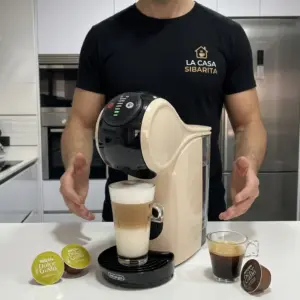
All our testing takes place in Spain. For this category we have analysed 19 pod coffee machines, plus the Nespresso models from our Spanish Nespresso comparison, and these five are the best of the ones you can buy on Amazon.co.uk. Every score comes from the same set of tests, and no sub-score goes live without a measurement behind it.
Design. We put each machine on a standard worktop with a wall cupboard above it and measure its real height, width and depth with the water tank fitted and the lid open. That shows the true spread of the category, from the 8.4 cm width of the Nespresso Essenza Mini and the 2.0 kg of the Nescafé Dolce Gusto Genio S to machines that need a deep worktop, such as the 37.1 cm depth of the Nespresso CitiZ & Milk. After a month of use we check for fingerprints and scratches, whether the plastic creaks when you press it and whether the drip tray adjusts for a tall glass or has to come out.
Cleaning. After twenty coffees and two rounds of milk froth we take apart everything that comes apart (pod holder, drip tray, water tank and coffee spout), wash it by hand or in the dishwasher where that’s allowed, and note where grounds build up and which corners you can’t reach without a brush. It’s the test that moves a score the most. The Tassimo My Way 2 rinses itself between drinks but leaves a few millilitres in the tray after each cycle, and the Genio S needed seven hot and three cold rinses on first use before the water ran clear.
Ease of use. On the Nespresso machines we time the warm-up from cold, the automatic switch-off and long runs of back-to-back coffees. The CitiZ was ready in 25-30 seconds in all ten cold starts we timed, and the Essenza Mini pulled fifteen shots in a row without losing pace or crema.
Capacity. We fill the tank to the line and count how many coffees come out before it needs topping up, with small and large cups, how many used pods fit in the container and whether the tank lifts out and refills without moving the machine. The range runs from the 0.6 litre tank of the Essenza Mini to the 1.4 litres of the Vertuo Up, which got through eight coffees in a day without a refill.
Every rating in this guide is based on real testing, continued use and head-to-head comparison between models, following our full testing methodology.
"This article contains affiliate links. We may earn a commission if you buy through them, at no extra cost to you"
How we calculate the score
The overall score of each pod coffee machine is the simple average of three criteria, each rated independently out of 10: Design, Capacity and a third one for day-to-day use, which is Cleaning on the Dolce Gusto and Tassimo and Ease of use on the Vertuo Up, CitiZ & Milk and Essenza Mini. There’s no weighting. All three count the same and price plays no part, so a cheap machine doesn’t gain points for being cheap and an expensive one doesn’t lose them.
Each criterion comes from its own test in the section above. When a test doesn’t produce a usable measurement, we don’t fill the gap with the manufacturer’s figure; we say so in the review. That’s why, on several of these machines, we don’t publish how many used pods fit in the container: we never managed to fill it.
Here’s a worked example from this list. The Tassimo My Way 2 gets 7.8 for Design, held back by its 325 mm depth; 8.2 for Cleaning, where the automatic rinse between drinks stopped any flavour carrying over but left a few millilitres in the tray after each cycle; and 8.4 for Capacity, with a 1.3 litre tank that gave us four or five drinks in a row without a refill. The total is 24.4 and the average is 8.1, the score you’ll see in its review and in the comparison table.
The Nescafé Dolce Gusto Genio S and the Nespresso CitiZ & Milk both round to 8.4. On the unrounded average the Genio S is just ahead (8.43 against 8.37), thanks to its 8.9 for Design and 8.7 for Cleaning, and our editors put it first.
The best pod coffee machines: our tested ranking
1. Nescafé Dolce Gusto Genio S: the best pod coffee machine overall, for hot and cold drinks in a small kitchen
| Features | Details |
|---|---|
| Material | Not specified |
| Milk frother | Not specified |
| User profiles | Not specified |
| Removable brew group | Not specified |
| Coffee grinder | No |
| 2 coffees at once | Not specified |
| See all | |
| Coffee types | Capsules |
| Water tank capacity | 0.8 L |
| Cup warmer | Not specified |
| Type | Automatic capsule machine |
| Pressure | 15 bar |
| Capsule container | Yes |
Test results
- Design (real measurements on the worktop): 29.0 cm high, 27.0 cm deep and 12.0 cm wide, with 2.0 kg on the scales
- Cleaning (first-use rinses until the water ran clear): about 7 hot and 3 cold cycles
- Capacity (0.8 L tank): we had to refill halfway through a round of 4 large cups
Why we recommend it
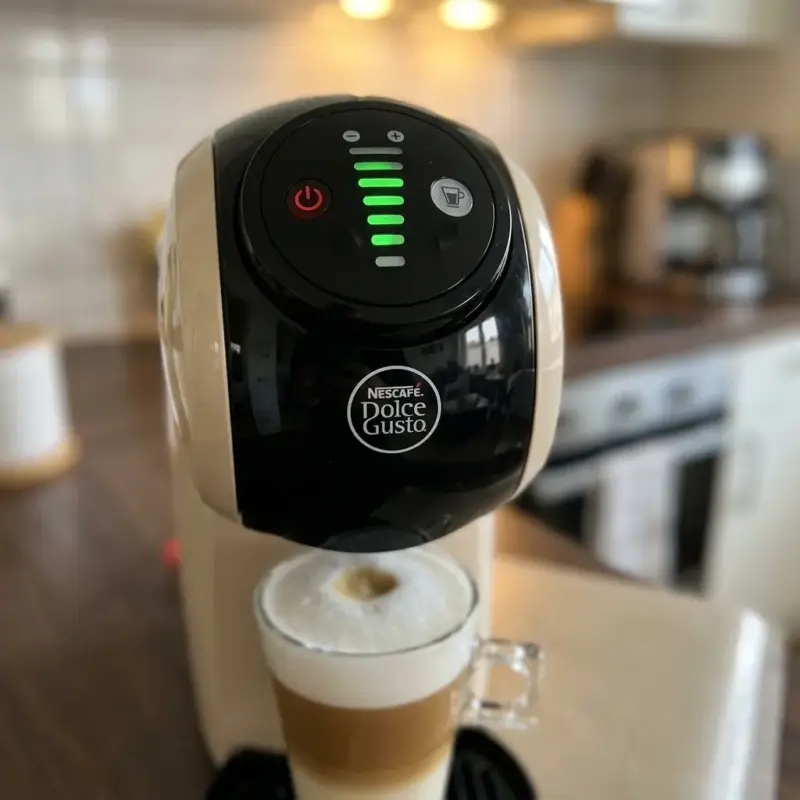
If you're short of worktop space, or you want a machine for a home office or a small flat, this format is one of the most practical we've had in our hands. Measured with the tank fitted, it's 12.0 cm wide, 27.0 cm deep and 2.0 kg, the lightest machine in the ranking. It slots in where most others won't and you can move it with one hand, which is why it scores 8.9 for Design, the top mark on the list. Small doesn't mean weak: the 15 bar pump gave espressos a consistent layer of crema, and the cappuccino came out with a pretty decent foam for a pod (give it a stir, as the milk and coffee tend to settle in layers).
Day to day, what won us over is how simple it is: a dial to set the amount, with an XL function for big cups, a hot or cold button and that's it. With more than 40 varieties of coffee, hot chocolate and iced drinks, it suits the person who wants a short espresso and the one who doesn't drink coffee at all. Cleaning earns it an 8.7, because the grounds stay inside the pod, so the tray barely gets dirty and there's no filter holder to scrub. The only catch was the seven hot and three cold rinses it needed on first use before the water ran as clear as the tap. On Amazon.co.uk it comes in white as a starter kit with six boxes of Starbucks pods; we tested it in Spain in taupe, and it's the same machine. If you're after pure espresso or brew in volume, look elsewhere; for convenience, variety and a small footprint, it hits the mark.
Weak points
Who it's for
Biggest advantage
Biggest drawback
Deals
Prices may change. We earn a commission on purchases made through these links.
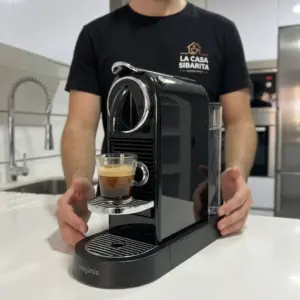
2. Nespresso CitiZ & Milk: the fastest warm-up we timed, for espresso and lungo
| Features | Details |
|---|---|
| Material | Not specified |
| Milk frother | Not included |
| User profiles | Not specified |
| Removable brew group | Not applicable |
| Coffee grinder | No |
| 2 coffees at once | No |
| See all | |
| Coffee types | Nespresso capsules |
| Water tank capacity | 1 L |
| Cup warmer | No; fold-down cup holder |
| Type | Capsule coffee machine |
| Pressure | 19 bar |
| Capsule container | Yes |
Test results
- Warm-up from cold (ten timed starts): 25-30 seconds every time, the fastest we timed
- Back-to-back coffees: six in a row with no noticeable wait between them
- Design (coffee machine measured in Spain): 27.7 cm high, 13.0 cm wide and 37.1 cm deep
- Capacity (1 L tank): two days at most with six shots a day plus rinses; the 11-pod container needed emptying almost daily
- Noise: a steady, clean hum that doesn’t pass into the worktop, with a slight rattle only in the first seconds
Why we recommend it
We were still putting the cup under the spout when the light stopped flashing. In our timings it was ready from cold in 25-30 seconds, the quickest start-up we recorded, and with coffees back to back there's no wait at all. Its 19 bar pump gives a stable crema and good body, especially with medium to strong pods, and the two buttons (espresso 40 ml and lungo 110 ml) are programmable, so you save your exact measure once and stop guessing every morning. Its best mark is the 8.8 for Design: a slim machine that fits under standard wall cupboards, with a fold-down cup rest that takes anything from an espresso cup to a tall glass.
One thing to know before you buy. The unit we tested in Spain was the Magimix version; in the UK, the same Nespresso model is sold made by De'Longhi (EN267.WAE, in white), with the Aeroccino milk frother and a 7-pod box. Our scores come from the coffee side of the machine, which is what we put through our tests; we haven't tested the Aeroccino frother, so it plays no part in them.
Weak points
It only makes two coffee sizes and doesn’t recognise the pod. If you want another measure you have to reprogram the buttons by holding them down, whereas the Vertuo Up reads each pod and sets the volume itself. That’s why it scores 8.3 for Ease of use, behind the Vertuo Up’s 8.8.
Capacity is its lowest mark (8.0). The 1 litre tank lasted two days at most in our heavy-use test, and the container holds 11 used pods, so with six coffees a day you’re emptying it almost daily, best done over the sink because some water drips out with the pods. You also depend on pods, which cost more per cup than ground coffee, and the 37.1 cm depth needs some room on the worktop.
Who it's for
👤 One or two people who mostly drink espresso and lungo, want a machine that’s ready almost as soon as it’s switched on (25-30 seconds from cold) and would like a milk frother in the box (the Aeroccino, which we haven’t tested); you’ll be emptying the 11-pod container and refilling the 1 L tank often if you drink a lot of coffee.
Biggest advantage
✅ Ready from cold in 25-30 seconds, the fastest start-up we timed, with 19 bar extraction and crema that's the same cup after cup.
Biggest drawback
❌ Only two cup sizes and no pod recognition, so any other measure means reprogramming the buttons by hand.
Deals
Prices may change. We earn a commission on purchases made through these links.
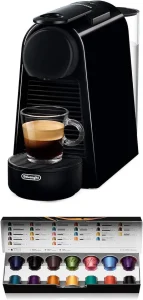
3. Nespresso Essenza Mini: the smallest machine in the ranking, for tight spaces
| Features | Details |
|---|---|
| Pressure | 19 bar |
| Capsule container | Yes |
| Water tank capacity | 0.6 L |
| Material | Not specified |
| Type | Capsule coffee machine |
| Coffee types | Single-serve pods |
| See all | |
| Milk frother | No |
Test results
- Design (real measurements): 8.4 cm wide, 20.4 cm high and 33 cm deep, with 2.3 kg on the scales; cups up to about 12 cm tall with the drip tray removed (9 cm with it)
- Warm-up from cold: under 30 seconds
- Long run: fifteen shots in a row without losing pace or crema
- Automatic switch-off: after exactly 9 minutes of inactivity in every check
- Three coffees from one pod: only the first was worth drinking; a single pod gives flavour up to about 80 ml
- Capacity (0.6 L tank): a 6-pod container, which means emptying it every three days at two coffees a day
Why we recommend it
This is the smallest and simplest machine in the Nespresso range, and that's exactly its appeal. At 8.4 cm wide and 2.3 kg it fits in any corner of the kitchen, slides under a wall cupboard and moves with one hand when you wipe underneath, which earns it an 8.8 for Design. It still runs at 19 bar, and in our test the espresso had body and a fine crema that lasted to the last sip. It was ready in under thirty seconds and pulled fifteen shots in a row without losing pace.
Two programmable buttons, espresso and lungo, are all there is to learn, and it switched itself off after exactly 9 minutes every time. It also takes third-party compatible pods, which we used without any problems and which bring the daily cost down, something the Vertuo Up can't do. We tested the Krups version in Spain; on Amazon.co.uk we link to the same Essenza Mini made by De'Longhi (EN85.B, in black), sold by Amazon in a pack with 50 Nespresso pods.
Weak points
The pump is noisy. The hum during extraction could be heard from the next room, and although it only lasts a few seconds per coffee (at rest the machine is almost silent), it’s worth knowing if you make coffee while others are asleep. There are only two sizes, so for a big mug you’ll have to top it up with hot water.
Capacity is its lowest score (7.6). The 0.6 litre tank is the price of the mini format and means trips to the tap almost every day if three of you drink coffee, and the 6-pod container is the smallest in the ranking. At least the tank lifts out and refills in seconds without moving the machine.
Who it's for
👤 One or two people, small kitchens, studios and offices, or anyone after a second machine, who drink espresso and lungo without milk and want the smallest possible footprint (8.4 cm wide); you’ll be refilling the 0.6 L tank often and you’ll hear the pump while it brews.
Biggest advantage
✅ At just 8.4 cm wide and 2.3 kg it fits anywhere, yet its 19 bar pump makes an espresso with dense, consistent crema.
Biggest drawback
❌ The pump is loud during extraction; it only lasts a few seconds, but you can hear it all over the kitchen.
Deals
Prices may change. We earn a commission on purchases made through these links.
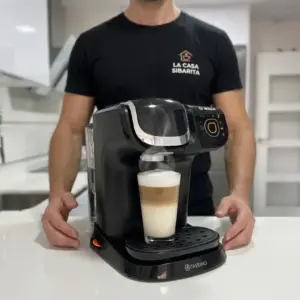
4. Tassimo My Way 2: the best for families with different tastes
| Features | Details |
|---|---|
| Material | Not specified |
| Milk frother | Not specified |
| User profiles | Yes |
| Removable brew group | Not specified |
| Coffee grinder | No |
| 2 coffees at once | Not specified |
| See all | |
| Coffee types | T DISC capsules |
| Water tank capacity | 1.3 L |
| Cup warmer | Not specified |
| Type | Multi-drink capsule machine |
| Pressure | 3.3 bar |
| Capsule container | Yes |
Test results
- Design (real measurements on the worktop): 290 mm high, 230 mm wide and 325 mm deep, with 3.3 kg empty
- Cleaning (automatic rinse between drinks): no hot chocolate taste carried over into an espresso, but it releases a few millilitres into the tray after each cycle
- Capacity (drinks in a row without refilling): 4-5 cups from the 1.3 L tank
- Pod barcode reading: 100% success with every pod we tried
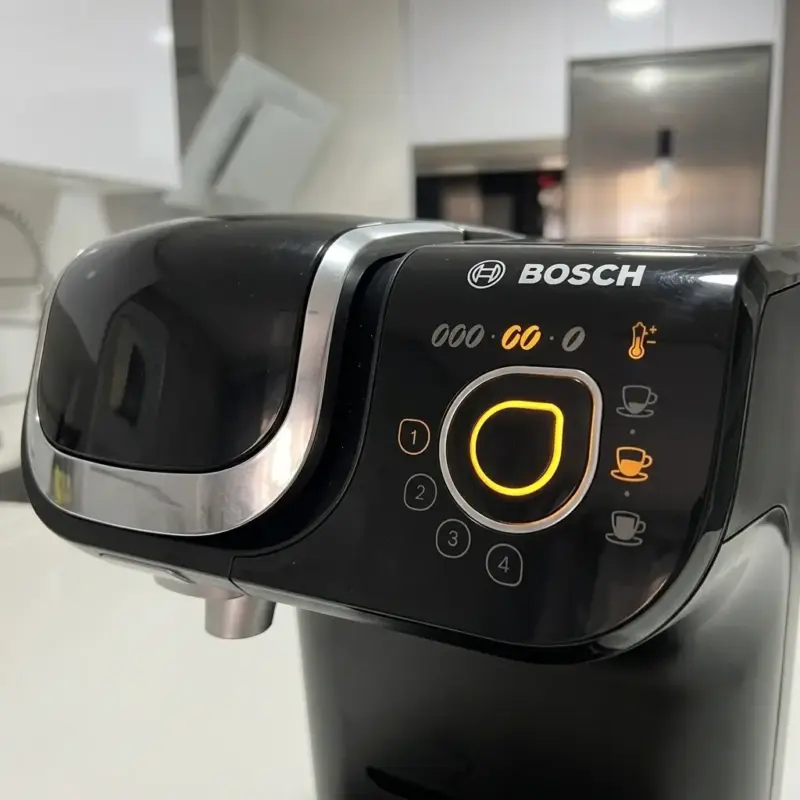
- First cup from cold: about 1 minute
Why we recommend it
Automatic barcode reading on every pod is what sets this machine apart from the rest of the list. You pop the pod in, it reads which drink it is and sets the volume and temperature by itself, so you don't need to know anything about coffee. In our tests it got every pod right (espresso, long coffee, cappuccino and hot chocolate) and, thanks to its 1,500 W, the first cup from cold took about a minute, with the next ones even quicker because it keeps the temperature between drinks.
What convinced us for family use are the four favourite profiles. Each person saves their own intensity, temperature and cup size and gets it with one touch, with no resetting every morning. The 1.3 L tank gave us four or five drinks in a row without going to the tap, and the built-in BRITA water filter helps with taste and limescale if your water is hard; it's its best mark, an 8.4 for Capacity. Compared with the Dolce Gusto Genio S, which sits higher in the ranking thanks to its tiny footprint, you give up worktop space (325 mm deep, the figure that keeps its Design score at 7.8) and pressure, but you gain a bigger tank and personal profiles. If there are several of you at home, that extra matters more than size. On Amazon.co.uk it's the TAS6502GB in black, the same listing as the machine we tested in Spain.
Weak points
Who it's for
Biggest advantage
Biggest drawback
Deals
Prices may change. We earn a commission on purchases made through these links.
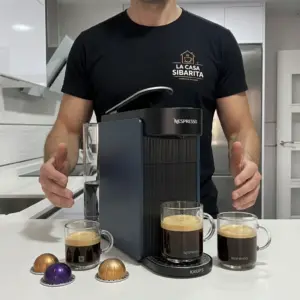
5. Nespresso Vertuo Up: the easiest to use, with automatic pod recognition
| Features | Details |
|---|---|
| Material | Not specified |
| Milk frother | No |
| User profiles | More than 50 premium blends available |
| Removable brew group | Not applicable |
| Coffee grinder | No |
| 2 coffees at once | No |
| See all | |
| Coffee types | Nespresso Vertuo capsules |
| Water tank capacity | 1.4 L |
| Cup warmer | No |
| Type | Capsule coffee machine |
| Pressure | Not applicable |
| Capsule container | Yes |
Test results
- Design (on the worktop): narrow, upright body and 4.1 kg; it’s long front to back and the maker doesn’t state the exact depth
- Capacity (1.4 L tank): eight coffees of different sizes in one day, two of them carafes, without a refill
- Automatic switch-off: after 2 minutes of inactivity in every cycle we timed
- Concentrated mode (measuring jug): clearly less water than a standard brew, so iced coffee doesn’t end up watery
- Five days of use (four to eight coffees a day): no pod jams in the used-pod container
Why we recommend it
If your mornings are a rush and you want decent coffee without fiddling with settings, this is the machine that makes it easiest. There's one main button and the Vertuo Up does the rest: it reads each pod and sets the volume itself, across 7 cup sizes from ristretto to carafe. In a home where one person drinks espresso and another wants a big mug at breakfast, nobody has to touch a menu. That simplicity earns it an 8.8 for Ease of use, the highest in the ranking.
The 1.4 litre tank covered our busiest day in full (eight coffees, two of them carafes), which gives it an 8.6 for Capacity. Its centrifugal extraction gave espressos a compact, even crema, although it thins out in the larger sizes. We tested it in Spain in blue; on Amazon.co.uk we link to the same Krups-made Vertuo Up in black (XN9408G0), with a 12-pod welcome set. It's currently out of stock there, so our editors have moved it down to fifth place for now.
Weak points
The main limitation is the system itself. It only takes Nespresso Vertuo pods, which aren’t interchangeable with Original pods or generic compatibles, so your cost per cup is tied to the official range. There’s no milk frother either, so a proper cappuccino needs a separate gadget; if milky drinks matter, the CitiZ & Milk comes with an Aeroccino frother.
It’s narrow from the front but long from front to back, so measure your worktop depth before buying. And the crema loses body in the large cup sizes, something we noticed clearly when moving from espresso to a big mug.
Who it's for
👤 Couples and small families where everyone drinks a different size, who want one-button coffee (a 1.4 L tank that lasted eight coffees in a day) and don’t need milk froth; you need a worktop with enough depth and you’re committing to Vertuo pods only.
Biggest advantage
✅ It reads every pod and brews 7 cup sizes, from ristretto to carafe, with a single button and no settings to learn.
Biggest drawback
❌ It only works with Nespresso Vertuo pods, so there are no Original or third-party compatibles to bring the cost per cup down.
Deals
Prices may change. We earn a commission on purchases made through these links.
Buying guide: how to choose the best pod coffee machine
If you're here, you want decent coffee as soon as you get up, without a grinder, without tamping and without making a mess of the kitchen. That's the promise of pods compared with a moka pot or a manual espresso machine: you press a button, wait half a minute and get the same cup every time, with the machine practically clean. In our experience that promise is kept almost every time. What goes wrong is something else. People choose on bars and looks, then find they've signed up to an expensive pod system, that the tank is too small or that their morning cappuccino isn't possible with that machine.
Here we turn the jargon into concrete decisions: which pod system suits you and what it will cost you each month (the sum almost nobody does), what size of tank you need for the number of coffee drinkers at home, whether you need milk froth and what maintenance really involves. It's all based on what we've learned from analysing 19 pod coffee machines and testing the five in this ranking in depth.
The pod system: the decision that ties you in the most
This is where many people get it wrong. They think they're buying a machine when they're really buying into an ecosystem. Most pod coffee machines are closed systems: they only take their own brand's pods, and that brand sets the range and the price for good. Before anything else, ask yourself two questions. Can you find those pods in your local supermarket, or will you have to order them online? And how much does each one cost? One pod per coffee, every day, adds up to far more over a year than it seems.
The alternative is open or flexible formats, which accept compatible pods from other makers or, with adapters, even ground coffee. You gain freedom and savings (ground coffee works out much cheaper per cup) in exchange for a little more fiddling and cleaning. Put simply, it's total convenience against total freedom, and there isn't really a middle ground.
None of the five machines in our ranking takes ground coffee, but the Nespresso Original ones are the least restrictive. We used third-party compatible pods in the Nespresso Essenza Mini without any problems. Vertuo, Dolce Gusto and Tassimo, on the other hand, keep you within their own pod ranges.
Do more bars mean better coffee? Not exactly
A ‘bar’ is simply the pressure at which water passes through the pod, and there's a classic trap here: comparing figures from different systems. Machines with 15-19 bar are after the dense crema of an espresso, extracting the coffee at high pressure. Multi-drink systems work at around 3 bar because they don't press, they infuse, and that lets them make tea or hot chocolate too. Nespresso Vertuo goes another way and spins the pod at high speed. A 3.3 bar machine isn't worse than a 19 bar one; it does something different. The coffee is fine, but without the crema or body of an espresso, and you need to know that before you buy, not after.
Among the high-pressure machines, what separates a good extraction from a mediocre one is the stability of the crema and the time to the first cup. 25-40 seconds is very good, around a minute is acceptable, and if a machine needs several minutes of preheating to serve at a good temperature, it isn't a disaster, but you'll have to get used to switching it on in advance. The quickest we timed was the Nespresso CitiZ & Milk, ready from cold in 25-30 seconds with a stable 19 bar crema, while the Essenza Mini pulled fifteen shots in a row without the crema losing consistency.
Water tank: how many coffees before a trip to the tap
This seems like a minor point until you live with it. A tank of 0.6-0.8 litres gives 4-6 coffees per fill, which is perfect for one or two people. But in a household of three or more, or a small office, that same tank makes you refill in the middle of breakfast, and that gets old fast. From 3-4 coffees a day, look for more than a litre; models with 1.3-1.4 litres get through a whole family round without interruption.
Our tip if you're torn between two sizes is to always go for the bigger one. It takes up a little more room but is far less annoying. In this respect, the machine that best handled family breakfasts was the Tassimo My Way 2, with 4-5 drinks in a row from its 1.3 litre tank, while the Vertuo Up got through eight coffees in a day on its 1.4 litres.
Just coffee, or flat whites and cappuccinos too?
This question decides half the purchase and hardly anyone asks it in time. Without a frother or some kind of milk solution, forget an easy cappuccino: you'll have to heat and froth the milk yourself. There are three routes. A built-in milk jug heats and froths by itself at the press of a button (the genuinely convenient option, although you have to rinse the circuit after every use). A separate frother is cheaper but means one more gadget on the worktop. And the milk powder pods of the multi-drink systems do the job but don't give the texture of frothed fresh milk.
And to be honest, if you drink your coffee black, don't pay for any of this. A frother is one of those features that changes daily life for those who need it and is completely unnecessary for those who don't. None of the machines in our ranking has a built-in milk jug. The Dolce Gusto Genio S and the Tassimo My Way 2 make their cappuccinos from pods, and the UK pack of the CitiZ & Milk includes an Aeroccino frother, which is the separate-frother route; we haven't tested it.
Size, cleaning and what you only notice after a month
Among the models in this ranking, widths range from 8.4 cm (Essenza Mini) to 23 cm (Tassimo My Way 2), so measure your space first, bearing in mind that most open their lever or lid at the top and need clearance above. Watch the depth too, which is the figure that catches people out: of the machines we measured, it goes from 27 cm on the Genio S to 37.1 cm on the CitiZ, and the Vertuo Up, whose exact depth the maker doesn't state, is also long from front to back. Then there's the used-pod container. On the machines where we counted, it holds from 6 pods (Essenza Mini) to 11 (CitiZ) before it needs emptying, which is a chore if several coffees are made in a row at home.
Real maintenance comes down to one thing: limescale. In hard water areas, descale every 2-3 months or the temperature and flow will suffer; it's the most common fault we've seen with prolonged use. A trick we always use is to run a little water without a pod when you switch on. It warms the cup and the first coffee doesn't arrive cold. If space is your problem, the narrowest machine in our tests was the Nespresso Essenza Mini, at 8.4 cm wide, and the lightest was the Nescafé Dolce Gusto Genio S, at just 2 kg.
When isn't a pod coffee machine worth it?
Let's be clear: this category buys convenience and consistency, not speciality coffee. If you like choosing the origin of your beans, adjusting the grind and controlling the extraction, a pod coffee machine will feel limiting within a fortnight. What you want is a manual espresso machine with a grinder, accepting the learning curve and cleaning that comes with it. The same goes if you enjoy the ritual: here the ritual lasts ten seconds.
It isn't worth it either if your household drinks a lot of coffee every day and money is tight. The cost per pod, multiplied by five or six cups a day, turns the low upfront price of the machine into a considerable recurring expense. For high volumes, a filter coffee machine or a bean to cup machine works out much cheaper per cup in the medium term.
Checklist: what to look for before you buy
- Can you find that system's pods in your usual supermarket, or will you depend on ordering online?
- Have you worked out how many coffees your household drinks a month and what the pods add up to over a year?
- Do you have milky drinks every day, or is black coffee enough? That decides whether you need a frother or a built-in jug.
- How many cups in a row do you make at a normal breakfast? That tells you the tank size you need.
- Does it fit your space on the worktop, counting the depth and the room to open the lever or lid at the top?
- Is the used-pod container easy to empty, or do you have to remove each pod by hand?
- Is your water hard? That sets how often you'll need to descale and whether the process is simple.
- Does it switch off automatically, and is the noise bearable if the coffee is made early with people still asleep?
Editorial independence
We choose the products in this comparison based on our own testing, real-world use and editorial judgement, not on commercial agreements with brands.
Although this guide includes affiliate links, they have no influence on the ratings or the order of the ranking.
If a product stops offering a good balance between performance and price, or a better alternative appears, we update the ranking and change our recommendation, even if that means replacing models that pay a higher commission with more competitive ones.
Update history
- 07/11/2026: The Nespresso Vertuo Up is out of stock on Amazon.co.uk, so it moves from first to fifth place and the Nescafé Dolce Gusto Genio S becomes our top pick.
- 05/11/2026: We publish our UK ranking, with the models available on Amazon.co.uk.
FAQs about pod coffee machines
Can I use own-brand compatible pods?
On open systems such as Nespresso Original, yes, and that's where a good part of the savings lies. There are aluminium and plastic ones, with very different results; the good ones come close to the original for noticeably less. Check first whether your system is open, because Vertuo reads a barcode on every pod and Dolce Gusto and Tassimo only take their own.
Can used pods be recycled?
Aluminium ones can, through the brand's collection scheme or your council's recycling, depending on where you live, and always empty. Plastic ones depend on the type. If the volume worries you, reusable refillable pods exist and work reasonably well with finely ground coffee on systems that accept them.
Why is my coffee coming out colder and colder?
It's almost always limescale in the circuit, which insulates the heating element. Descale and try again. If the problem persists, warm the cup first with a cycle of plain water: a cold cup takes several degrees off the coffee in the first second.
Do I need to descale if I use bottled water?
Yes, although you can leave longer between descales. All water leaves mineral deposits. The sign to watch is the flow: when the coffee takes longer to come out or the machine is noisier than usual when pumping, it's time. Don't wait for the warning light if you notice that first.
What should I do if a pod gets stuck?
Unplug the machine, let it cool and open the lever all the way; it almost always drops out when you tilt the machine over the container. Don't force it with a knife or put your fingers inside the pod holder, where the piercing needle is. If it keeps happening, the used-pod container is usually full.
How much does pod coffee cost a year compared with beans?
Pods are convenient, but they're the most expensive coffee per cup: beans usually cost a fraction for the same amount. At two coffees a day, the yearly difference is considerable. What you're buying with pods is time and zero cleaning, not savings.
The models we have analysed or tested
Real tests · No sponsorships
Marco Blasco
I'm Marco Blasco and I've been testing and comparing home appliances for more than five years. My ratings come from real tests, first-hand experience and objective criteria, explained transparently. Our tests are carried out in Spain. Through detailed guides and comparisons I've helped thousands of people choose with more confidence, and I can do that because I'm completely independent of the brands.