
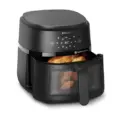
Philips Airfryer 2000 Series NA230 Air Fryer

Gallery
Deals
This page contains affiliate links: if you buy through them we may earn a commission, at no extra cost to you. Prices and availability may change. As an Amazon Associate, La Casa Sibarita earns from qualifying purchases.
Pros
-
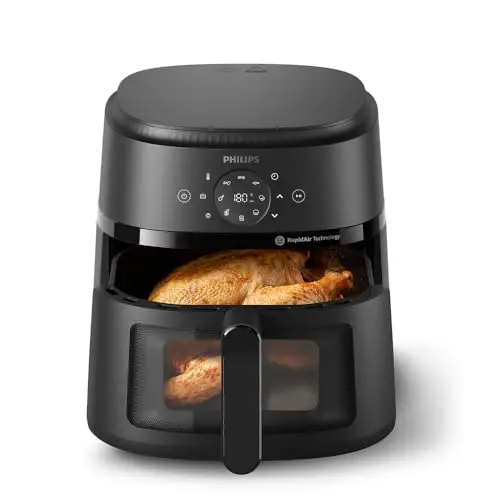
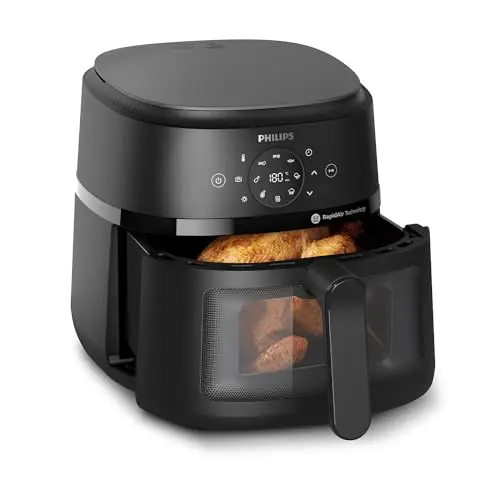
The window in the drawer lets you check browning without opening it and losing heat.
-
Heats up quickly: 180 °C in 2 min 21 s, a little over three minutes for a true 200 °C.
-
13 presets plus manual control suit both beginners and fine-tuners.
-
Dishwasher-safe basket and crisper plate, with a non-stick that resists scrubbing.
Cons
-
With compact loads such as chips, the centre browns less and needs a shake halfway.
-
The deep basket won't take a medium whole chicken without touching the element.
Contents
Technical specifications
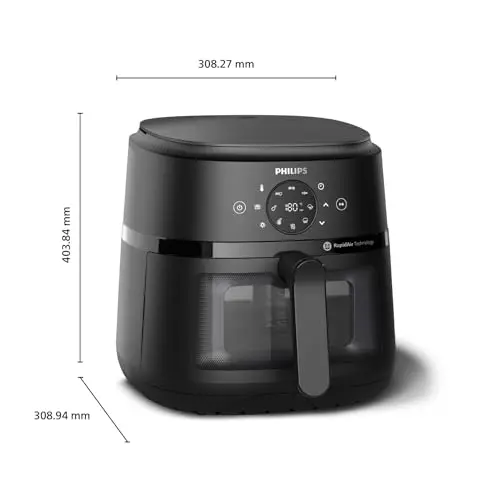
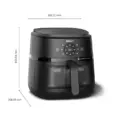
| Dimensions | 30.8 x 40.4 x 30.9 cm |
|---|---|
| Number of people | 4-5 people |
| Power | 1,700 W |
| Capacity | 6.2 L |
| Dishwasher safe | Yes |
| Keep warm | Yes (keep warm) |
| Programmes | 13 cooking modes |
| Timer | 1 to 60 minutes |
| Delayed start | No delayed start |
| Temperature | 60-200 °C |
| Stirs food | No |
| Cooks 2 foods at once | No |
Description
Summary
We think this air fryer is worth it if you want something simple, quiet and with a viewing window you’ll actually use, as long as you accept that chips need a shake halfway through. That’s our verdict after two weeks with it in different kitchens, and the rest of this summary explains why.
What impressed us most is the built-in window in the drawer. It may sound like a minor detail, but in practice it lets you check the browning without opening the basket, so you don’t lose hot air or lengthen the cooking time; with air fryers that don’t have a window, you end up opening the drawer more often than you need to.
The official figures are 1,700 W, a 6.2 L basket, 13 preset cooking modes with manual time and temperature control, and removable dishwasher-safe parts. It measures 30.8 cm high, 40.4 cm deep and 30.9 cm wide, and weighs 5.3 kg, so it fits on a normal worktop, although it isn’t one you’ll want to move every day. In the UK it’s sold as the NA230/09; the unit we reviewed was the NA230/00, the same air fryer under a different regional reference.
It’s a good fit for couples and small families who want to cook a bit of everything (chips, chicken, vegetables, even sponge cakes) without wrestling with the appliance. If you live alone the basket is on the large side, and if you want to cook a whole chicken you’ll have to joint it, as we explain below.
The drawback that bothered us most is evenness with compact loads. Without shaking, the centre of the basket browns less than the edges, so you have to step in once per batch if you want an even result.
Analysis and verdict
Cooking results – Score: 7.8/10
The high-speed hot air circulation works, and you notice it in wings that come out crisp outside and juicy inside with hardly any oil. With irregularly shaped food, such as jointed chicken, the air reaches every part and the browning is fairly even; that’s where this Philips gave us its best dishes.
Where it struggles is with dense, uniform loads such as chips. Packed tightly, the core of the basket gets less air and you’re left with a pale patch if you don’t stir halfway through. Compared with models that have top and bottom heating elements, which spread the heat better without stirring, a manual shake is part of the process here.
The 13 programmes save you effort if you don’t cook much, because you choose chips, chicken or vegetables and the appliance sets the time and temperature for you; and if you like to fine-tune, manual control is there. It also came up to temperature in under three minutes in our tests, so preheating barely holds you up.
Capacity – Score: 8.2/10
The 6.2 L basket holds four portions of a side dish or two complete main courses, which is the use we find most comfortable. Compared with 4 L air fryers, you don’t need two batches for dinner for four, and compared with dual-drawer models you give up cooking two things at once in exchange for a much more compact body.
Watch out for the shape of the basket, because it’s deeper than it is wide relative to the size of the appliance. That means loose vegetables visually fill the space sooner than you’d expect, and a medium whole chicken touches the top heating element, so you’ll need to cook it in quarters or as thighs. It’s not a question of litres but of geometry.
Cleaning – Score: 8.6/10
The basket and crisper plate go in the dishwasher, and day to day that’s what we ended up doing. By hand, the non-stick releases grease with the first pass across almost the entire surface, and after two weeks of scrubbing with a non-abrasive sponge we saw no scratches or loss of slickness.
The part that takes the most work is the crisper plate, because its flat bars hold a thin film in the corners that you have to go over with the edge of the sponge. A trick that worked well for us is cooking the greasiest food on air fryer paper or in a silicone liner, so you arrive at the washing-up with half the residue.
Handling and controls
The touchscreen is clear and responds instantly with dry hands. With damp fingers, after taking the basket out, you sometimes have to press again for it to register, which doesn’t happen with physical buttons. The drawer fits firmly and hasn’t loosened with repeated use.
There’s no printed manual; everything is handled through a QR code and the recipe app (HomeID on the UK listing), which adapts times and temperatures to the model with guided steps. We found it useful for new dishes, but if you prefer a booklet next to the appliance, you’ll miss it. The body stays warm during cooking, although the rear vent blows out very hot air, so leave a few centimetres between it and the wall.
Value for money
Among mid-range air fryers of around 6 L, this Philips does without the things that push up the price of others (dual heating elements, Wi-Fi, higher peak temperatures) and instead gives you a window, very quiet operation and a build that feels solid. If your priority is simplicity and reliability without paying for features you may never use, we think it’s fairly priced; if you want maximum power with frozen food or remote control, there are pricier alternatives that do it better.
Pros
- The window in the drawer lets you watch the browning without opening it, so you don’t lose heat or lengthen cooking when you’re short of time.
- With 1,700 W it reaches temperature in under three minutes, so you can rustle up a quick dinner without waiting for the oven.
- The 13 preset modes plus manual control suit both people who don’t want to think about it and those who fine-tune every dish.
- Basket and crisper plate are dishwasher safe, and the non-stick stands up to scrubbing without marking, so cleaning won’t put you off using it every day.
Cons
- With compact loads such as chips, the centre of the basket browns less and you have to shake it halfway if you want even colour.
- The basket is deeper than it is wide, so a medium whole chicken won’t fit without touching the heating element and needs jointing.
Our test
Test 1: Cooking results – chips, wings and vegetables in back-to-back batches
We tested this Philips in Spain, and it’s the same air fryer sold on Amazon.co.uk. We put 500 g of hand-cut chips in, without preheating, on the chips programme and left them untouched until halfway through to see how it coped on its own. We repeated the test with six chicken wings on their programme and with a tray of chopped broccoli and courgette, comparing each dish with what we got from other air fryers of a similar size in the same at-home tests.
The chips at the edge came out perfect and those in the middle were visibly paler, so we opened the drawer, gave it a shake and the second half evened out the colour. The wings browned evenly thanks to their shape, and the vegetables had slightly more toasted spots around the outer ring. For you, that means dense side dishes need one intervention per batch; with meat or irregular vegetables you can almost forget about it. We can’t say how it handles a maximum load of frozen food, which we didn’t test.
Test 2: Capacity – filled to the max, a whole chicken and four chicken breasts
We filled the basket with chips up to the maximum line and counted portions when serving. Then we tried to fit a medium whole chicken, and in another batch we laid four chicken breast fillets in a single layer, without piling them up, to see how much air was left between them.
The chips made four generous side portions. The whole chicken touched the top heating element and we ruled it out; in quarters it fits easily. The four fillets fitted without overlapping, but practically edge to edge, so for the best browning we’d have used three. If there are two or three of you at home, this basket is more than enough; if there are four of you and you eat large cuts of meat, expect to cook in two batches or joint it.
Test 3: Cleaning – washing up by hand after the wings
After the wings, the food with the most loose fat in all our tests, we let everything cool completely and washed the basket and crisper plate with a non-abrasive sponge, hot water and washing-up liquid, without soaking, to see how much effort it took.
The basket came clean in one pass; the crisper plate needed an extra going-over in the corners of the bars, where the grease clings as a film. Nothing was baked on and we saw no marks on the coating. Day to day, it’s worth putting everything in the dishwasher, and if you wash by hand, focus on the crisper plate and don’t worry about the basket. What we can’t guarantee is how the non-stick holds up after several months in the dishwasher, because our two weeks aren’t enough to tell.
If you’d like to know more about what to look for, take a look at our guide to the best air fryers, where you’ll find the best models we’ve tested and help choosing the right one for you.
Contents
Other models we analysed

Real tests · No sponsorships
Marco Blasco
I'm Marco Blasco and I've been testing and comparing home appliances for more than five years. My ratings come from real tests, first-hand experience and objective criteria, explained transparently. Our tests are carried out in Spain. Through detailed guides and comparisons I've helped thousands of people choose with more confidence, and I can do that because I'm completely independent of the brands.