
Bosch EasyAquatak 120 Pressure Washer

Gallery
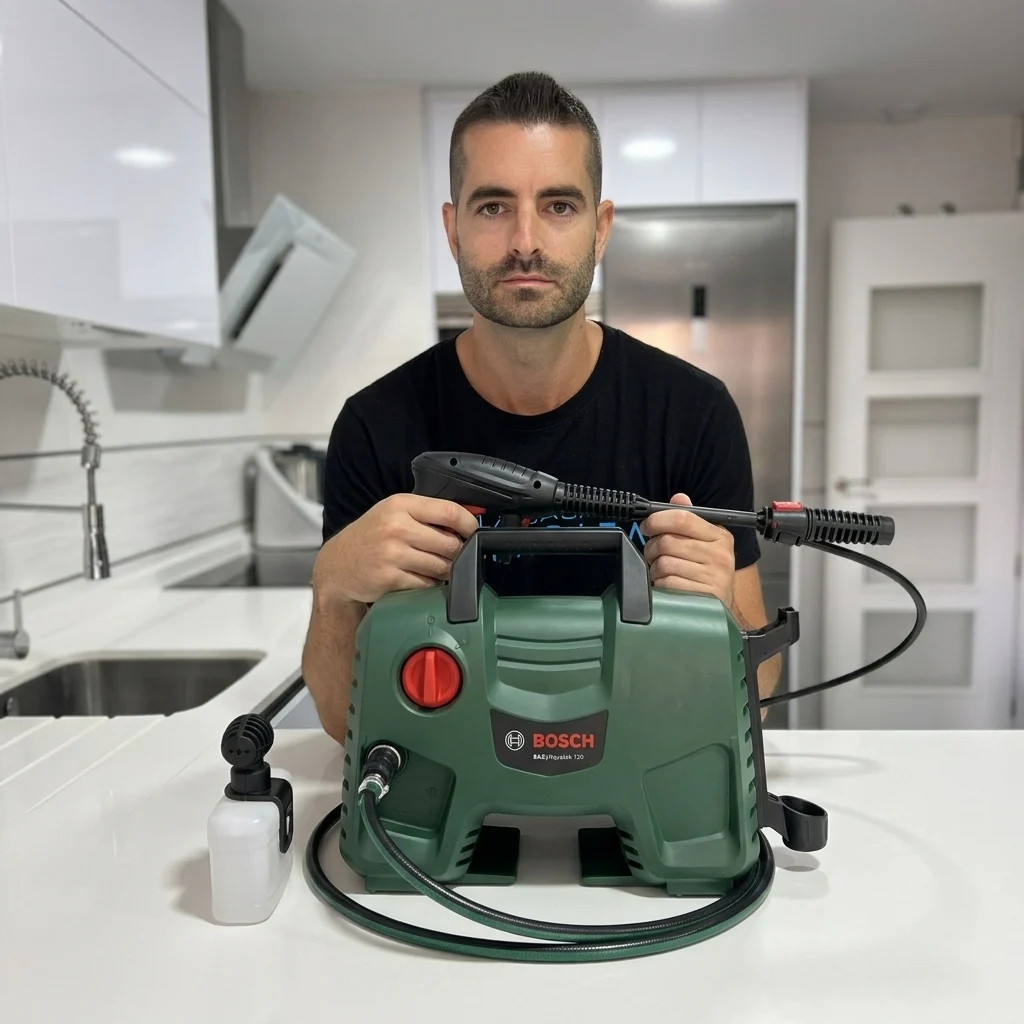
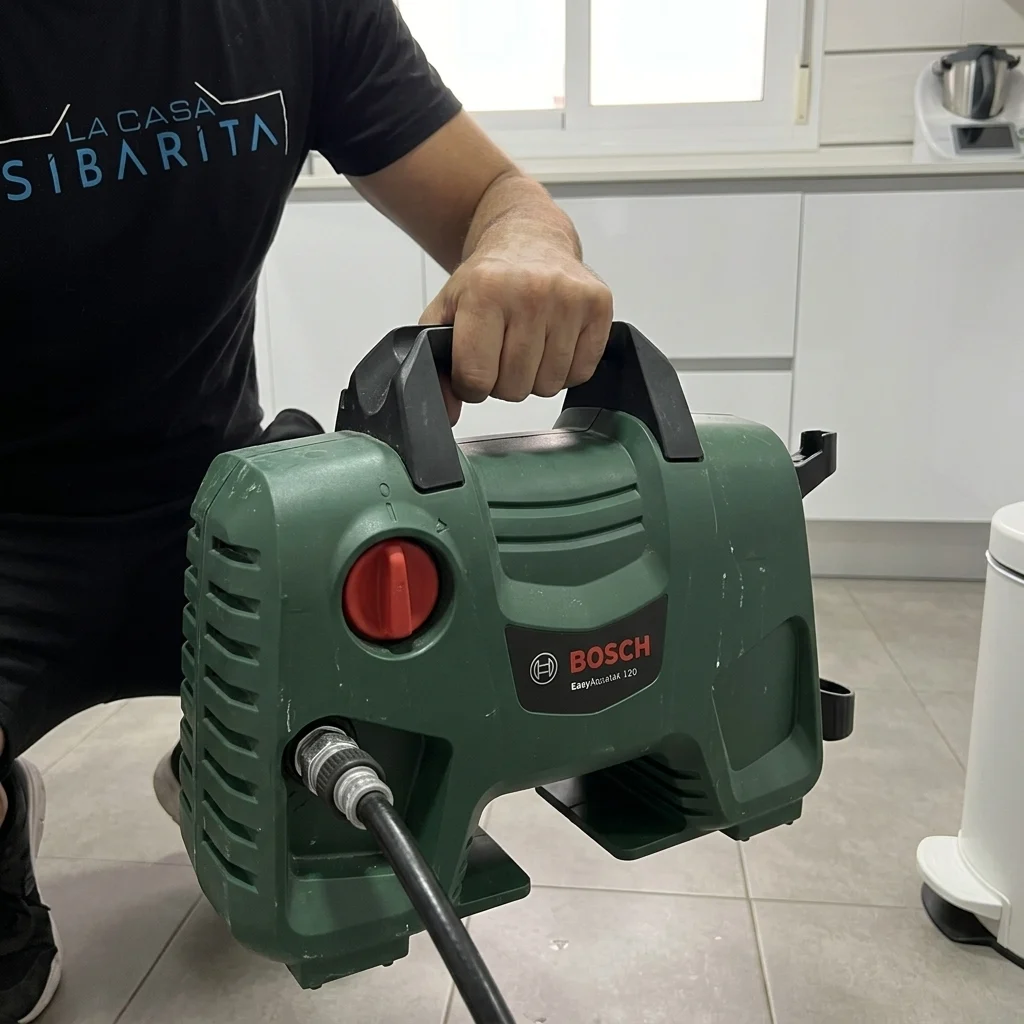
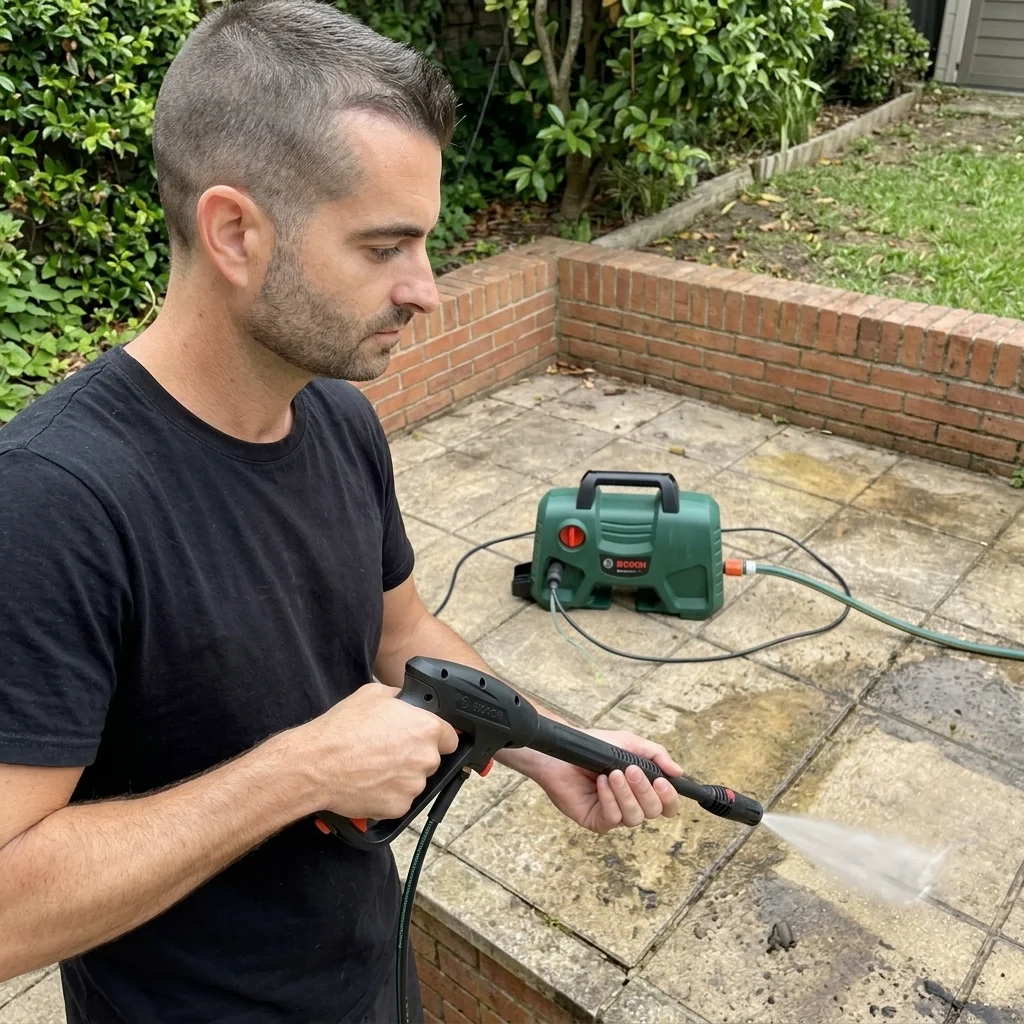
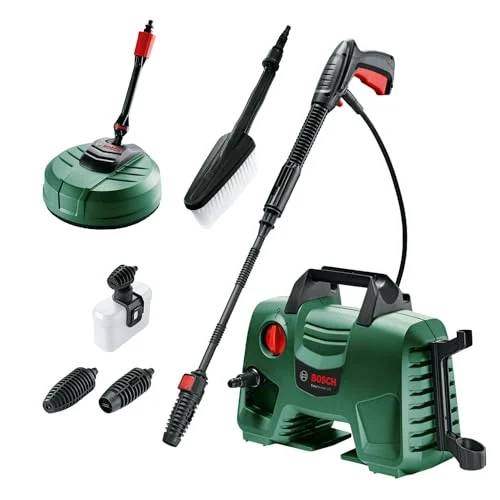

Deals
This page contains affiliate links: if you buy through them we may earn a commission, at no extra cost to you. Prices and availability may change. As an Amazon Associate, La Casa Sibarita earns from qualifying purchases.
Pros
-
Self-priming pump works from a bucket, ideal where there's no outdoor tap.
-
Just 5 kg, easy to store and carry up the stairs.
-
Three push-fit nozzles that click on and off in seconds.
-
Rotary nozzle cleaned stubborn dirt in almost half the time of the fan nozzle.
Cons
-
No wheels, so you lift and move it by hand on long patios.
-
Noisy in continuous use, at 82-85 dB(A) at one metre.
Contents
Technical specifications
| Maximum pressure | 120 bar |
|---|---|
| Weight | 5 kg |
| Power | 1,500 W |
| Maximum flow rate | 320 L/h |
Description
Summary
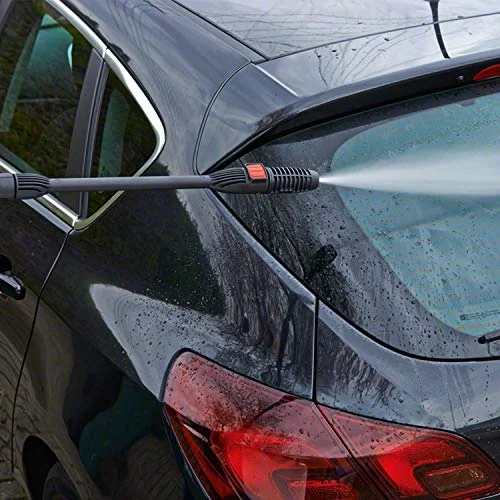
If you live in an upstairs flat, have no outdoor tap on the balcony or only need to tidy up a small patio and wash the car now and then, this pressure washer fits the bill because its self-priming pump lets it draw water from a bucket or tank without being connected to a tap. That’s its trump card and where it really stands out.
It has a 1,500 W motor and claims 120 bar of pressure, although in continuous use we measured a little less. It weighs 5 kg and is very compact, so it fits in any corner and you can carry it with one hand.
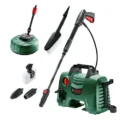
It comes with three nozzles (a rotary nozzle for stubborn dirt, an adjustable fan nozzle and a foam tank for detergent) and a push-fit connection system that clicks on and off in seconds, so you can switch between jobs without wrestling with threads.
What we liked least is that it has no wheels, so on large areas you have to pick it up and move it every few minutes, which gets tiring. It isn’t the most powerful in its class either, so it falls short for several cars or large patios.
For light home use where space is tight, we think it’s a smart buy; if you want a workhorse for big surfaces, look elsewhere. We tested it in Spain; on Amazon.co.uk it’s sold as the 06008A7972 Amazon Exclusive ‘Home and Car Kit’, which according to the listing adds a patio cleaner and a wash brush and comes with a 5 m hose.
Analysis and verdict
Pressure and flow – Score: 7.0/10
On paper it promises 120 bar, but in continuous use we got 100-105 bar, with a flow of around 320 L/h (5.3 L/min), measured with a pressure gauge and stopwatch on a tap supplying around 3 bar. That’s decent force for loose mud, dust and soaping down around the home, although on heavily caked-on dirt or large areas you can tell there’s no power to spare.
The range also includes 100 and 110 bar versions, and this 120 sits at the top. Compared with other basic compacts it belongs to the same light home-use class, so what really sets it apart is the self-priming pump rather than brute force. Note that the UK listing quotes 350 l/h and 100 bar in its feature list.
Accessories – Score: 8.4/10
It comes with three nozzles (a rotary nozzle for stubborn dirt, an adjustable fan nozzle and a foam tank for detergent) with a push-fit connection that goes on and off in seconds, no threads to fight with. In our test on porcelain tiles, the rotary nozzle cleaned the surface in 1 min 50 s compared with 3 min 10 s for the fan nozzle, almost half the time.
The only downside is that the lance connector is hard to fit when cold and you have to push firmly until you hear the click. Once it’s on, switching between nozzles is quick and easy. The UK Amazon Exclusive kit also lists a 250 patio cleaner and a wash brush, which weren’t part of the unit we tested, so we can’t judge them.
Handling – Score: 6.8/10
At 5 kg it’s one of the lightest in its class, it fits in any corner and goes up the stairs without effort. Its self-priming pump widens your working area because you don’t depend on a tap: put the hose in a bucket or tank and you can work just the same, which is very handy on balconies or in upstairs flats. With the 6 m hose and 5 m cable of our unit we had around 9-10 m of reach from the socket; the UK kit lists a 5 m high-pressure hose, so expect slightly less.
What lets the handling down is that it has no wheels: on large areas you have to lift it and reposition it every few minutes, which is tiring. It’s also noisy (82-85 dB(A) at one metre), gives a noticeable jolt on start-up and, after about 25 minutes of continuous use, the pump housing feels warm to the touch.
Build quality and value for money
The finish felt good to us, with solid plastics and a firm build. For guarantee cover, check the manufacturer’s terms; your statutory rights under the Consumer Rights Act 2015 apply in any case. During the first few uses it gives off a slight new-plastic smell as it warms up, which soon disappears.
In terms of value for money, we think it’s fair for what it offers in the compact home range: you’re paying for the flexibility of drawing water from a bucket and for the brand’s backing, not for raw power.
Pros
- Self-priming pump: you can work with water from a bucket or tank without a tap, ideal for balconies and upstairs flats.
- Compact and light (5 kg): it fits in any gap and you can carry it with one hand.
- Push-fit connections and three nozzles (rotary, adjustable fan and foam): you switch jobs in seconds, no threads.
- The rotary nozzle deals with stubborn dirt much better, in almost half the time of the fan nozzle.
Cons
- No wheels: you have to lift and reposition it, which is tiring on long patios or with several cars.
- Real pressure below the rated figure (100-105 bar against 120): it falls short on large surfaces.
- It’s noisy (82-85 dB(A) at one metre), a nuisance early in the morning or with neighbours close by.
- After a while the pump housing gets warm, and on start-up it gives a jolt that moves the casing.
Our test
Test 1: Pressure and flow – dried mud with water from a bucket
What’s special about this Bosch is that its self-priming pump let us run the test without always relying on a tap. We marked a 1 m² strip of patio with dried mud and an area of car with crusty dirt, working with the standard lance at 30 cm and counting the passes needed, and we repeated part of the test drawing water straight from a bucket instead of the tap, to see whether self-priming affects performance. As a reference we always compared against the same area cleaned with a garden hose alone.
With a pressure gauge and stopwatch on a tap supplying around 3 bar, we measured 100-105 bar in continuous use and a flow of 320 L/h (5.3 L/min), below the 120 bar on the spec sheet. Power draw settled at 1,450 W, with a start-up peak of close to 1,700 W that gives the machine a noticeable jolt when you switch it on. That force was enough to lift the dried mud from the patio strip without the extra passes the hose alone needed, but on very stubborn dirt there was no power to spare. We don’t have an exact pass count to publish, and we couldn’t check whether pressure drops further when drawing from a small tank rather than a large bucket.
Test 2: Accessories – nozzles, connection system and foam tank
Our unit didn’t come with a brush, so our accessories test focused on the three standard nozzles (rotary, adjustable fan and foam tank for detergent) and on the push-fit system that connects them to the lance, trying each one on the same 1 m² porcelain tile to see which is genuinely useful and which is surplus. Before timing anything we had to persevere with the lance connector, which is hard to fit when cold until you hear the click.
The rotary nozzle cleaned the tile in 1 min 50 s against the 3 min 10 s the adjustable fan nozzle needed, almost half the time on stubborn dirt, although it vibrates quite a bit in your wrist. The foam tank used around 200 ml in 10 minutes of soaping, a reasonable amount for occasional home use. Once assembled, switching nozzles was quick and thread-free. What we can’t vouch for is how long that push-fit connection lasts after years of use, because our test didn’t run that long.
Test 3: Handling – assembly, reach and packing away without wheels
As this pressure washer has no trolley or wheels, we adapted our ‘does it roll up the stairs’ check to whether its 5 kg can be carried up by hand without effort, which is exactly how you move it. We assembled it from the box, connected the hose and checked whether the 6 m hose plus 5 m cable (around 9-10 m of reach) could get all the way round a car without unplugging.
The reach was more than enough to do the whole car in one go, and thanks to the self-priming pump we could put the hose in a bucket when we tried a balcony with no tap nearby. On start-up the power peak gives a jolt that shifts the machine slightly on smooth floors, so it’s worth holding it, and after about 25 minutes of continuous use the pump housing feels hot to the touch. What really hampers packing away is the lack of wheels: on large areas we ended up lifting and repositioning it every few minutes, something its design can’t avoid. We didn’t check whether it tips over when you pull hard on the lance, because its light weight kept it fairly stable throughout.
If you want to know more about what to look for, take a look at our pressure washer buying guide, where you’ll find the best models we’ve tested and advice on choosing the right one for you.
Contents
Other models we analysed

Real tests · No sponsorships
Marco Blasco
I'm Marco Blasco and I've been testing and comparing home appliances for more than five years. My ratings come from real tests, first-hand experience and objective criteria, explained transparently. Our tests are carried out in Spain. Through detailed guides and comparisons I've helped thousands of people choose with more confidence, and I can do that because I'm completely independent of the brands.