
Oclean Flow Electric Toothbrush

Gallery
Deals
This page contains affiliate links: if you buy through them we may earn a commission, at no extra cost to you. Prices and availability may change. As an Amazon Associate, La Casa Sibarita earns from qualifying purchases.
Pros
-
Up to 180 days of claimed battery life in Morning mode.
-
USB-C charging with any phone charger, with no base to pack.
-
IPX7 rating, so you can use it in the shower and rinse it under the tap.
-
Very clear jump in intensity between Gentle and Night modes.
Cons
-
Residue on the chewing surface of the back molars in all three disclosing-tablet tests.
-
No warning when you press too hard, so you have to control the force yourself.
Contents
Technical specifications
| Cleaning modes | 5 modes (Morning, Evening, Standard clean, Whitening, Gentle) |
|---|---|
| Accessories | USB-C charging cable, user manual |
| Brush heads included | Not specified |
| Brush head movement | Sonic technology |
| App | No |
| Battery life | 180 days |
| Pressure sensor | Not specified |
Description
Summary
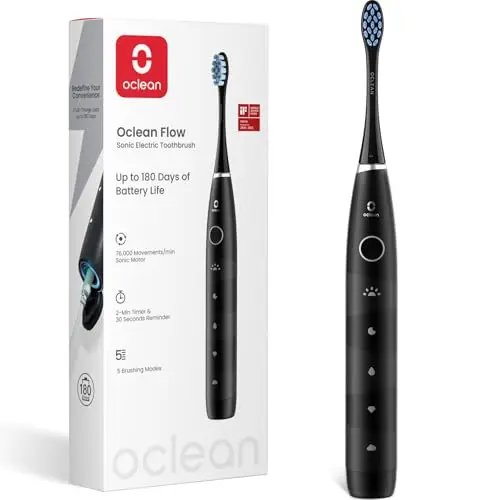
If you’re looking for a simple sonic toothbrush that goes a long time between charges, the Oclean Flow gets straight to the point. There’s no app, no Bluetooth and no screen; instead, it stakes everything on battery life and on doing the basics well.
It has 5 modes (Morning, Night, Standard Clean, Whitening and Gentle), a 2-minute timer with a prompt every 30 seconds to change quadrant, and round-tipped bristles cut in a W shape, designed to work the gaps between teeth.
Battery life is its main selling point. We tested it in Spain, sharing it between two people for three weeks, and it went past 40 brushes without the low-battery warning appearing. It’s the same model sold on Amazon.co.uk, in black.
Its weak point is that it doesn’t help you correct your technique. All the guidance comes down to the timer and the light showing the active mode, and there’s one area of the mouth that needs a second pass, which we explain in the cleaning test.
It suits people moving up from a manual brush or who put battery life above everything else, and much less those who want brushing statistics or alerts while they brush. If you’re torn between this and a model with an app, ask yourself whether you’ll really look at the statistics every week.
Analysis and verdict
Cleaning – Score: 8.3/10
Cleaning relies on a brushless magnetic sonic motor that reaches up to 76,000 movements per minute and on a head with W-cut bristles. That cut focuses the work on the gaps between teeth, exactly where a manual brush usually falls short.
The score reflects what we saw with the disclosing tablet. The visible surfaces and the gaps between the front teeth responded well from the first pass, and we explain what didn’t come out so clean in Test 1.
To keep that result, timing is what matters. Sticking to the timer’s intervals stops you lingering on the front teeth and rushing the back, which is where a sonic brush needs the most patience.
To get the most out of it, follow the quadrant sequence the timer sets and let the vibration work without scrubbing, with the head angled towards the gum. If you’re coming from a manual brush, the most common mistake is to keep pressing hard as before; with a sonic brush you just rest the head and move tooth by tooth. Move the head slowly along the gumline and don’t forget the inner surfaces of your teeth.
Battery life – Score: 9.4/10
This is the criterion that holds up the score and the one that matters most if you travel often. Oclean claims up to 180 days per charge from a 2,500 mAh battery, a figure calculated in Morning mode, which has a medium intensity. If you use Night, Standard Clean or Whitening every day, which vibrate more strongly, it will last less.
Our test didn’t run it flat, so we don’t give our own figure for days per charge or full charging time. The score combines the claimed battery life with what we did see over three weeks of shared use, which we describe in Test 2.
It charges by cable, with no base of its own, and when the battery is low the indicator flashes red. There’s no need to leave it plugged in or give it a permanent spot in the bathroom, so you can keep it in a drawer or wash bag and charge it only when needed.
To score this criterion we look at how many days it lasts with two two-minute brushes a day, how long a full charge takes and whether you can go away without a charger. They’re the three questions you’ll ask yourself once it’s at home, and when we’ve pinned down the two missing figures we’ll update this review.
Pressure sensor and modes – Score: 7.8/10
This model doesn’t claim a pressure sensor, so if you brush hard out of habit you’ll have to keep it in check yourself. There’s no need to press for a better clean either, because on a sonic brush it’s the vibration that does the work. A simple trick is to hold the handle with your fingertips rather than in a clenched fist, because that makes it harder to overdo it.
The modes range from Gentle, the lowest and designed for sensitive gums, to Night, the most intense. In between sit Morning, with a medium intensity, and Standard Clean and Whitening, one step below Night. A light on the handle tells you which one you’re in. To start with, try Standard Clean for a week and adjust from there, dropping to Gentle if your gums feel irritated.
What costs it marks is the lack of tracking. It doesn’t connect to the brand’s app and has no Bluetooth, and the only guidance is the timer with its quadrant pause. For people who want simplicity that’s enough, but it won’t warn you about anything else.
Design and what’s in the box
The handle has a black finish and an IPX7 rating, so you can rinse it under the tap or use it in the shower. Because it doesn’t rely on a charging base, it takes up very little space by the basin and fits in any wash bag. With no screen or app, there’s nothing to learn before your first brush either.
The box for the basic model includes the brush, the manual, the head and the charging cable, but it doesn’t say how many heads it comes with. If you’ll be sharing the handle or want spares from the start, check the pack before you buy, because there are versions with more heads and a travel case.
After each use, rinse the head under the tap, shake off the water and leave it to dry upright, without the cap. If you share the handle with someone else, each of you needs your own head, so store them separately or mark them so you don’t mix them up.
Change the head when the bristles start to splay or every three months, whichever comes first. With worn bristles the brush vibrates just the same, but it reaches the gaps between teeth less well, which is exactly where this head works best. Note the date you changed it or check the bristles every few weeks so you don’t overrun.
Who we recommend it for and how to use it
The Flow suits two kinds of people in particular. The first is anyone moving from a manual brush who wants something that doesn’t complicate their routine, with no app to set up and no base to plug in. The second is anyone who travels often or forgets to charge things, because the battery takes that worry off their hands.
Where it falls short is with people who need the brush to help them correct their technique. If your dentist has told you that you press too hard or miss areas, look in our guide for a model with more help while you brush. Nor is it the best choice if you like to see how your brushing improves week by week.
For the first few weeks, always brush the quadrants in the same order and use the timer’s pause to move to the next zone. Once that order becomes automatic, the two minutes will take care of themselves, shared evenly across your whole mouth, including the back, which is the part people most often neglect.
Pros
- Up to 180 days of claimed battery life in Morning mode, enough to forget about the cable for months.
- USB-C charging with any phone charger, with no base of its own to pack.
- IPX7 rating, so you can use it in the shower and rinse it under the tap.
- Very clear jump in intensity between Gentle and Night, with room to start gently if your gums are delicate.
Cons
- Residue on the chewing surface of the back molars on all three days of the disclosing-tablet test, so that area needs a second pass.
- No warning when you press hard, neither a sound nor a vibration, so you have to control the force yourself.
Our test
Test 1: Cleaning – three days with a disclosing tablet
We applied a plaque-disclosing tablet before brushing and brushed for two minutes in Standard Clean mode, following the quadrant sequence set out in the manual (upper right, upper left, lower right, lower left). We repeated the test on three consecutive days with the same user. The tablet stains plaque, so anything still coloured after brushing is what the brush hasn’t removed.
The staining dropped on the outer surfaces and between the front teeth from the first pass, and residue remained on the chewing surface of the back molars on all three days. If you have a small mouth, spend a few extra seconds on those molars and hold the head still on each one for a moment before moving on. On the part that shows most when you smile, on the other hand, there’s no need to linger.
Test 2: Battery life – three weeks with two users
We did two two-minute brushes a day in Morning mode for three weeks, with two users taking turns with the handle, and checked the indicator every day in case the red low-battery warning appeared. We also checked that the USB-C port accepts the phone chargers we had at home.
After more than 40 brushes, the low-battery warning still hadn’t appeared. We didn’t run it flat, so we don’t give our own figure for days per charge or full charging time. If you travel, you can leave the cable at home on trips of several weeks, although in intense modes such as Night it will use more power. And if you share it as we did, bear in mind that the battery is split between the two of you.
Test 3: Pressure sensor and modes – every mode against a fingertip
We went through every mode with the head resting on a fingertip and then in the mouth, pressing hard on purpose to see whether any over-pressure warning came on. We also compared the intensity between modes and checked whether the quadrant pause can be felt without looking.
Pressing hard triggers no warning, neither a sound nor a vibration, which is consistent with no pressure sensor being claimed. The jump in intensity between Gentle and Night is very clear, and the quadrant pause can be felt, enough to change zone without counting. If your gums are delicate, start with Gentle and move up a mode as you get used to it. With healthy gums, Standard Clean is the mode designed for everyday use.
If you’d like to know more about what to look for, take a look at our guide to the best electric toothbrushes, where you’ll find the best models we’ve reviewed and help choosing the right one for you.
Contents
Other models we analysed

Real tests · No sponsorships
Marco Blasco
I'm Marco Blasco and I've been testing and comparing home appliances for more than five years. My ratings come from real tests, first-hand experience and objective criteria, explained transparently. Our tests are carried out in Spain. Through detailed guides and comparisons I've helped thousands of people choose with more confidence, and I can do that because I'm completely independent of the brands.