
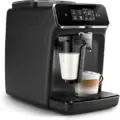
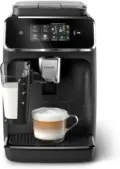
Philips 2300 Series LatteGo Bean to Cup Coffee Machine

Gallery
Deals
This page contains affiliate links: if you buy through them we may earn a commission, at no extra cost to you. Prices and availability may change. As an Amazon Associate, La Casa Sibarita earns from qualifying purchases.
Pros
-
12-step ceramic grinder: a dose in about six seconds, no whole pieces
-
Cappuccino in 1 minute 27 seconds from switched off
-
Five espressos in a row between 35.7 and 36.9 seconds
-
Front-loading 1.8-litre tank good for 31 espressos
Cons
-
Mild espresso on medium strength and only three levels to correct it
-
Grounds drawer full at coffee 12 and hopper empty at 28, before the water
Contents
Technical specifications
| Material | Plastic |
|---|---|
| Milk frother | Yes |
| User profiles | No |
| Removable brew group | Yes |
| Coffee grinder | Yes |
| 2 coffees at once | Yes |
| Coffee types | Beans + ground |
| Water tank capacity | 1.8 L |
| Cup warmer | No |
| Type | Bean-to-cup |
| Pressure | 15 bar |
Description
Summary
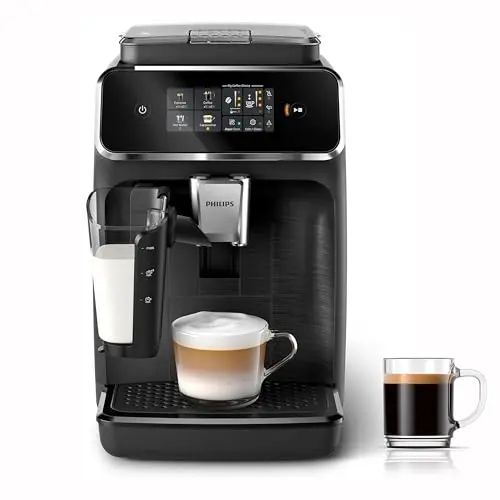
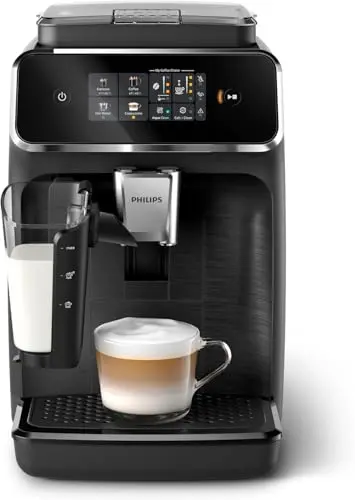
If you want to switch to fresh beans with one-touch cappuccino and you won’t use a long list of recipes, the Philips 2300 Series LatteGo gets the basics right. It makes four drinks, espresso, coffee, cappuccino and hot water, from a touchscreen where each one has its own icon.
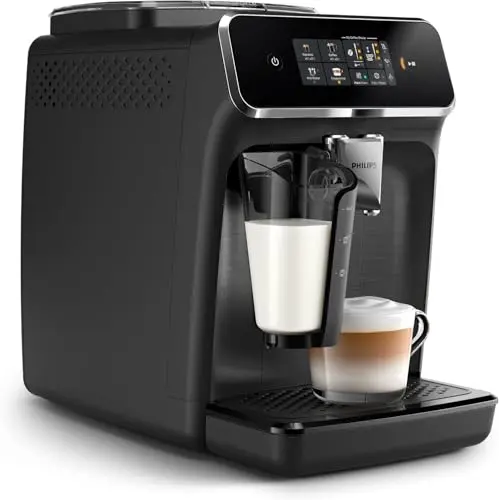
Where it doesn’t cut corners is the mechanics. It has a 12-step ceramic grinder, a 1.8-litre tank that comes out from the front and a two-part milk carafe with no tubes, which we rinsed under the tap in 10 seconds.
In our tests it made five espressos in a row between 35.7 and 36.9 seconds, with crema and temperature very even from the first cup to the fifth. The coffee is consistent and pleasant, although mild on the medium strength setting.
The grinder works quickly and cleanly, with the dose ready in about six seconds. You’ll hear it, at around 65 dB(A) at one metre, but only very briefly.
Where you’ll notice its limits most is maintenance. The grounds drawer filled up at coffee 12 and the hopper ran out of beans at 28, both before the water, which lasted 31 espressos.
We tested the 2300 Series LatteGo in Spain as the EP2330/10. On Amazon.co.uk it’s sold as the EP2339/40, a different reference and finish within the same 2300 Series LatteGo range. The listing describes the same four drinks, LatteGo milk system and 12-step ceramic grinder, so our results apply to it, although details such as the colour won’t necessarily match the unit we tested.
Analysis and verdict
Coffee quality – Score: 7.8/10
We made the five espressos with the grind on position 4 and strength on the middle of its three levels. The extractions ranged from 35.7 to 36.9 seconds and the weight in the cup went from 39.3 to 39.8 grams, half a gram of difference. For a machine that decides the dose and time by itself, that’s a consistency that inspires confidence from day one.
The first crema was a medium-to-light hazelnut, 3 or 4 millimetres thick, with fine bubbles and the odd larger one. The fifth was more even and slightly darker. In both cases it’s a light crema, the kind that settles into a thin layer when you stir. The temperature was 66.1 °C for the first and 67.6 °C for the fifth, fine for drinking straight away but borderline if the coffee is going to sit on the table.
The reservation is strength. On the medium setting the espresso is mild and, as there are only three levels, all you can do is turn it up to maximum or grind a couple of steps finer. If you nearly always take your coffee with milk, it won’t bother you. If you love a short, concentrated espresso, it will leave you wanting more.
Grinder – Score: 8.3/10
The burrs are ceramic and the selector has 12 positions. We tried 2, 6 and 10. At the fine setting the grind was fairly even, with no whole pieces and a small amount of dust. At medium the particles were uniform with little loose dust. At coarse the particles were larger and somewhat irregular, with a few big fragments, but no unground beans.
Grinding a dose took between 5.8 and 6.0 seconds, and the noise readings were between 65.0 and 65.5 dB(A) at one metre, with a background level of 31.8 dB(A) in the kitchen. It’s a noise you notice while it lasts, but it’s over quickly.
The doses weighed between 9.7 and 9.8 grams at all three settings, so changing the grind doesn’t alter the amount of coffee. Afterwards a small amount of coffee remained at the chute outlet, without building up. It loses points for the noise and a coarse setting that’s less regular than the other two, although that’s not the one you use for espresso anyway.
Capacity – Score: 8.0/10
With the 1.8-litre tank full, we counted 31 espressos of 40 ml before it asked for water, including the automatic rinse it does at switch-on. Some of the water goes on those rinses, which is why the count falls short of what the tank would give if it were all shared out into cups. At four coffees a day, it lasts the best part of a week.
The tank comes out from the front, on the right-hand side, without moving the machine. The warning came before the next coffee started and didn’t cut any short, although by then there wasn’t enough water left for a full cup.
Two other things run out before the water. The grounds drawer asked to be emptied at coffee 12 and the 275 g hopper ran out of beans at 28, a figure that matches the almost 10 grams per coffee we weighed at the grinder. For every tank, expect to empty the grounds twice and refill the beans once.
Drinks, milk and cleaning
The cappuccino was served in 1 minute 27 seconds from switched off, and reached the cup at 61.8 °C. The froth is plentiful and airy. It works well in a breakfast cappuccino but isn’t the fine, dense microfoam of a coffee shop.
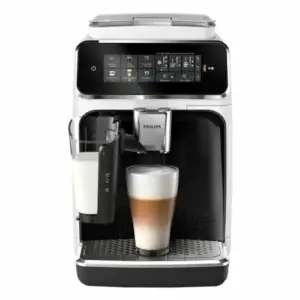
The milk carafe holds 0.26 litres and has two parts with no tubes, which can also go in the dishwasher. The menu is short, with fewer drinks than the Philips 3300 Series, which adds latte macchiato and iced coffee. It doesn’t save user profiles, so each person adjusts the strength when making their coffee. It can, however, make two cups at once.
The brewing unit is removable and can be cleaned away from the machine. As well as beans, it takes pre-ground coffee, useful for the occasional decaf. There’s no cup-warming tray, so it’s worth warming the cup with hot water before an espresso, as we did in our tests.
On the worktop it measures 37.1 cm high, 24.6 cm wide and 43.3 cm deep and weighs about 8 kg. It’s narrow but needs depth, so measure the space before you decide. The body is plastic.
Who we recommend it for
It will suit you if what you drink every morning is black coffee, white coffee or a cappuccino and you want the machine to do the work without menus to learn. In a household of one or two, the tank and hopper last several days and cleaning the milk system is just a rinse.
It’s not the machine for you if everyone at home wants a different recipe or if you want to save your settings, because the menu is short and there’s no per-person memory. Nor is it right if you want to fine-tune your espresso, since the machine decides the dose and extraction and the strength setting has little range.
Pros
- A 12-step ceramic grinder that grinds a dose in 5.8 to 6.0 seconds, with no whole pieces at any of the three settings we tried. The coffee is ground fresh and barely adds to the wait.
- A cappuccino in 1 minute 27 seconds from switched off, with a two-part milk carafe we rinsed in 10 seconds. You can have one every day with no cleaning hanging over you.
- Five espressos in a row between 35.7 and 36.9 seconds, with half a gram of difference in the cup. The fifth cup comes out like the first.
- A 1.8-litre tank that comes out from the front and gave 31 espressos of 40 ml. It refills without moving the machine.
Cons
- Mild espresso on the medium strength setting and only three levels to correct it. If you want it short and concentrated, you’ll have to turn it up to maximum and grind finer.
- The grounds drawer filled up at coffee 12 and the hopper ran out at 28, before the 31 from the water tank. For every tank you empty the grounds twice and refill the beans once.
Our test
Test 1: Coffee quality – five espressos in a row with the same beans
We made five 40 ml espressos in a row with a medium-roast arabica and filtered water, with the grind on position 4 of 12 and strength on level 2 of 3, changing nothing in between. We timed each extraction from pressing the button until the coffee stopped dripping, compared the crema of the first with the fifth and measured the temperature of both with a probe thermometer, five seconds after finishing and in a preheated porcelain cup.
The times were 36.9, 36.1, 35.8, 35.9 and 35.7 seconds, with 39.3 grams in the first cup and 39.8 in the fifth. The fifth crema was more even and slightly darker than the first, at about 4 millimetres, and the temperature went from 66.1 to 67.6 °C. For you, that means the coffee comes out the same even if you make several in a row, for example when you have visitors. If you want more body, start by turning up the strength, which we left on the middle setting.
Test 2: Grinder – fine, medium and coarse grinds on white paper
We ground one dose at position 2, another at 6 and another at 10, and checked a sample of each on white paper for unground pieces and loose dust. We weighed the beans before and after each grind, timed three doses, took noise readings one metre from the front at grinder height and checked the chute when we’d finished. The doses weighed 9.7, 9.8 and 9.7 grams, the times were 6.0, 5.8 and 5.9 seconds and the noise readings 65.0, 65.3 and 65.5 dB(A). There were no whole pieces at any setting; the fine one left some dust and the coarse one a few large fragments.
For you, that means you can move between the fine and medium settings without worrying about a messy grind, and grinding barely adds seconds to each coffee. You’ll hear it, but only for as long as the dose takes. Very little coffee stayed in the chute, just a small amount at the outlet, so almost everything that reaches the cup is freshly ground.
Test 3: Capacity – a full tank until the warning, counting 40 ml espressos
We filled the tank and hopper to the maximum and made 40 ml espressos, always the same reference cup, until the machine asked for water. We noted at which coffee the beans ran out, when it asked for the grounds drawer to be emptied, whether the tank comes out and refills without moving the machine and how much warning it gives.
It gave 31 espressos, counting one automatic rinse at the start. The grounds drawer asked to be emptied at coffee 12 and the hopper ran out at 28. The tank comes out from the front, and the warning arrived before the next coffee started, when there was some water left but not a full cup. For you, that means water isn’t what you’ll be topping up most, it’s the grounds you’ll be emptying. With long coffees or milky drinks the figure will be lower, because they use more water per cup, and we didn’t count that.
If you’d like to know more about what to look for, have a look at our guide to the best bean to cup coffee machines, where you’ll find the best models we’ve tested and help choosing the right one for you.
Contents
Other models we analysed

Real tests · No sponsorships
Marco Blasco
I'm Marco Blasco and I've been testing and comparing home appliances for more than five years. My ratings come from real tests, first-hand experience and objective criteria, explained transparently. Our tests are carried out in Spain. Through detailed guides and comparisons I've helped thousands of people choose with more confidence, and I can do that because I'm completely independent of the brands.