
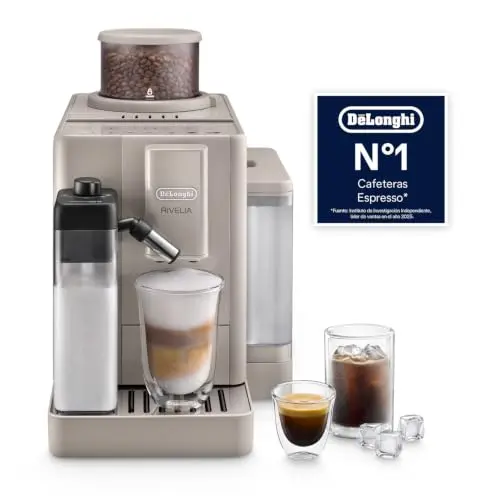
De’Longhi Rivelia Start EXAM422.55.BG Bean to Cup Coffee Machine

Gallery
Deals
This page contains affiliate links: if you buy through them we may earn a commission, at no extra cost to you. Prices and availability may change. As an Amazon Associate, La Casa Sibarita earns from qualifying purchases.
Pros
-
Five espressos in a row between 30.6 and 31.8 seconds
-
Fast, quiet grinder: 5.6 to 6.1 seconds per dose, 56.8 dB at most
-
Two 250 g bean hoppers that swap in 30 to 35 seconds
-
Full cappuccino in 1 minute 32 seconds from switched off
Cons
-
1.4-litre tank and a grounds drawer that warns after 10 coffees
-
13-position grind selector numbered only from 1 to 7
Contents
Technical specifications
| Material | Plastic with metal details |
|---|---|
| Milk frother | Yes |
| User profiles | No |
| Removable brew group | Yes |
| Coffee grinder | Yes |
| 2 coffees at once | Yes |
| Coffee types | Beans and ground |
| Water tank capacity | 1.4 L |
| Cup warmer | No |
| Type | Bean-to-cup |
| Pressure | 15 bar |
Description
Summary
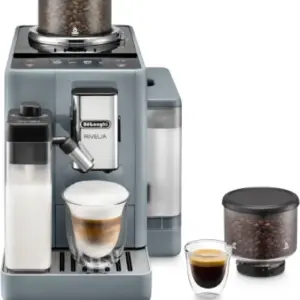
Two different coffees in the same machine, your everyday beans and an afternoon decaf, without emptying anything by hand. That’s the idea behind the De’Longhi Rivelia Start EXAM422.55.BG, a slim bean to cup machine with two interchangeable bean hoppers that lets you switch from one to the other whenever you like.
What impressed us most in testing was its consistency. Five espressos in a row came out almost identical in timing, and the fifth reached the cup slightly hotter than the first, with a fine, even crema from start to finish.
The grinder keeps pace. It grinds a dose in a moment and is quieter than we expected from a bean machine, so your first coffee of the morning won’t wake the whole house.
It makes ten one-touch drinks, three of them cold, and the automatic milk carafe handles cappuccinos without you having to froth anything. It works at 15 bar with 1,450 W and takes up just 24.5 cm of width on the worktop, which isn’t much for everything it packs in.
In return, it needs attention. The water tank is small and the grounds drawer asks to be emptied early, so in a busy household you’ll be refilling and emptying often. If there are two of you and you like switching beans, it’s a great fit. If you want a machine that runs for ages between refills or lets you control extraction by hand, you’d be better off with a different type of machine.
We tested the Rivelia Start in Spain. On Amazon.co.uk it’s sold in the same beige finish under a different product code (ASIN); the listing gives EXAM422.55.BG, the reference we tested, although its title also mentions EXAM420.55.BG, so check the reference on the listing before you buy.
Analysis and verdict
Coffee quality – Score: 8.8/10
We made five 40 ml espressos back to back with the same settings and the machine barely wavered. There were 1.2 seconds between the fastest and slowest extraction, with an average of 31, and on a bean to cup machine that means your after-lunch coffee will taste the same as your breakfast one without touching any settings.
Temperature rose slightly through the run. The first espresso reached the cup at 68.4 °C and the fifth at 70.1 °C, hot enough to drink straight away with some margin if you add a splash of milk. The crema was hazelnut in colour, about 4 mm thick with small bubbles, and by the fifth cup it was just as fine, even a shade darker.
To tailor the coffee to your taste you have three strength levels and three temperatures, plus the grind. It isn’t the range of a high-end machine, but it’s enough to adapt the cup to a lighter or darker roast without any fuss. What you won’t find is fine manual control over extraction, which is why it doesn’t score higher here.
Grinder – Score: 8.6/10
This is one of its best features. An espresso dose is ground in between 5.6 and 6.1 seconds, and with readings taken at one metre the noise stayed between 55.7 and 56.8 dB. It’s a short, restrained sound that won’t stop a conversation in the kitchen while the coffee’s being made.
We checked the grind on white paper at three settings. At 2, the fine setting, it came out even with no pieces of bean and a little loose dust. At 4 the particles were regular with hardly any dust, and at 6 they were larger and clearly separate, with the odd irregular fragment but no whole beans. A thin film of ground coffee and a few loose particles were left in the chute, with no build-up.
The weak point is the selector. It has 13 positions, but the visible numbering only runs from 1 to 7 and the steps in between aren’t marked, so at first it’s hard to tell which one you’re on. Once you get the hang of it, it stops being a problem, but it’s what costs it a few tenths here.
Capacity – Score: 7.8/10
With everything filled to the maximum, we kept making 40 ml espressos until the machine started asking for things. The grounds drawer warned at coffee 10, the water tank at 25 and the beans ran out at 27. Water and beans are fairly well matched, but the drawer interrupts you twice before you need to refill anything.
For a couple having four or five coffees a day, that means emptying the grounds every two days and topping up water and beans roughly every five or six. As soon as more people or milky drinks are involved, the numbers shrink and the machine asks for attention almost every day.
The 1.4-litre tank comes out from the right-hand side, tilting slightly outwards, and refills without moving the machine. It needs no clearance above, so it can sit under a wall cupboard, but it’s worth leaving 8 to 10 cm free on the right. The water warning comes in good time, because it blocks the next drink and asks for a refill rather than leaving you with half a coffee.
Two types of beans in one machine
The two bean hoppers are what this model is all about. Each holds 250 g, and swapping one for the other took us between 30 and 35 seconds, including a function that empties the grinder before the change so the two coffees don’t mix.
With a fixed hopper, switching coffees means using it all up or emptying it by hand. Here, the cup after the change contained at most a tiny amount of the previous coffee. If one of you drinks regular and the other decaf, or you like one bean for espresso and another for milky drinks, this is the feature that justifies choosing it over a single-hopper bean to cup machine.
Milk, drinks and cleaning
The automatic milk carafe makes cappuccino, flat white, latte macchiato and hot milk at the touch of a button. A full cappuccino, from completely switched off to the served cup, was ready in 1 minute 32 seconds. After each use there’s an automatic rinse you start with one touch, and taking the carafe apart and washing it under the tap took us 52 seconds.
The menu is rounded off by espresso, coffee, a filter-style coffee and three cold drinks, including a cold brew. It also dispenses hot water for tea. For cold milk drinks you need a second carafe, sold separately. Measured with a tape, it stands 38.5 cm high, 24.5 cm wide and 43 cm deep. It weighs 9.4 kg and has dishwasher-safe parts, which makes the weekly clean easier.
The body is plastic with metal details and the brewing unit comes out for cleaning. As well as beans, it takes pre-ground coffee through a separate chute. It makes two coffees at once, handy when you have breakfast together. It doesn’t save user profiles or have a cup-warming tray, so everyone adjusts their drink as they go.
Pros
- Five espressos in a row between 30.6 and 31.8 seconds, with the fifth cup slightly hotter than the first. The coffee tastes the same in the morning as after lunch, with no tweaking.
- A dose ground in 5.6 to 6.1 seconds and a maximum of 56.8 dB at one metre. The grinder is fast and quiet and leaves the chute almost clean.
- Two 250 g bean hoppers that swap in 30 to 35 seconds, with the grinder emptied before the change. You can alternate regular and decaf without mixing them or wasting cups.
- A full cappuccino in 1 minute 32 seconds from switched off. The milk carafe comes apart and washes under the tap in 52 seconds.
Cons
- A 1.4-litre water tank and a grounds drawer that warns after 10 coffees. With several people at home or milky drinks, you’ll be refilling and emptying often.
- A grind selector with 13 positions but numbered only from 1 to 7. The steps in between aren’t marked, and at first it’s hard to know where you are.
Our test
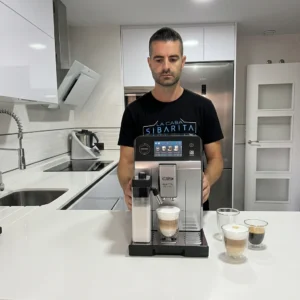
Test 1: Coffee quality – five espressos in a row with the same beans
We made five 40 ml espressos in a row with medium-roast beans, the grind at position 3.5 and strength and temperature on the highest of their three levels, without touching anything in between. We timed each extraction from pressing the button until the coffee stopped dripping, compared the crema of the first with the fifth and measured the temperature of both in the cup. The extractions took 31.8, 30.9, 30.7, 30.8 and 30.6 seconds, and the cup went from 68.4 °C for the first to 70.1 °C for the fifth.
Only the first coffee is a second slower, and from the second onwards the differences are just tenths. The first crema was a medium hazelnut, about 4 mm thick with small, fairly even bubbles. The fifth came out slightly darker, 4 to 5 mm, fine and uniform, with no large bubbles. For you, that means you can serve several coffees in a row and the last won’t be worse than the first. What we can’t tell you is how it behaves beyond five cups, because the test stopped there.
Test 2: Grinder – fine, medium and coarse grinds on white paper
We ground at positions 2, 4 and 6 and checked each result on white paper for unground pieces and loose dust. We then timed the grinding of one dose three times, took noise readings at one metre and looked for residue in the chute. The dose took 6.1, 5.8 and 5.6 seconds and the readings were 56.8, 56.2 and 55.7 dB. In the chute we found a thin film of coffee and a few loose particles.
The fine setting left no pieces of bean and only a little dust, the medium was regular and the coarse kept clearly separate particles with no whole beans, so all three are usable. For espresso, a point between 3 and 4 worked for us. The noise lasts as long as the grinding, a few seconds per coffee, and the low retention in the chute helps when you alternate two types of beans, because almost none of the previous coffee reaches the next cup.
Test 3: Capacity – everything filled to the maximum, counting 40 ml espressos
We filled the water tank and bean hopper to the maximum and made 40 ml espressos, the reference cup we use to compare how far machines go between refills. We noted at which coffee each warning appeared and checked whether the tank comes out and refills without moving the machine. The grounds warning came at coffee 10, the water at 25 and the beans at 27.
The grounds drawer is the first thing you’ll notice, because it needs emptying twice before the water runs out. The tank comes out from the right-hand side with a slight tilt, and there’s no need to move the machine as long as it has a few centimetres free on that side. The water warning blocks the next drink and asks for a refill. We can’t tell you how much the count drops with milky drinks, because we only counted espressos.
If you’d like to know more about what to look for, have a look at our guide to the best bean to cup coffee machines, where you’ll find the best models we’ve tested and help choosing the right one for you.
Contents
Other models we analysed

Real tests · No sponsorships
Marco Blasco
I'm Marco Blasco and I've been testing and comparing home appliances for more than five years. My ratings come from real tests, first-hand experience and objective criteria, explained transparently. Our tests are carried out in Spain. Through detailed guides and comparisons I've helped thousands of people choose with more confidence, and I can do that because I'm completely independent of the brands.