
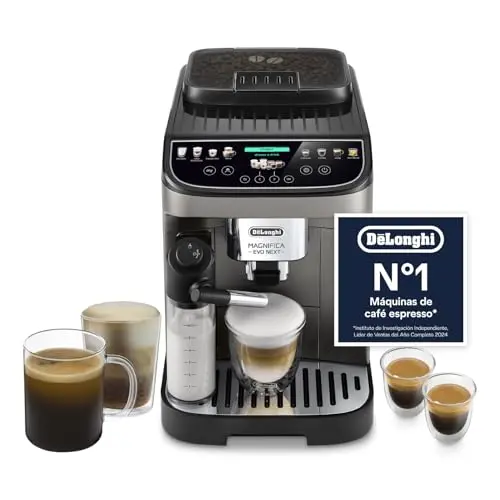
De’Longhi Magnifica Evo Next ECAM312.80.TB Bean to Cup Coffee Machine

Gallery
Deals
This page contains affiliate links: if you buy through them we may earn a commission, at no extra cost to you. Prices and availability may change. As an Amazon Associate, La Casa Sibarita earns from qualifying purchases.
Pros
-
Consistent 44-second extraction across five espressos in a row
-
Three profiles that save size, strength and temperature
-
Full cappuccino in 1 minute 51 seconds from switched off
-
Front-loading tank you can refill without moving the machine
Cons
-
25 espressos from a full tank and hopper, short for more than two people
-
70 dB while grinding, some retention in the chute and a powdery finest setting
Contents
Technical specifications
| Material | Not specified |
|---|---|
| Milk frother | Yes |
| User profiles | Yes |
| Removable brew group | Yes |
| Coffee grinder | Yes |
| 2 coffees at once | Not specified |
| Coffee types | Beans + ground |
| Water tank capacity | 1.8 L |
| Cup warmer | Not specified |
| Type | Bean-to-cup |
| Pressure | 15 bar |
Description
Summary
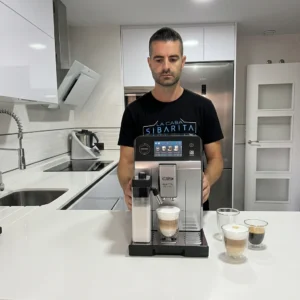
This is the bean to cup machine we’d recommend if you want an espresso with character without stepping up to the premium end of the market. The De’Longhi Magnifica Evo Next ECAM312.80.TB makes a fuller-bodied coffee than most automatic machines in its class, and it does so with a consistency we checked by making cup after cup.
In our tests, five espressos in a row took 44 seconds each, apart from the first at 50 while the circuit finished warming up. The crema was thin but even, hazelnut in colour, and in the cup we measured 68 °C, plenty hot for coffee at home, although below the range of a professional café machine.
Its other strength is how much you can adjust. Between thirteen grind settings, several strength levels and three temperatures, there’s room to fix a cup without changing beans, and adjustable temperature rarely turns up below the top-of-the-range models. The three user profiles save all three settings.
It makes 13 drinks with an automatic milk jug, and a full cappuccino from completely switched off was served in 1 minute 51 seconds. It works at 15 bar with 1,450 W, a 1.8-litre tank and a 250 g hopper, and takes pre-ground coffee through a separate compartment.
Where you notice it isn’t a premium machine is in how long it runs between refills. With the tank and hopper full we got 25 espressos, a reasonable figure for a couple but short once the house fills up, and well below what premium machines with large hoppers manage.
We tested the Magnifica Evo Next in Spain. On Amazon.co.uk it’s listed under a different product code (ASIN) from the Spanish one, but with the same ECAM312.80.TB reference in Titanium, so it’s the same machine.
Analysis and verdict
Coffee quality – Score: 8.5/10
Consistency is the first thing you notice. Running five espressos back to back with the same settings, the last four took exactly 44 seconds and only the first stretched to 50, which is how long the circuit needs to settle from cold. That steadiness is what separates a serious bean to cup machine from an entry-level one, where the cup swings between watery and bitter without you touching anything.
In the cup it leans towards Italian espresso, with more character and body than the average home automatic, and a thin but even hazelnut crema that survives the first stir of the spoon. The 68 °C we measured is plenty hot for drinking straight away and higher than many basic automatics, but it doesn’t reach café territory, so if you leave it to stand it cools sooner than you’d like.
The range of adjustment helps a lot, with thirteen grind settings, four strength levels on the unit we tested (the Amazon.co.uk listing quotes five) and three temperatures, and adjustable temperature is the one you almost never find at this price. That said, the machine doesn’t take kindly to extremes, so it’s best to adjust one setting at a time rather than going straight to the maximum.
Grinder – Score: 8.1/10
The grinder has thirteen settings, and we tried the finest, a medium one and the coarsest, checking each result on white paper. At the finest the grind is quite powdery, at medium it has an even texture that suits espresso and at the coarsest the particles are visible but regular.
A dose took 9 seconds to grind, the noise reading was 70 dB at 1 metre and a little coffee stayed behind in the chute afterwards. You can clearly hear it, but only for those few seconds of grinding per coffee. The retention is worth bearing in mind if you switch between different beans, because some of the previous coffee can stay in the chute.
For espresso, the middle settings suit it best. Don’t push it to the finest setting, which combined with a high dose can even clog the machine. We took points off for that very powdery fine end, the retention in the chute and because it has less useful range than the grinders on more expensive machines.
Capacity – Score: 8.0/10
The numbers here add up better than we expected. With the 1.8-litre tank and the 250 g hopper filled to the maximum we got 25 espressos of 40 ml, and what’s interesting is that water and beans run out at practically the same time, because each coffee uses around 10 grams of beans and about 75 ml of water including rinses. Neither one is left over while the other runs short.
Those 25 coffees are comfortable for a couple having two or three cups a day, the best part of a week without touching anything. As soon as three or four people are involved, or milky drinks come into play, the count drops quickly and the hopper becomes a frequent stop. Premium machines with 500 g hoppers are in another league here.
The good news is access. Despite its 44 cm depth, the tank comes out from the front and refills without moving the machine on the worktop, which you’ll appreciate if you have wall cupboards above. Do allow about 20 cm of free space in front, though, because without it the manoeuvre gets awkward.
Recipes, profiles and milk
The milk side is what works best. A full cappuccino, from completely switched off to the served cup, was ready in 1 minute 51 seconds, warm-up and frothing included, and the foam comes out dense and repeatable without touching anything. On a rushed morning, that’s the number that matters.
The three user profiles do better than usual for the class, because they keep the three things that change the cup: drink size, strength and temperature. We checked by saving a profile with all three changes, leaving it and going back in, and it came back intact, which is where this generation improves on earlier Magnifica models. For a couple they’re more than enough; in a household of four with different tastes, they’re a bit tight.
Handling is what holds it back. Everyday drinks are one touch away, but for a less common recipe you have to go into the menu, scroll and select, which adds two to four presses compared with machines whose large screens group everything into families. Cleaning the milk system also takes a while, because taking it apart and rinsing it clean under the tap took us 53 seconds. Neither is serious on its own, but together they make each morning a little less smooth than on a large-screen machine.
Cleaning and maintenance
The brewing unit comes out and rinses under the tap, with no tablets or special products, and a couple of times a week is enough. It’s the difference you notice most after a few months, because a fixed unit collects residue that ends up affecting the taste and, eventually, a trip to the repair centre. The removable parts are dishwasher-safe, and regular descaling is still part of the deal, as with any bean to cup machine.
Pros
- Consistent 44-second extraction across five espressos in a row, with only the first a little slower. The fifth cup comes out the same as the first and you don’t need to recalibrate mid-morning.
- Three profiles that save size, strength and temperature, the three settings that change the cup most. Everyone gets their coffee back with one touch.
- A full cappuccino in 1 minute 51 seconds from switched off, warm-up and frothing included. A milky drink fits into a rushed morning without any fuss.
- A tank that comes out from the front despite the 44 cm depth. You refill it without moving the machine, even with wall cupboards right above.
Cons
- 25 espressos from a full tank and hopper, which runs out quickly once there are more than two of you. It’s well below premium bean to cup machines with large hoppers.
- 70 dB at 1 metre while grinding, and a little coffee retained in the chute. The finest setting is also quite powdery, so for espresso you need to stay in the middle settings.
Our test
Test 1: Coffee quality – five espressos in a row with the same beans
We made five 40 ml espressos in a row with the same settings, using medium-roast beans, a mid-range grind and strength on the third of its four levels, without touching anything in between. We timed each extraction from pressing the button until the coffee stopped dripping, compared the crema of the first with the fifth and measured the temperature in the cup.
The first took 50 seconds and the next four 44 each, so the circuit settles as soon as it has made one cup and doesn’t budge after that. The crema was thin but even and hazelnut in colour, with a good initial layer, and the temperature stayed at 68 °C. What we did find is that it doesn’t like extremes, because combining the finest grind with a high dose clogs it, so adjustments are best made one setting at a time. We can’t vouch for how it behaves over many more cups in a row, because the test stopped at five.
Test 2: Grinder – fine, medium and coarse grinds on white paper
We ground at the finest setting, a medium one and the coarsest and checked each result on white paper for unground pieces and loose dust. We then timed the grinding of one dose, took a noise reading at one metre and checked for residue stuck in the chute. At the finest setting the grind was quite powdery, at medium it had an even texture suitable for espresso and at the coarsest the particles were visible but regular. The dose took 9 seconds, the noise reading was 70 dB at 1 metre and a little coffee was retained in the chute.
For you, that means the starting point for espresso is the middle settings, without pushing to the finest, which with a high dose can even clog the machine. The noise lasts as long as the grinding, 9 seconds per coffee, so you’ll notice it but it’s over quickly. The small amount retained in the chute is worth remembering if you switch beans, because the first cup after the change may carry a little of the previous coffee.
Test 3: Capacity – a full tank until the warning, counting 40 ml espressos
We filled the tank and hopper to the maximum and counted how many drinks they lasted, always using a 40 ml espresso as the reference cup, which lets us compare with other bean to cup machines we’ve tested. We also checked whether the tank comes out and refills without moving the machine, which isn’t always easy with a depth of 44 cm.
We got 25 espressos before it asked for more, and the maths explains why. Each coffee uses about 10 grams of beans and 75 ml of water including rinses, so the 250 g hopper and the 1.8-litre tank run out almost together. For two people that’s a relaxed week or so. The tank slides out from the front and refills without moving the machine, although it needs around 20 cm of free space in front to do it comfortably. What we can’t vouch for is how long it lasts if you mostly drink milky coffees, because each one uses considerably more water than an espresso.
If you’d like to know more about what to look for, have a look at our guide to the best bean to cup coffee machines, where you’ll find the best models we’ve tested and help choosing the right one for you.
Contents
Other models we analysed

Real tests · No sponsorships
Marco Blasco
I'm Marco Blasco and I've been testing and comparing home appliances for more than five years. My ratings come from real tests, first-hand experience and objective criteria, explained transparently. Our tests are carried out in Spain. Through detailed guides and comparisons I've helped thousands of people choose with more confidence, and I can do that because I'm completely independent of the brands.