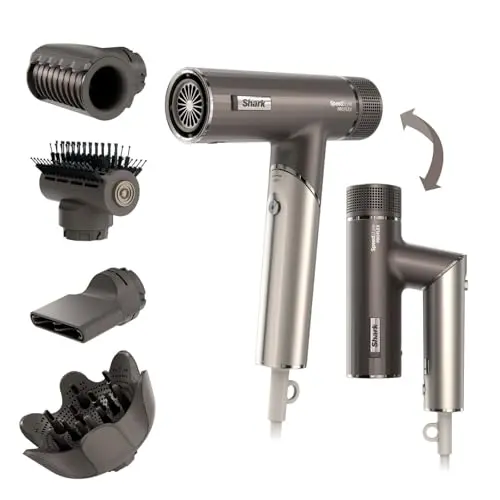
Shark SpeedStyle Pro Flex Hair Dryer
Gallery
Deals
This page contains affiliate links: if you buy through them we may earn a commission, at no extra cost to you. Prices and availability may change. As an Amazon Associate, La Casa Sibarita earns from qualifying purchases.
Pros
-
3 min 2 s to dry long, soaking-wet hair, the second-best time we've recorded.
-
Folding handle that stayed play-free after two weeks of daily use.
-
Automatic heat for each attachment, with 61-63 °C measured.
-
Diffuser with extending prongs plus three more attachments in the box.
Cons
-
80-82 dB at one metre, among the loudest digital dryers we've measured.
-
No distance sensor, and automatic mode adds 17 seconds to the drying time.
Contents
Technical specifications
| Power | 1,700 W |
|---|---|
| Measurements | 10.59 x 4.8 x 19.63 cm |
| Number of temperature settings | 4 |
| Number of speed settings | 3 |
| Weight | 0.68 kg |
Description
Summary
If you travel a lot and always end up squeezing your home dryer into your suitcase, or there’s no drawer in your bathroom big enough for a normal one, the Shark SpeedStyle Pro Flex solves both with a handle that folds in half. And it gives nothing away in performance, because on long, soaking-wet hair it clocked 3 minutes 2 seconds at full power, the second-best time of all the dryers we’ve timed.
It suits you if you want a fast dryer that also adapts by itself to whichever attachment you fit. When you clip on the concentrator, the smoothing brush or the diffuser, it adjusts heat and airflow on its own, and in that automatic mode we measured 61-63 °C at the outlet, well below the 86-88 °C of the forced maximum setting.
Shark quotes 1,700 W, air speeds of up to 160 km/h, three airflow and four heat settings, with a control system that measures the temperature a thousand times a second so it never goes above 110 °C. Four attachments come in the box, diffuser included, and the dryer recognises each one as it clicks on.
The diffuser was one of the surprises. Its prongs extend and retract, and on natural curls it left the hair defined and well separated without feeling rough, something not every dryer in this range manages.
We tested the HD542EU version in Spain. On Amazon.co.uk it’s sold as the HD543PLUK in Lilac Frost, with a UK plug and the same four attachments. Apart from the colour and the plug, the listing describes the same dryer we tested.
Its limitation is noise. We measured 80-82 dB at one metre without an attachment and 82-84 dB with the concentrator, at the top end of the digital dryers we’ve tried. That’s the price of moving so much air through such a compact body.
Analysis and verdict
Power and airflow – Score: 9.2/10
With a claimed 1,700 W and 160 km/h, the air comes out of a narrow outlet that concentrates it and lets you get close to the roots for volume. On our long, soaking-wet hair it took 3 minutes 2 seconds on forced maximum, a time beaten by only one of the dryers that have been through the same method, and far ahead of any conventional motor.
The automatic mode, which kicks in when you fit an attachment, is gentler and therefore slower. With it, the same blow-dry took us 3 minutes 19 seconds, seventeen seconds longer. It’s the setting most people would use every day, because the air is warmer rather than hot, and you can always force maximum when you’re in a hurry.
Compared with a conventional folding travel dryer, which usually sticks to low wattage and weak airflow, you don’t give anything up here. And compared with high-end digital dryers that don’t fold, the difference in drying time is a matter of seconds, not minutes.
Hair care – Score: 8.8/10
The heat control measures the outlet air a thousand times a second and keeps it below 110 °C on any setting. On forced maximum we measured 86-88 °C two centimetres from the outlet, and 61-63 °C in automatic mode, a difference you feel as soon as you point it at the roots. There’s also a mode that lowers the air temperature further for the scalp, designed for the first stage of drying.
Over two weeks of drying with warm air and a final cool shot, the scalp was fine in automatic mode and also on maximum at a normal distance, and the hair was less frizzy than with our tester’s usual dryer. The ionic technology and the anti-frizz tool, which tucks in loose strands with two air currents over hair that’s already dry, finish the job without straighteners.
The diffuser with extending prongs left curls defined and well separated, without any rough feel, one of the best curl results we’ve seen from a dryer that isn’t specifically designed for curls. What it doesn’t have is a sensor that adjusts the heat according to distance. The protection depends on the mode you choose, not on how close you are.
Weight and noise – Score: 8.3/10
On the scales it weighed 642 g without an attachment and 683 g with the concentrator, in line with the 680 g Shark quotes. Folded, it fits in a medium drawer or a wash bag, and after two weeks of opening and closing it every day the handle hinge was still firm with no play. In ten minutes non-stop with the arm raised, the weight started to tell on the wrist at minute nine.
Noise is where the compact size costs it most. The 80-82 dB at one metre without an attachment and 82-84 dB with the concentrator put it among the loudest of the digital dryers we’ve measured, with a high-pitched tone. It isn’t unbearable, but if you dry your hair early with people asleep nearby, they’ll hear it.
The 2.41 m cable comfortably reaches the bathroom socket and has an electronics box near the plug that’s bulkier than a normal cable. The rear filter twists off for cleaning, and after two weeks it only had small traces of hair.
Attachments included
There are four. The concentrator rotates 360 degrees so you can aim the airflow without twisting your wrist. The smoothing brush dries and smooths in one step, although it locks in a fixed position and you have to stop to turn it, which takes some getting used to. The anti-frizz tool works on dry hair, tucking in loose strands. And the diffuser with extending prongs covers everything from loose waves to tight curls. On Amazon.co.uk they’re listed as the Turbo Concentrator, QuickSmooth Brush, FrizzFighter Finishing Tool and DefrizzFast Diffuser.
Pros
- 3 minutes 2 seconds to dry long, soaking-wet hair, the second-best time we’ve recorded, so you finish sooner than with almost any other dryer.
- Folding handle that stayed play-free after two weeks, so it fits in a drawer or a wash bag without giving up power.
- Automatic adjustment for each attachment, with 61-63 °C measured, so the air arrives warm rather than hot without touching a button.
- Diffuser with extending prongs that left curls defined and separated, plus three more attachments for smoothing and frizz control.
Cons
- 80-82 dB at one metre and 82-84 dB with the concentrator, among the loudest digital dryers we’ve measured, so it can be heard all over the house.
- No distance sensor, and automatic mode is 17 seconds slower, so scalp protection depends on the mode you choose and costs you drying time.
Our test
Test 1: Power and airflow – long, soaking-wet hair after a shower
We dried long hair straight out of the shower, towel-dried no more than usual, with the concentrator fitted. We did two rounds of three days each: one leaving the automatic mode set by the attachment, and another forcing speed and heat to maximum. We timed it until roots and ends felt dry to the touch and compared it with the other dryers that have been through this method on the same hair.
In automatic mode the runs came in at 3:16, 3:21 and 3:19; on forced maximum, 2:59, 3:05 and 3:02. Only one dryer we’ve measured went below that time, and the gap between the two modes is seventeen seconds, which is what drying with warmer rather than hotter air costs you. We can’t say how it behaves on very thick, dense hair, because that wasn’t the hair we tested on.
Test 2: Hair care – two weeks of warm air and a cool shot
We measured the air temperature with a thermometer two centimetres from the outlet after thirty seconds of running, in automatic mode with the concentrator and on forced maximum, three readings each. We then dried hair every day for two weeks with warm air and a final cool shot, using the concentrator on straight hair and the diffuser on natural-curl days.
The thermometer read 61-63 °C in automatic mode and 86-88 °C on maximum. In automatic mode the scalp was fine throughout, and on maximum it was also fine at a normal distance. Frizz at the end was lower than with our tester’s usual dryer, and the diffuser left curls defined, well separated and not rough. What we can’t vouch for is the long-term effect on the hair fibre, because two weeks isn’t enough to judge that.
Test 3: Weight and noise – ten minutes with the arm raised
We placed the sound meter one metre away at ear height, with the dryer on maximum speed, and took three ten-second readings without an attachment and three with the concentrator. We weighed the dryer with and without the nozzle, dried for ten minutes non-stop with the arm above shoulder height, and checked the handle hinge every day, along with whether it fitted folded into a medium wash bag.
The sound meter read 80-82 dB without a nozzle and 82-84 dB with the concentrator, and the scales 642 g without an attachment and 683 g with it. The weight made itself felt on the wrist at minute nine, the cable reached comfortably, the handle stayed firm with no play after two weeks and it fitted folded in the wash bag. The filter only had small traces of hair. If noise matters more to you than size, it isn’t the one we’d recommend.
If you’d like to know more about what to look for, take a look at our guide to the best hair dryers, where you’ll find the best models we’ve tested to help you choose the right one for you.
Contents
Other models we analysed
Real tests · No sponsorships
Marco Blasco
I'm Marco Blasco and I've been testing and comparing home appliances for more than five years. My ratings come from real tests, first-hand experience and objective criteria, explained transparently. Our tests are carried out in Spain. Through detailed guides and comparisons I've helped thousands of people choose with more confidence, and I can do that because I'm completely independent of the brands.