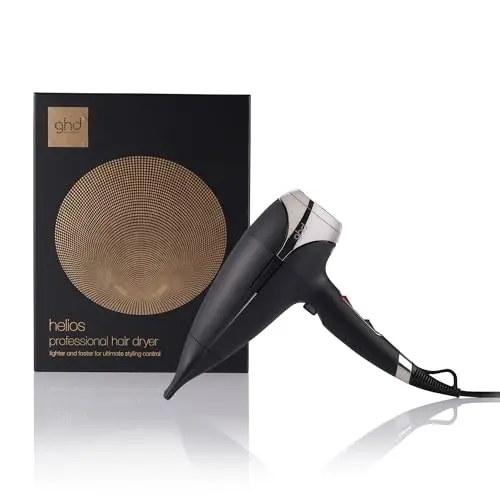
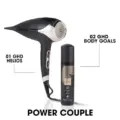
ghd Helios Hair Dryer

Gallery
Deals
This page contains affiliate links: if you buy through them we may earn a commission, at no extra cost to you. Prices and availability may change. As an Amazon Associate, La Casa Sibarita earns from qualifying purchases.
Pros
-
3 min 31 s to dry long, soaking-wet hair, one of the fastest times we've recorded.
-
Very concentrated stream, even without the nozzle, for precise section-by-section styling.
-
77-79 dB at one metre with a deep tone, one of the quietest for its airflow.
-
3 m cable that reaches any bathroom socket with ease.
Cons
-
780 g, the heaviest we've tested, with wrist fatigue from minute seven.
-
No diffuser in the box and no distance heat sensor (87-89 °C on maximum).
Contents
Technical specifications
| Power | 2,200 W |
|---|---|
| Measurements | 32 x 24.8 x 10.9 cm (packaging) |
| Number of temperature settings | 3 |
| Number of speed settings | 2 |
| Weight | 780 g (tested) |
Description
Summary
Is a salon-style dryer with a brushless motor worth it when all you want is to dry your hair at home without losing half the morning? With the ghd Helios, the answer depends on how much speed matters to you, because that’s where it performs best. Long, soaking-wet hair took us 3 minutes 31 seconds at full power, one of the best times among the dryers we’ve timed on the same hair.
It suits you if your hair is long or thick, you dry it every day with the nozzle and you want a smooth, polished finish without reaching for straighteners. With 2,200 W, a brushless motor and air that ghd puts at 120 km/h, the stream is so concentrated that you often don’t even need the nozzle to direct it.
The ioniser is always on, and over our two weeks frizz at the end was lower than with our tester’s usual dryer. The 3 m cable is salon length and more than enough in a home bathroom.
What convinces us least is the weight. At 780 g on the scales it’s the heaviest of the dryers we’ve tested in this range, and in ten minutes with the arm raised it started to tell on the wrist at minute seven, earlier than any other. There’s no diffuser in the box either, so if you have curls you’ll need to buy one separately.
There’s no sensor to adjust the heat according to distance. On maximum heat we measured 87-89 °C, and while that’s fine at a normal distance, it does sting if you bring it right up to the scalp. It’s a fast, forceful dryer rather than a delicate one.
We tested the Helios in Spain, and it’s the same dryer sold on Amazon.co.uk, where the listing is the black model with a UK plug, sold by Amazon.
Analysis and verdict
Power and airflow – Score: 8.9/10
The 2,200 W brushless motor moves air at a claimed 120 km/h and channels it through an interior designed to push it out in a narrow, straight stream. In practice the air goes where you point it rather than spreading over your whole head, which you’ll appreciate when working section by section with a round brush.
The 3 minutes 31 seconds we measured on long, soaking-wet hair puts it among the fast dryers, close to the quickest digital models we’ve tested and well ahead of conventional-motor dryers of the same wattage. Compared with a 2,200 W brushed-motor dryer, the difference isn’t in the wattage figure but in how the air reaches your hair.
There are only two speeds, medium and high, plus three heat settings and the cool shot button. That’s fewer combinations than dryers with a display, but the switches are easy to use blind with your thumb. If you’re used to a dryer with six or nine settings, you might miss something in between.
Hair care – Score: 8.2/10
The Helios has power to spare and only just enough control. There’s no sensor measuring the distance to your head or lowering the heat by itself; you pick one of three heat settings and that’s it. On the highest setting we measured 87-89 °C two centimetres from the outlet and 65-67 °C on the middle one, normal figures for a powerful dryer but without the safety net of models with a sensor.
The ioniser is always on and it shows in the finish. After two weeks of drying with warm air and a final cool shot, the hair was smoother and less frizzy than with our tester’s reference dryer, and the shine ghd promises is most visible on straight or wavy hair styled with the nozzle.
The catch for curly hair is that there’s no diffuser in the box. It’s sold separately and needs its own adaptor ring, so all you get is the nozzle and a silicone hanging loop. Compared with a mid-range dryer that includes a diffuser, here you’re buying performance on straight hair and paying extra for curls.
Weight and noise – Score: 7.9/10
It weighs 780 g on the scales without an attachment and 823 g with the nozzle, and that’s the price of a salon motor. In our ten minutes non-stop with the arm raised, the weight showed up on the wrist at minute seven, the earliest of all the dryers we’ve measured with this same method. For a three-and-a-half-minute blow-dry it doesn’t matter; for long styling sessions with a brush, it does.
It fares better on noise. We measured 77-79 dB at one metre on maximum speed without the nozzle and 79-81 dB with it, a low level for the amount of air it moves, with a deep tone that’s less irritating than the high-pitched whistle of some digital motors. ghd talks about a ‘low sound level’; we’d say it’s one of the quieter ones, which isn’t quite the same thing.
The 3 m cable reaches anywhere in the bathroom with plenty to spare, although it doesn’t swivel and it’s best not to wrap it around the dryer when you put it away. The rear filter unscrews for cleaning, and after two weeks it only had small traces of hair.
Versions and colours
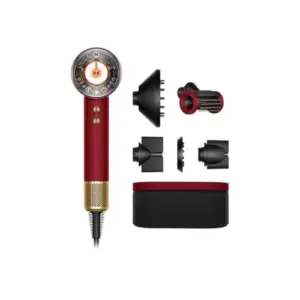
The Helios comes in several colours, all with the same mechanics and the same nozzle. ghd also offers a kit with the diffuser included, which is the one to look out for if you have curly hair and don’t want to buy the diffuser separately. The Amazon.co.uk listing is for the black model with a UK plug, and it states that ghd adds its own manufacturer’s guarantee; your statutory rights under the Consumer Rights Act 2015 apply in any case.
Pros
- 3 minutes 31 seconds to dry long, soaking-wet hair, one of the fastest times we’ve recorded, so you spend less time with your arm in the air.
- Very concentrated stream even without the nozzle, letting you work section by section with a brush without messing up the rest.
- 77-79 dB at one metre with a deep tone, one of the quietest for the airflow it delivers, which you’ll notice if you dry your hair early while others are asleep.
- 3 m cable that reaches any bathroom socket without tugging or extension leads.
Cons
- 780 g on the scales and wrist fatigue from minute seven, the heaviest and quickest to tire of the dryers we’ve measured, which you’ll feel in longer styling sessions.
- No diffuser in the box and no distance heat sensor, with 87-89 °C on maximum, so with curls or a sensitive scalp you’ll pay extra for the attachment and have to manage the distance yourself.
Our test
Test 1: Power and airflow – long, soaking-wet hair after a shower
We dried long hair straight out of the shower, towel-dried no more than usual, with the concentrator nozzle fitted and speed and heat on maximum. We timed it until roots and ends felt dry to the touch and repeated the test on three different days on the same hair, comparing it with the other dryers that have been through this same method.
The three runs came in at 3:28, 3:34 and 3:31. Only a couple of the digital dryers we’ve measured beat that time, and it leaves every conventional-motor dryer behind. We also noticed that the very concentrated stream forces you to keep the dryer moving, because if you linger over one section it heats it up quickly. We can’t say how it behaves on very thick, dense hair, because that wasn’t the hair we tested on.
Test 2: Hair care – two weeks of warm air and a cool shot
We measured the air temperature with a thermometer two centimetres from the outlet after thirty seconds of running, on the highest and middle settings, three readings each. We then dried hair every day for two weeks on the middle heat with a cool shot at the end, using the nozzle on lengths and ends and no nozzle at the roots. We couldn’t test a diffuser because one isn’t included.
The thermometer read 87-89 °C on maximum and 65-67 °C on the middle setting. At the usual distance the scalp was fine, but when we deliberately brought the dryer closer it did sting, and there’s nothing on the dryer to prevent that. Frizz at the end was lower than with our tester’s usual dryer. What we can’t vouch for is how kind it is to curls, because without a diffuser that part of the test couldn’t be done.
Test 3: Weight and noise – ten minutes with the arm raised
We placed the sound meter one metre away at ear height, with the dryer on maximum speed, and took three ten-second readings without an attachment and three with the nozzle. We weighed the dryer with and without the nozzle, then dried for ten minutes non-stop with the arm above shoulder height, noting the minute the weight became noticeable, whether the cable reached comfortably and what was in the rear filter after two weeks.
The sound meter read 77-79 dB without the nozzle and 79-81 dB with it, and the scales 780 g without an attachment and 823 g with the nozzle. The weight made itself felt at minute seven, the 3 m cable had length to spare and the filter only had small traces of hair. It’s a dryer that handles short blow-dries well and takes its toll in long brushing sessions; if you have a delicate wrist, it isn’t the one we’d recommend.
If you’d like to know more about what to look for, take a look at our guide to the best hair dryers, where you’ll find the best models we’ve tested to help you choose the right one for you.
Contents
Other models we analysed

Real tests · No sponsorships
Marco Blasco
I'm Marco Blasco and I've been testing and comparing home appliances for more than five years. My ratings come from real tests, first-hand experience and objective criteria, explained transparently. Our tests are carried out in Spain. Through detailed guides and comparisons I've helped thousands of people choose with more confidence, and I can do that because I'm completely independent of the brands.