
iRobot Roomba 205 DustCompactor Combo Robot Vacuum

Gallery
Deals
This page contains affiliate links: if you buy through them we may earn a commission, at no extra cost to you. Prices and availability may change. As an Amazon Associate, La Casa Sibarita earns from qualifying purchases.
Pros
-
Compacts the dirt, so you only empty it about once every 60 days.
-
Precise, methodical laser navigation.
-
Intuitive app for scheduling cleaning by room, day and time.
-
Detects rugs and raises its suction automatically.
Cons
-
On our test unit it didn't avoid rugs when mopping unless you marked them in the app.
-
The app doesn't show the water level, so you have to check it on the robot.
Contents
Technical specifications
| Navigation | Laser |
|---|---|
| Filter | Yes, with high-efficiency filter for fine dust and allergens |
| Mopping | Yes |
| Height | 9.3 cm |
| Suction power | 7,000 Pa |
| Battery life | 120 min |
| Pet hair brush | Yes |
| Self-emptying | No |
| Small object detection | No |
| Carpet detection | Yes |
| App | Yes |
| Smart mapping | Yes |
Description
Summary
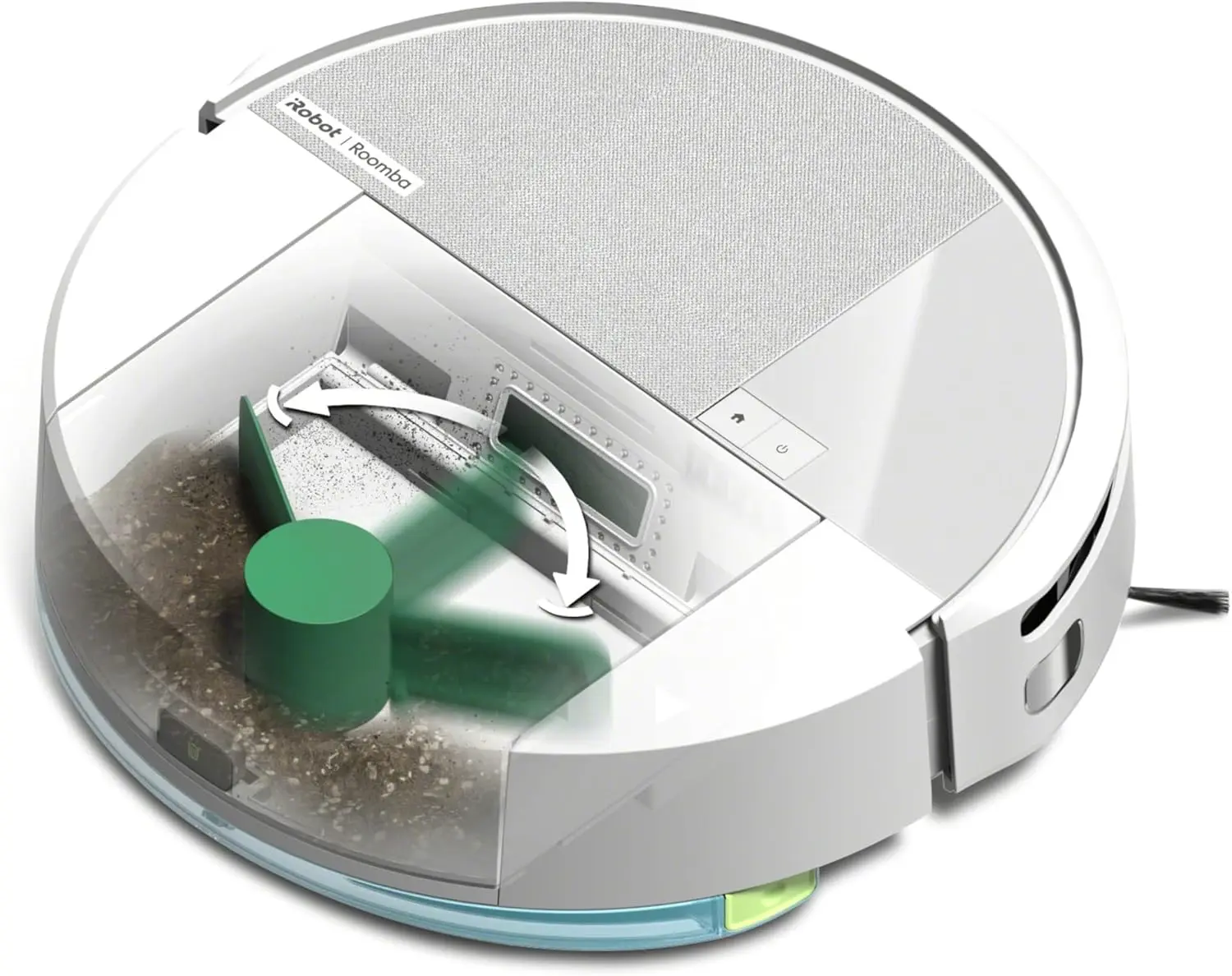
The first thing that caught our eye on this robot vacuum was how it deals with the dirt. Its DustCompactor system compacts debris and stores it for up to 60 days. According to the Amazon.co.uk listing, the compacting happens inside the robot itself, so there’s no separate self-emptying station taking up space.
With 7,000 Pa of suction it leaves floors clearly cleaner than the budget models we’ve tried.
It can detect small objects such as cables and socks, as well as rugs. It applies downward pressure when mopping that removes stuck-on stains while keeping the floor’s original shine, without leaving streaks.
The app lets you set up more personalised cleaning by creating a map of your home, and sends alerts if anything goes wrong with the robot.
What we liked least is that at 9.3 cm tall it sometimes struggles to get under very low sofas and beds.
Analysis and verdict
Suction power – Score: 9/10
The Roomba 205 has gone for 7,000 Pa of suction, which is clearly more powerful than other models from the brand we’ve tried.
We noticed it because this robot picks up more dust and hair, leaving floors cleaner, as it adjusts its suction to the floor it’s crossing.
Its main rubber brush is designed to lift debris off the floor and collects our pets’ hair, helped by the side brush that reaches the fluff that gathers in corners.
What we liked most is that when it spots a rug it raises its power and gets at the dog hair left there, and we saw a big difference compared with our old entry-level robot.
What we liked least is that, on the unit we tested, the suction level couldn’t be set manually.
Battery life – Score: 10/10
The first thing we noticed is that at 9.3 cm tall it doesn’t fit under some of our very low furniture and beds. What is a real plus is the DustCompactor, which compresses all the dirt in the bin so it can go up to 60 days between emptyings. We sometimes forgot to empty it until the app reminded us.
As for battery life, we found it enough to cover up to 100 m², so it got through a whole day cleaning our home.
What we didn’t like is that to check the water level you have to look at the robot itself, as the app doesn’t show it.
🆚 Quick comparison with other models
This is a robot vacuum that strikes a balance between good battery life and strong suction, and it compacts all the dirt for very easy maintenance.
Although the Roborock Q10 S5+ has vibrating mop pads and more power, the Roomba 205 is quieter and more compact. Overall, it offers a more balanced, comfortable experience for hassle-free daily cleaning.
✅ Pros and ❌ Cons
- Pro: compacts the dirt and holds up to 60 days of debris before it needs emptying.
- Pro: 7,000 Pa of suction, higher than other entry-level models we’ve tested, with good results on hair and dust.
- Pro: detects rugs and small objects, raising its power automatically on rugs.
- Pro: mops with constant pressure that removes stuck-on stains without leaving streaks or puddles, and it can vacuum and mop at the same time.
- Pro: simple app with a home map, custom zones and maintenance alerts.
- Con: at 9.3 cm tall, it struggles to get under very low sofas and beds.
- Con: on our test unit, suction and mopping levels couldn’t be adjusted manually.
- Con: the app doesn’t show the water tank level; you have to check the robot itself.
- Con: you can’t create cleaning profiles with specific settings by day and time, as you can on higher-end models.
Mopping – Score: 9.5/10
We found the mopping system on this model so effective because it applies constant pressure to the floor, especially on tiles and parquet. You can’t adjust this pressure manually, but it leaves no streaks or puddles behind.
It has a fairly large water tank (240 ml) feeding the automatic mopping system, which keeps the mop pad damp as it cleans. We like that it can vacuum and mop at the same time, so there’s no need for two passes.
Maintenance is simple: refill the water tank and wash the mop pad and filters once a week. No tools or fuss needed.
What we liked least is that, although it adjusts the mopping to the floor, it can’t tell how dirty an area is, so if there are stubborn dried-on bits, don’t expect it to go over them several times to shift them.
🧠 Navigation and obstacle detection
It has a laser navigation system that scans your home and creates a digital map you can view in the app to set up your own cleaning plans. It also uses sensors to detect small objects such as cables and toys, even in low light.
We tried it in our children’s bedroom while they were asleep, and it handled itself really well. It’s quiet, it avoided the toys without any problem, and all with the lights off.
📱 App and smart features
The mobile app is very easy to use. As soon as you open it you see the map of your home and can choose which area to clean.
We like that you can also select areas you’d rather clean yourself so the robot leaves them alone. We use this to keep it off our thick-pile rugs.
What we liked least is that you can’t create profiles with specific suction and mopping settings for a given day and time of the week, as you could on a higher-end model. The current UK listing says the Roomba Home app lets you adjust cleaning passes, suction power and the amount of mopping solution, and that the robot won’t mop rugs thanks to automatic carpet detection; on the unit we tested we couldn’t do this, so check it if it matters to you.
Our test
Test 1: Suction power – rice and flour on short-pile rug and hard floor
We tested this model in Spain, and it’s the same robot (same ASIN) sold on Amazon.co.uk. We started with the hardest part: 30 g of rice and flour spread over a 50 cm square on the short-pile rug, then the same test on hard floor, letting the Roomba 205 make a single pass on maximum. Our unit didn’t let us raise or lower suction by hand, so what we saw was simply its factory behaviour: as soon as it detected the change of surface it raised its power on its own, something that was hard to notice by eye but was confirmed when we went over the area with a handheld vacuum.
On hard floor there was hardly anything left to pick up. On the rug, the main rubber brush and the side brush left the area much cleaner than we expected from a robot at this price, although we didn’t check whether it matches models with even more suction, as they weren’t part of this circuit. What we can’t vouch for is how it performs with finer or ground-in dirt, or whether it keeps up that level over successive passes without the occasional help of a handheld vacuum.
Test 2: Battery life – living room, hallway, bedroom and two rugs without recharging
We set up our usual circuit (living room, hallway and bedroom with two rugs) and ran it on medium to see whether it finished in one go or needed to return to its dock halfway. The manufacturer talks about up to 100 m² and 120 minutes of battery life, and in our real-world test, with the two rugs automatically raising its power, it covered around 90 m² of home without asking to recharge once, without collisions and without getting lost.
What struck us most wasn’t so much the battery life itself as how little attention the robot needed afterwards: thanks to the DustCompactor, we didn’t have to empty the bin until two months of normal use had passed. What we can’t confirm is how it behaves in much larger spaces than ours, or whether very low furniture (its 9.3 cm height stops it getting under some sofas) leaves areas uncovered on the same route.
Test 3: Mopping – milky coffee and tomato sauce on laminate and porcelain tiles
We left milky coffee and tomato sauce stains to dry for 30 minutes on laminate and porcelain tiles, and mopped twice on medium flow, the only setting our unit offered, since the pressure couldn’t be adjusted by hand either. The constant pressure lifted the coffee stain well, but the more set tomato residue was harder going: the robot doesn’t detect how dirty an area is, so if a spot is really stuck on, it won’t go back over it on its own.
When it finished there were no rings or puddles on either surface, and the 240 ml tank comfortably lasted both passes without running dry. One detail we think matters: on our test unit, if you have rugs on the route, you need to mark them manually in the app before mopping, because in this mode the robot didn’t avoid them by itself and would have got them wet. What we can’t vouch for is whether the result stays as clean with more ingrained stains or ones repeated several times on the same spot.
If you want to know more about what to look for, take a look at our robot vacuum buying guide, with the best models we’ve tested to help you choose the right one for you.
Contents
Other models we analysed

Real tests · No sponsorships
Marco Blasco
I'm Marco Blasco and I've been testing and comparing home appliances for more than five years. My ratings come from real tests, first-hand experience and objective criteria, explained transparently. Our tests are carried out in Spain. Through detailed guides and comparisons I've helped thousands of people choose with more confidence, and I can do that because I'm completely independent of the brands.