
How we test, score and compare every product
La Casa Sibarita was set up to help you when you shop online. There's no shortage of information on the internet, but good information is hard to find: articles written by people who have actually done the research and who genuinely help you compare products. That's why we publish reviews of individual models, comparisons we keep up to date and buying guides.
We carry out our tests in Spain. In the UK we recommend the version with a British plug, and that's the one each review links to on Amazon.co.uk. If a model is sold in the UK under a different reference or with a different bundle, we tell you. We've also gone a step further and added an AI assistant that helps you with your purchases, using only checked, up-to-date information from our own website. To meet the people behind the tests, visit our About us page.
The whole of this page rests on one simple idea. You can only compare two products if they have been measured in the same way. That's why every type of product has a fixed, written test protocol and identical scoring criteria for every model in its category.
Choosing the products
These are the points that matter most when we decide which products to add to our comparisons or update.
Up-to-date models
Our most important criterion is that these are the newest models with the best features. Each brand's latest releases bring its best technology, and they're what buyers look for most.
Popularity
Well-proven products and brands with a long track record give us some reassurance about after-sales service and the availability of spare parts.
Market trends
We focus on up-to-date buying guides that explain how to choose based on the newest features and functions in each category.
Value for money
We know the newest, most powerful model isn't always the right choice. That's why we also include brands that offer good features at a sensible price.
Established and emerging brands
We pick the leading brands on the market, the ones buyers trust most. We also give a chance to newer brands that quickly stand out for their strong reviews.
How we evaluate
Exactly where the information that ends up as a score comes from.

1Product tests
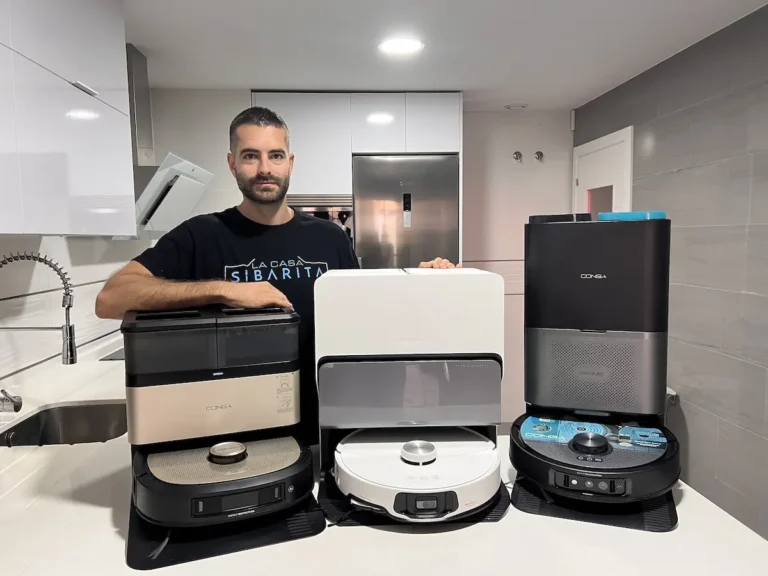
In most of our comparisons we test products that brands send us or that we buy ourselves, always following the written protocol for that category.
2Manufacturer data
We take technical information only from the manufacturer's official documentation and check it against our own measurements. When the real figure doesn't match the stated one, we say so.
3Other real-world reviews
We also listen to people who have actually used the product, because they give the most reliable picture of long-term use. We combine what they say with our own findings.
4Key features
We concentrate on the features that really matter in each category, the ones that are useful to you, and leave out irrelevant information.
5Verified reviews
When we analyse a product we haven't tested yet, we look at what buyers have said in different online shops. We only take verified purchase reviews into account.
The same test protocol for every product of the same type
Before we test a single model, each type of product has its own written, fixed test protocol. It sets out what we measure, with what load, for how long, in which mode and under which conditions. Nothing is improvised and nothing changes from one review to the next.
Every robot vacuum goes through exactly the same suction test. Every air fryer cooks the same amount of chips. If two products in the same category get different scores, it's because they performed differently in the same test, not because we judged them in a different way.
A set protocol
Each type of product has three written tests, one for each scored criterion.
Identical conditions
The same quantities, the same timings, the same modes and the same setting for every model.
Results compared
We don't judge a result in isolation. We compare it with the other models in the same category.
A score from 1 to 10
That comparison gives the score for each criterion and, from there, the overall score.
Real examples of our protocols
Here are two of the protocols we use, exactly as they are defined. Open each category to see the three tests every model goes through.
Robot vacuums
1Suction power
We spread 30 g of rice and flour over a 50 cm square, once on a hard floor and once on a short-pile rug, and let the robot make a single pass on its maximum setting. We then pick up whatever is left with a handheld vacuum and compare it with other robots of the same type tested on the same course.
2Battery life
The robot cleans non-stop in its medium mode around a course made up of a living room, hallway and bedroom with two rugs, until it returns to its base. We time it and note whether it finishes in one go or has to recharge. On models with mapping, we also time how long it takes to resume where it left off. On models with gyroscopic navigation, we point out that they can't resume.
3Mopping
Dried-on stains of milky coffee and tomato sauce on laminate and on porcelain tiles, left for 30 minutes. The robot makes two passes at a medium water flow with whatever mopping system it has, pad or roller. We check whether it leaves smears once dry, whether it goes back over the edges and what it does with rugs: wets them, lifts its mop or steers around them.
Air fryers
1Cooking results
500 g of chips, in a single batch, without preheating, on the chips programme. We check whether they cook evenly in the centre and at the edges of the basket and whether you need to shake them halfway. We then repeat the test with chicken wings and vegetables.
2Capacity
We fill the basket to the stated maximum and count how many real portions it makes. We also check whether a whole chicken or four fillets fit without overlapping.
3Cleaning
After cooking something greasy, we let it cool and wash the basket and crisper plate with a non-abrasive sponge. We note whether the non-stick coating releases the residue first time and which parts are dishwasher-safe.
These are just two examples. Every product category we compare has its own test protocol, defined in the same way.
How we score
Every product gets a score from 1 to 10 on the three most important criteria in its category. The average of those three gives the overall score.
The same three criteria for every product of the same type
The writer doesn't pick the three scored criteria product by product. They are set in advance for each type of product and are identical for every model in that category. A robot vacuum is always scored on suction power, battery life and mopping; an air fryer always on cooking results, capacity and cleaning.
- Fixed criteria for each category. The three scored aspects are defined before we analyse any model.
- One test per criterion. Each of the three criteria has its own test protocol.
- A relative score, not an absolute one. The score is set by the person who tests and researches the product, compared with the other products in the same category.
- A simple average. The overall score is the average of the three scores, with no hidden weighting and no adjustments afterwards.
Example · Robot vacuum
What we score for each type of product
A sample of the fixed criteria by category. Every model in each row is scored on exactly these three points, no more and no less.
| Product type | Criterion 1 | Criterion 2 | Criterion 3 |
|---|---|---|---|
| Robot vacuums | Suction power | Battery life | Mopping |
| Air fryers | Cooking results | Capacity | Cleaning |
| Electric toothbrushes | Cleaning | Battery life | Pressure sensor and modes |
| Electric shavers | Closeness of shave | Battery life | Comfort and cleaning |
| Hair dryers | Power and airflow | Hair care | Weight and noise |
| Pressure washers | Pressure and flow | Accessories | Handling |
How our comparisons are put together
Once every product has been scored with the same protocol and the same criteria, our editors decide the order of each ranking. The score is worked out separately.
Editorially ranked
In each category you'll find a ranking of the best models and a comparison table. The order of the ranking is an editorial choice and the overall score is given independently of position, so a higher-scoring product can appear further down.
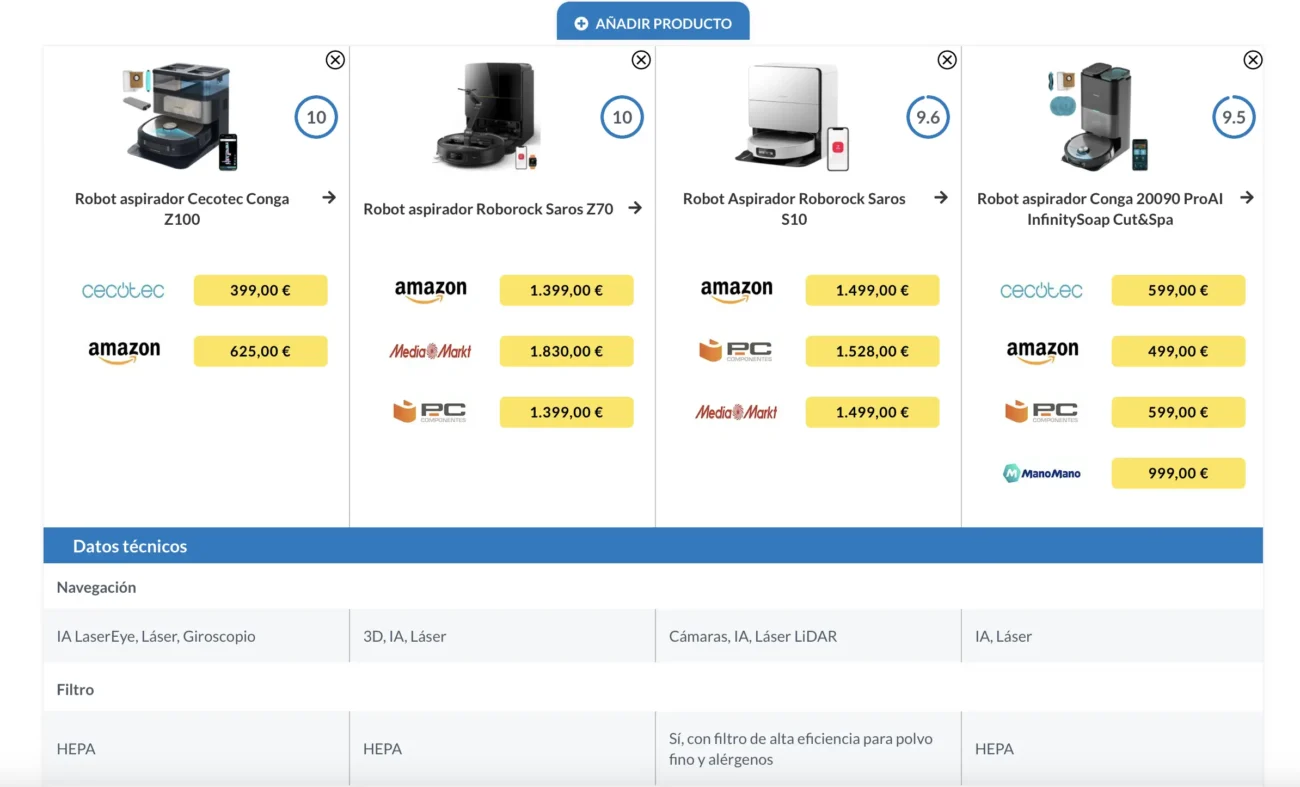
Comparison table
It shows the models in the ranking, in the same order and with their overall score. You can remove the ones you're not interested in and add others with the add button, so you only see the brands or models you want.
Pros and cons
In each comparison you'll see the biggest advantage and the biggest drawback of every model. If you want to know more, the full review button takes you to the complete review.
A practical summary
In the ranking we include a short summary of the product's main advantages and what they mean in practice, along with its weak points and how much they matter day to day.
Indicative prices
For each product in the ranking you'll see the price from our last check on Amazon.co.uk. The price and availability that count are the ones on Amazon.
Regular reviews
When a new model comes out, it goes through the same protocol as the ones before it and gets its score; our editors then decide where it sits in the ranking.
Prices, reviews and being upfront with you
Ranking products and linking to a retailer means we owe you transparency. These are the rules we follow.
How we rank
Each product's position is an editorial decision based on our test results, value for money and the kind of user it suits best. Its overall score, worked out with the protocol and criteria for its category, is given independently of that position. No brand can pay to appear higher up.
Verified user reviews
When we draw on other people's reviews, we only consider verified purchase reviews and we say so. We don't publish or commission fake or incentivised reviews.
Retailer prices
The price we show is the one from our last check on Amazon.co.uk. The price that counts is always the one you see on Amazon.co.uk when you complete your purchase.
Affiliate links
Our links to Amazon.co.uk are affiliate links. As an Amazon Associate, La Casa Sibarita earns from qualifying purchases, at no extra cost to you. That commission has no influence on the score or the order of the ranking. You'll find all the details in our affiliate disclosure.
Editorial independence
Some brands lend us products to test and review. Even so, we never favour one brand over another. We are completely independent. A manufacturer lending us a unit doesn't change the protocol we test it with or the criteria we score it on.
Our reviews are based solely on what our writers conclude from the research and tests described on this page. The same goes for our AI assistant: we want to give you high-quality information, and impartial recommendations are the best way to do that.
If something we say doesn't match your own experience with a product, write to us through our contact page. We'll check the review again and, if needed, repeat the test.